Scientists finally explain the real reason people ‘knock on wood’

60 percent of Americans reportedly “knock on wood” for good luck. But why?

knock, wood, superstitions, origins, history
Why do we knock on wood? Photo credit: Canva

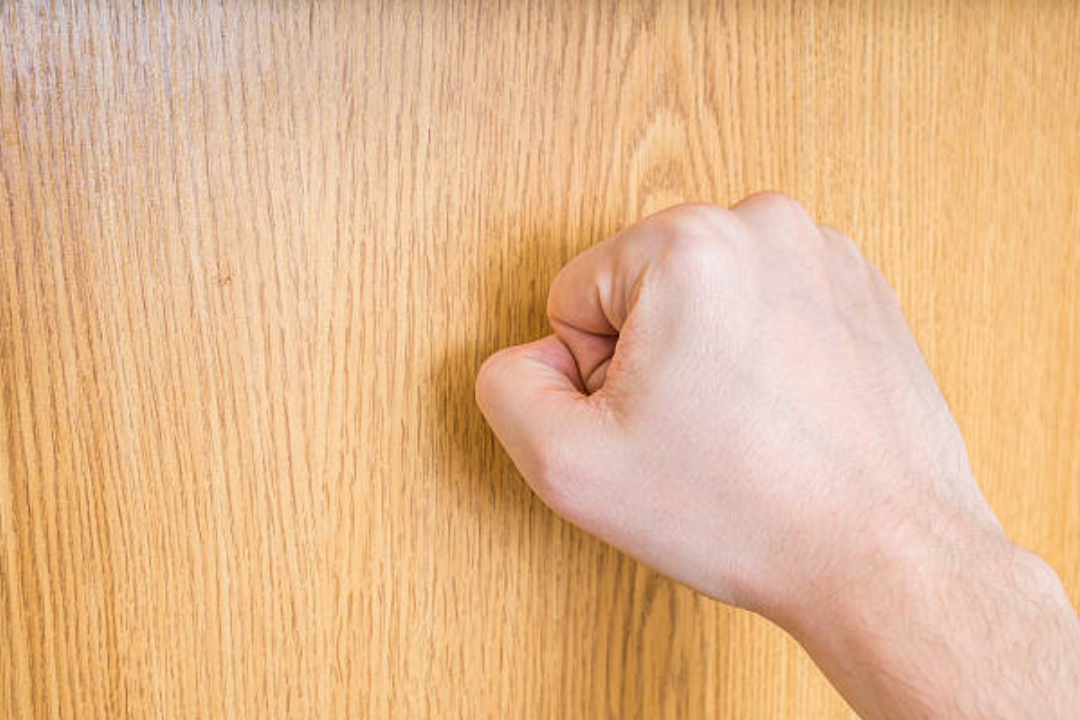
You’re having a great week. No mishaps, no drama, no unexpected bills. “I’m on top of the world!” you shout out loud. Then, suddenly, your hand shoots out to the nearest wooden surface. Your knuckles rap on it a few times, and you didn’t even think about it. What was that?

Sixty percent of Americans “knock on wood,” according to a 2015 60 Minutes/Vanity Fair poll. Most do it almost automatically. But where does the habit come from?
knocking, wood, superstition, history, habit
It’s compulsory. Many don’t think before they knock on wood. Photo credit: Canva

It seems like everyone has a different answer. Ask a group of people, and you’ll get a mix of shrugs, half-remembered myths, and a few confident answers based on a big pile of nothing.

The honest truth: nobody knows for sure. What we do have, however, are a few compelling theories, a paper trail leading back to the 19th century, and fascinating science that explains why we keep doing it—even when we don’t believe in it.

“Knock on wood” or “Touch wood?” Depends on where you live

In the United States, we knock. In the United Kingdom, they touch. Both phrases describe rapping knuckles on wood after saying something hopeful—and they mean the same thing: don’t tempt fate.

@johnsenglishpage

Ever heard someone in Britain say “Touch wood!” after hoping for good luck? It’s the UK equivalent of “knock on wood” in other countries. People say it (and sometimes literally touch a wooden object) to avoid jinxing something they want to happen. For example: “The weather’s been perfect all week, touch wood it stays like this for the weekend.” “I’ve never had a speeding ticket, touch wood.” It’s one of those little British superstitions you’ll hear everywhere, from pubs to workplaces. #Johnsenglishpage #learnenglish #learnenglishwithus #englishtutor #englishlessons #englishtips #naturalenglish #englishlanguage #englishlearning #studiareinglese ♬ original sound – John Howarth

Beyond the English-speaking world, the tradition varies. In Turkey, a person pulls their left earlobe and then knocks on wood twice. In Italy and Catalonia, the equivalent phrase is “tocca ferro,” meaning “touch iron.” Sweden has its own version: peppar, peppar, ta i trä, which translates to “pepper, pepper, knock on wood,” and involves throwing pepper over your shoulder for good luck. In Brazil and Portugal, three knocks on wood are necessary—but only on furniture without legs, so most pieces (e.g., standard tables and chairs) don’t qualify.

What do all these diverse customs have in common, and what do they reveal about human nature?

The ancient tree spirit theory (and why scholars don’t like it)

The most romantic explanation traces the phrase “knock on wood” back to pre-Christian pagan traditions. This theory suggests that ancient Celtic and Indo-European cultures believed trees were inhabited by spirits or minor gods, especially oak, ash, and hazel. Knocking on a tree trunk could awaken those spirits to ask for protection, show gratitude for good luck, or drive away malevolent forces lurking in the woods.

trees, wood, superstition, europe, history
Ancient trees could be the reason why we knock on wood. Photo credit: Canva

It’s a beautiful story. Sacred groves existed across ancient Europe, serving as meeting places between people and the divine. The Druids worshipped the oak. The Scandinavians based their entire cosmology on the ash tree, Yggdrasil. The Germanic Norns—three fate-weaving goddesses—directed destiny through the World Tree itself.

But there’s a problem. As folklorists Jacqueline Simpson and Steve Roud note in A Dictionary of English Folklore, there’s no direct evidence linking these ancient traditions to the modern “knock on wood” superstition. More than a thousand years passed between Europe’s Christianization and the first recorded mention of touching wood. This long interval suggests the practice wasn’t passed down continuously.

The game of tag that may have started everything

So where does the phrase come from? The strongest documented theory points to a Victorian-era children’s game.

@hedgerow_healing

🌿 D R Y A D S 🌿 We have all knocked on wood to ward off bad luck, or to prevent something we said from becoming true. But where does this superstition come from? Well the most widely accepted explanation dates back to ancient pagan cultures such as the Celts, who believed that tree spirits known as Dryads resided in trees. A Dryad is a tree spirit, an elf-like tree entity whose life force was connected to the tree. The Celtic people revered trees, and saw them as powerful living beings who played a large role in Celtic culture. Each tree has its own magic, wisdom and sacred meaning. ✨ It was thought that knocking on wood was a way to rouse the tree spirit and ask it for protection, to ward off bad luck, or to show gratitude for good luck. Druids, witches and wise women carried small carved pieces of certain trees around with them which are said to host a resident Dryad, creating a moveable protection token. These would have been in the shapes of wands or staffs. Ordinary folk also would have also carried these, however they might not have been carved for the same ritualistic purpose, but for straightforward protection. 🌿 To create your own talisman you must first go to a sacred space such as an old grove, leyline, sacred spring or site, and find a tree just as the setting or rising sun strikes light upon its trunk. 🌿 From there connect with the tree, ask it for its protection and inform the Dryad of your intentions, as arrogantly cutting off a branch without first asking will anger the spirit. 🌿 From there you can transform your piece of Livewood into a wand, staff, or Ogham stave. You can add pieces on to it such as precious gems, stones, feathers, leather etc. If you have followed the ritual correctly you will end up with a powerful protection token which can be used in meditations, divinations and rituals. . . . . #Dryads #treespirits #treewisdom #treelore #celticfolklore #celtictraditions #celticotherworld #celticgods #celticgoddesses #celticmythology #paganism #paganculture #paganworship #natureworship #pagantraditions #naturegods #naturegoddess #sacredspace #sacredearth #sacredplace ♬ original sound – Seren

The earliest known written reference to “touch wood” as a superstitious practice appears in Ballads in the Cumberland Dialect, published in 1805 by R. Anderson. Folklorists connect it to a game called “Tiggy Touchwood,” a form of tag in which players were safe from being caught as long as they touched something wooden, such as a door, a fence, or a tree. Touching wood meant you were protected.

Roud, a leading folklore scholar, connects the game to the superstition in The Lore of the Playground:

“Given that the game was concerned with ‘protection,’ and was well known to adults and children, it is almost certainly the origin of our superstitious practice of saying, ‘touch wood.’ The claim that it goes back to tree spirits is complete nonsense.”

Religious and historical theories

Although the game theory has the strongest evidence, it’s worth knowing the other stories in circulation.

cross, christianity, cruxifiction, superstition, wood
Could the reason why we “knock on wood” come from religious backgrounds? Photo credit: Canva

The Christian Cross Theory suggests that knocking on wood invokes the protective power of Christ’s crucifixion. While religious relics like the True Cross were cherished for their supposed protective powers, this theory mainly explains how the custom may have been reinterpreted through a Christian lens rather than its original genesis. Scholars point to the lack of medieval records linking this idea to superstition, suggesting it is likely a later adaptation tied to seeking divine protection.

The Jewish Persecution Theory, another proposed origin, links wood-knocking to coded signals allegedly used by Jewish communities to signal safe passage during the Spanish Inquisition. While this theory points to another possible protective motivation for the ritual, it’s difficult to verify and appears less frequently in academic literature. Its inclusion illustrates the wide range of narratives people have constructed to make sense of the custom.

The Miners and Sailors Theory points to a more practical foundation: knocking on wooden beams to test their stability, which by extension may have led to a superstition about safety. Similarly, sailors knocked on deck wood for good fortune at sea. Together, these theories suggest how everyday safety rituals could evolve into superstition—even when direct documentation is limited.

Why our brains keep doing it anyway

This is where the science gets truly fascinating. Even people who recognize the habit as irrational still engage in it. And there’s a solid reason why—one that has nothing to do with tree spirits or sacred crosses.

Jane Risen, a behavioral science professor at the University of Chicago, has spent years exploring this very contradiction. In a 2016 article in Psychological Review, she found that individuals can recognize a belief as irrational in real time yet still choose not to challenge it—a phenomenon she terms “acquiescence.” As she explained:

“We see people maintaining these beliefs that they themselves acknowledge are irrational. They’ll say, ‘I know it’s crazy, but I’m going to do this.’ We have [these beliefs] because they’re the output of pretty basic cognitive processes.”

Two systems drive human thinking. The fast, intuitive one makes judgments before the slower, more deliberate system can catch up. As Risen explained, “Detecting an error in your intuitive belief doesn’t necessarily lead you to correcting it. It seems that some intuitions are just very difficult to shake.”

But that’s not all. Researchers at the University of Chicago Booth School of Business published a 2013 study in the Journal of Experimental Psychology finding that the physical motion of knocking on wood is just as important as the saying itself.
wood, knocking, superstition, history, research
There are psychological aspects to why we knock on wood. Photo credit: Canva

Here’s what the study found: participants who knocked downward—pushing force away from themselves—felt a bad outcome was less likely than those who knocked upward or simply held an object. The study suggests this outward physical motion creates a feeling of pushing bad luck away. Rituals like spitting or throwing salt may work the same way.

There’s an emotional payoff, too. “These beliefs and behaviors actually do end up regulating your emotions,” Risen told Discover magazine. “When you knock on wood, you may worry about this less.”

Jacqueline Woolley, a psychologist at the University of Texas at Austin, found that superstitious beliefs are most prevalent around ages five and six, before skepticism begins to develop. Meanwhile, Nadia Brashier, a researcher at Harvard University, observed that adults around age 70 tend to be less superstitious than those around age 19, as accumulated life experience typically reshapes the brain’s understanding of cause and effect.

The meaning behind the knock

Here’s what the research and folklore actually agree on: the phrase “knock on wood” is almost certainly not thousands of years old. Its documented history dates back to the 19th century, likely rooted in a children’s game of tag. The pagan, Christian, and persecution theories make for interesting stories, but none have the same weight of supporting evidence.

What holds up the tradition is psychology. Whether the gesture started with a game of Tiggy Touchwood, a fragment of the True Cross, or a coded knock on a synagogue door, it endures today because of how the human brain functions. We’re wired to seek some control over what we cannot control. A small physical act—touching something solid, directing force away from the body—provides that sense of comfort, even if only for a moment.

The next time your hand reaches for the nearest table after saying something hopeful, you don’t need to feel embarrassed. You’re doing something humans have practiced across cultures for at least two centuries, probably longer. Call it a habit, call it superstition, call it a small act of hope. Whatever you call it, the impulse remains the same: to hold on, just for a moment, to the good things in front of you.

  • The ancient, brilliant reason we divide days into 60-minute hours and 60-second minutes
    How we measure days and hours has evolved over millennia.Photo credit: Canva

    Humans have devised many ways of measuring things in an attempt to learn more about our world, including numerical systems that help get us all on the same page. But we haven’t always agreed. The ongoing battle between the imperial and metric systems demonstrates the challenge of standardizing measurement. As most of the world uses the base-10 metric system, the United States remains the primary imperial holdout.

    But one thing we agree on is how we measure time, or at least how we measure hours and seconds. And oddly enough, it’s not using the metric system. Why is that? How did we decide to split days into 60-minute hours and 60-second minutes instead of splitting them into, say, hundredths?

    Clock face with minutes and seconds
    Why 60-minute hours and 60-second minutes? Photo credit: Canva

    Why there are 24 hours in a day

    Let’s start with how we got the 24-hour day. We measure time, in general, by years using the Earth’s full orbit of the sun. But we could really split that year up any way we choose. The rising and setting of the sun gives us a framework for days, so that’s a helpful divisor. However, daylight length varies greatly from place to place and from season to season. So how did we land on 24 hours in a day?

    We have the ancient Egyptians, Babylonians, and Greeks—and their affinity for duodecimals (counting by 12)—to thank for that. They each had a way of breaking light and dark hours into 12 parts each, giving us a 24-part day. However, those 12 parts were not measured equally.

    According to Scientific American:

    “The concept of fixed-length hours, however, did not originate until the Hellenistic period, when Greek astronomers began using such a system for their theoretical calculations. Hipparchus, whose work primarily took place between 147 and 127 B.C., proposed dividing the day into 24 equinoctial hours, based on the 12 hours of daylight and 12 hours of darkness observed on equinox days. Despite this suggestion, laypeople continued to use seasonally varying hours for many centuries. (Hours of fixed length became commonplace only after mechanical clocks first appeared in Europe during the 14th century.)”

    Why there are 60 minutes in an hour

    Oddly enough, the need for a standard way to divide 12-hour days and nights into smaller parts led us back to ancient times once again. The Babylonians used a sexagesimal (base-60) system to make astronomical calculations, which they had inherited from the Sumerians, who used it around 2000 B.C.

    What makes 60 special? With 12 divisors (1, 2, 3, 4, 5, 6, 10, 12, 15, 20, 30, 60), it can be evenly divided in more ways than any other number up to and including 100, which has only nine divisors.

    Using that system, Greek astronomer Eratosthenes (276 to 194 B.C.) divided a circle into 60 parts to measure latitude. Hippocrates honed this sexagesimal (base-60) system by adding in longitude a century later. Ptolemy later improved those measurements, subdividing the 360 degrees of latitude and longitude into smaller parts.

    The first 60 parts became known as partes minutae primae, or “minutes.” The second division of 60 became partes minutae secundae, or “second minute” (what we now call seconds).

    A compass shows 360 degrees
    Minutes and seconds were first used in geography, not time measurement. Photo credit: Canva

    Those minutes and seconds were used for measuring latitude and longitude, not time, but a circle is a circle. The very first round clock displays divided hours into halves, thirds, quarters, and even twelfths, but not sixtieths. The 60-minute hour didn’t become popularized until minutes were put on mechanical clocks at the end of the 16th century. The spread of the Gregorian calendar around that time also helped universalize how humans measured time, but countless questions remained about the precision of timekeeping.

    Exactly how long is a second?

    After all, how long is a second exactly? We can measure it as a division of larger units of time, but on its own, how do we determine a standard for it? Precision and standardization in timekeeping became more and more important as things like train travel, where people had to know what time a train would arrive or depart, became more common.

    That happened in 1967, when researchers gathered at the 13th General Conference of the International Committee for Weights and Measures. Among other things, they debated which element to use as the standard for atomic clocks. Ultimately, they landed on Cesium-133, which had been used in atomic clock research since the 1950s.

    The video above explains exactly how and why scientists chose that element and made the calculation, but the result was that a second became formally defined as exactly 9,192,631,770 ticks of a Cesium-133 atom.

    That may be far more than you ever wanted to know about time measurement. But isn’t it fascinating how a combination of ancient wisdom and modern technology gave us 60-minute hours and clocks that can tell us, down to the second, what time it is anywhere in the world? Aren’t humans amazing?

  • Experts share how to get that dreaded orange stain out of shower liners without tossing them
    Woman wearing a shower cap smiles from behind a shower curtain.Photo credit: Canva

    Shower liners are like any other piece of fabric; they need to be washed. As people become more environmentally conscious, fewer plastic shower liners are ending up in the trash. Instead, people have been investing a few extra dollars into reusable shower liners, but are finding that the dreaded orange stain is still showing up after a washing.

    The orange stain seems to start creeping up, not long after hanging the bright white liner behind your shower curtain. What is this stain, and how can you get it out without having to replace the entire liner? According to experts, the orange stain can be caused by different things, but ruling out dye from a shower curtain, the likely culprits are hard water or bacteria.

    “If you live in an area prone to hard water, then there’s a good chance that the orange stains in your shower curtains are caused by mineral buildup,” Allie Ogletree writes for Angi before later sharing the other culprit. “If your shower curtains are orange and slimy, then bacteria called Serratia marcescens could be the reason behind your orange shower curtains.”

    shower curtain; shower liner; get orange out; clean shower liner; shower liner cleaner
    Moldy shower curtain/Canva

    While hard water is more of an annoyance than a health hazard, an orange stain caused by bacteria may be a bigger concern, making it a priority to keep it off your shower liner.

    The Cleveland Clinic notes that this particular bacteria, often found on shower curtains, can cause unpleasant health issues. They write, “Serratia marcescens is bacteria that sometimes causes infections, including UTIs and pneumonia. You’re at higher risk for infection if you’re in the hospital or at a long-term care facility, have a weakened immune system or a medical device in your body. S. marcescens can be hard to treat because it’s often resistant to many antibiotics.”

    Tossing the shower curtain into the washer may kill the bacteria, but it doesn’t always get the stain out. Cleaning experts have a solution.

    shower curtain; shower liner; get orange out; clean shower liner; shower liner cleaner
    Woman cleaning shower/Canva

    Method One

    Spray down the orange parts of the liner with an enzyme stain remover spray, then soak it in OxyClean and scrub with a soft brush. Once the first few steps are done, toss it in the washing machine with a half cup of baking soda. When the washer reaches the rinse cycle, add a half cup of vinegar. According to Real Simplefollowing these steps will have your shower liner looking good as new.

    If you have a plastic liner, you can wash it by hand and skip a few of the steps, but you may still want to scrub any residue off with a scrub brush. Cleaning enthusiast Jeneva Aaron tells Real Simple“You can soak a plastic liner in a baking soda and vinegar solution to remove soap residue.”

    shower curtain; shower liner; get orange out; clean shower liner; shower liner cleaner
    Woman cleaning glass shower/Canva

    Method Two

    Going back to basics just may be what works. Angi touts using a simple vinegar and water mixture on the stain, allowing it to sit for 15 minutes before scrubbing, which can do the job. But you can take it one step further by adding baking soda to a few drops of white vinegar to create a paste to spread onto the grime, then scrub off.

    According to the experts at Angi, “If your shower curtain still has discoloration after cleaning it, you can toss the shower curtain in the washing machine on the delicate setting to try to remove any remaining bacteria and then soak it in bleach to remove the orange. Just be sure to wear PPE, have good ventilation, and avoid mixing bleach and vinegar, as this creates a hazardous gas.”

    shower curtain; shower liner; get orange out; clean shower liner; shower liner cleaner
    Laundry room/Canva

    How to keep the orange away

    One of the reasons bacteria builds up is due to the moisture in the bathroom, so ventilating the bathroom will help cut down on how often the liner needs to be washed. In addition to ventilating the bathroom, close the shower curtain and place it on the outside of the bathtub where it’s dry. Closing the shower curtain after getting out of the shower will allow the liner to dry completely, as it will not be folded onto itself.

    Surprisingly, there’s no need to wash the shower liner weekly to aid in keeping the bacteria from discoloring it. Cleaning experts at Real Simple say that a fabric shower curtain should be washed once every three months, as long as a shower liner is used. The liner should be washed monthly to interrupt bacterial growth.

People Skills

Dating coach shares blueprint for how to talk to strangers even when it feels impossible

Science

Scientists finally explain the real reason people ‘knock on wood’

Family

Hero Mom repeatedly runs into burning house to save her 6 kids from devastating fire

Heroes

After 11 hours, rescuers gave up on the boy in the well. Then a 14-year-old hero stepped in.