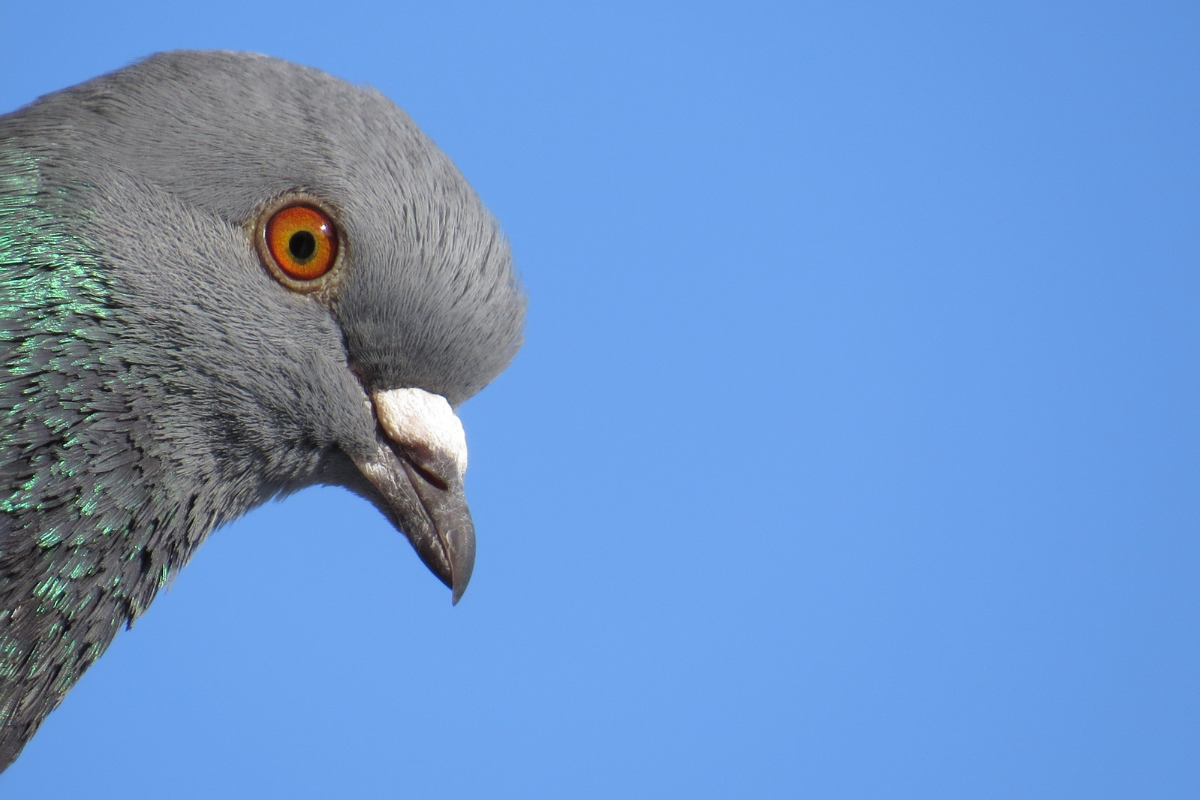
Pigeons are unappreciated. Often thought of as pests in big cities, they scavenge for discarded particles of food and stare blankly at passersby. It’s led some people to believe, falsely, that pigeons aren’t very intelligent or worthy of the space they take up.
Some people have even been known to try and poison them.
But it’s time to change our thinking. Humans domesticated pigeons thousands of years ago, and part of the reason they congregate around humans is because they’ve lost much of their survival instinct. Beyond even that, they’re highly intelligent creatures that don’t get nearly the credit they deserve.
Pigeons have been trained to identify cancer with remarkable accuracy
A study published in 2015 noted that the visual systems used by pigeons have a lot in common with those of humans. The researchers decided to put that visual recognition to the test in a high-stakes scenario.
Pigeons were trained with food reinforcement to recognize the difference between images of malignant and benign human tissue samples. Once they were up to speed, they proved to be incredibly accurate at identifying the cancerous images.
What’s especially fascinating is that the researchers were able to demonstrate real learning and pattern recognition by the birds. They were able to generalize their learnings, meaning they weren’t just memorizing the correct answers to the images they trained on. Once trained, they were still accurate when looking at novel images they’d never seen before.
The pigeons were then similarly trained on mammogram images and once again showed they were adept at picking up on the visual patterns present in malignant imaging. Reading a mammogram correctly is a highly specialized skill that, in humans, requires years of intensive training—and even then, misses happen quite frequently.
The study found that the average trained pigeon was about 85% effective in identifying cancerous images. However, when pigeons were grouped together four at a time—called “flock sourcing”—their accuracy rose to a staggering 99%.
“The birds’ successes and difficulties suggest that pigeons are well-suited to help us better understand human medical image perception,” the researchers concluded, “and may also prove useful in performance assessment and development of medical imaging hardware, image processing, and image analysis tools.”
Pigeons have a long history of helping humans, and even saving lives
Pigeons may not look very smart, but they have exceptional vision and brains that can process images at a more advanced level than humans.
For starters, they have a massive field of vision that covers about 340 degrees. That’s thanks to the positioning of their eyes on the sides of their head. Inside their eyes, however, they have an extra color cone not present in humans, allowing them to see ultraviolet and polarized light. It helps them identify patterns and details that are impossible for humans to see.
But their smarts and abilities don’t stop there. You’ve heard of homing pigeons, but not many people realize how incredible these birds are at navigation. They have iron-sensitive cells in their bodies that allow them to feel and leverage Earth’s magnetic field. They’re also known to use the sun as a compass, detect familiar scents from miles and miles away, and remember visual landmarks.
Humans realized a long time ago that these creatures could be extremely helpful.
Hero pigeons
Pigeons have been used to carry messages long distances for thousands of years. But during the World Wars, their incredible navigation skills saved lives.
During WWI, a famous homing pigeon named Cher Ami became a legend. Amidst the 1918 Battle of the Argonne Forest, an American battalion of over 500 soldiers became stranded behind German lines. Worse, they were being shelled by friendly fire. Unable to communicate, they began sending carrier pigeons to alert allies of their predicament, but the pigeons kept getting shot down. Except for Cher Ami, who was shot through the chest and blinded in one eye, but still managed to fly 25 miles in just 25 minutes to deliver the lifesaving message and save nearly 200 of the soldiers.
Cher Ami underwent surgery to save his (Cher Ami was known as a ‘her’ but later correctly gendered as a he) life and was eventually given the French Croix de Guerre for his service. His taxidermied body is on display at the Smithsonian.
Another famous pigeon of war, aptly named G.I. Joe, similarly saved at least 100 Allied soldiers during WWII and received the Dickin Medal.
In the 1970s and 1980s, the U.S. Coast Guard and Navy used pigeons during ocean search and rescue operations. Their razor sharp vision and excellent navigational skills made them elite spotters of people stranded in the water.
Pigeons are no longer used for search and rescue due to budgeting concerns and the advancement of GPS and satellite technology.
It’s high time that pigeons were given their due. Instead of sneering and shooing them away, let’s appreciate their brilliance and their “superhuman” abilities. The potential of the humble pigeon to save even more lives may yet be untapped.