Researchers have long realized we weren’t all experiencing imagination in the same way. In fact, the ability to inwardly visualize objects and scenarios can be drastically different from person to person.
Professor Adam Zeman, a British neurologist, shares in Science Direct that, in the 19th century, at least one man knew some people didn’t have a mind’s eye at all. “British psychologist Sir Francis Galton recognised in the 1880s that for some people the ‘power of visualization‘ was zero,” he shares.
But it wasn’t until years later that Zeman coined terms to describe those who could imagine vividly and those who couldn’t. The names he gave them were “aphantasia” (“without imagination”) and “hyperphantasia” (“beyond imagination”). According to Aphantasia Network, these terms formally identified “both ends of the imagery spectrum, opening the field to serious scientific study.”
Detailed imagery
Notably, there are many first-hand accounts from people with hyperphantasia (which only make up 3% to 6% of the population) wherein they can create imagery in their mind from a mere suggestion. This imagery is so layered and detailed, it’s almost as if the individual is right there in the room with it.
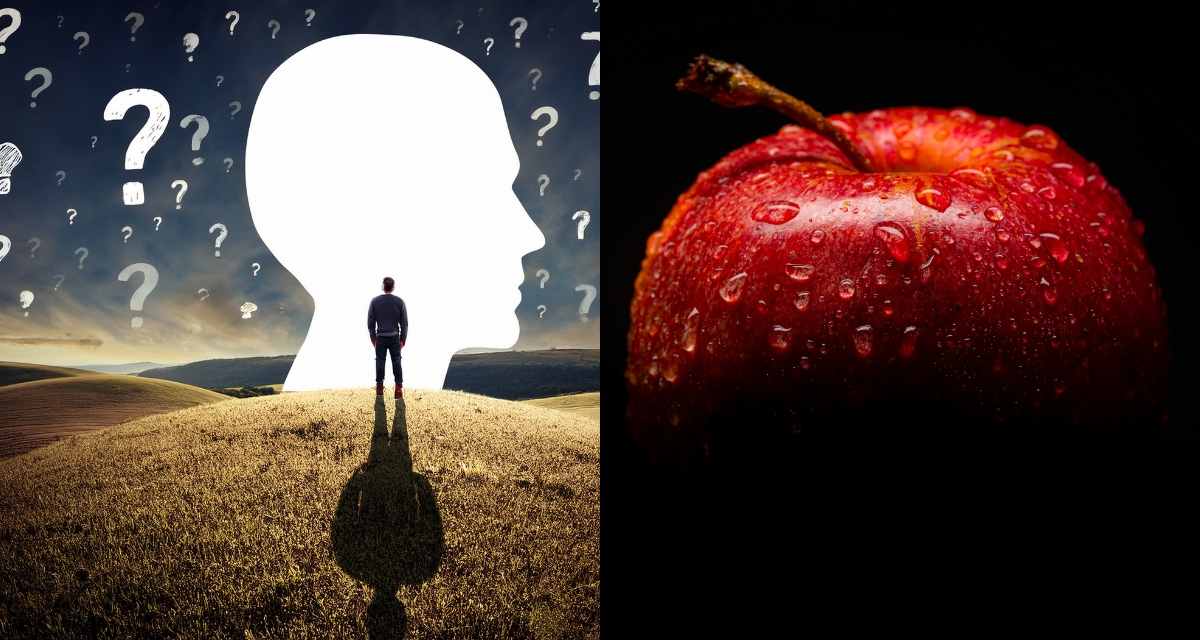
There are self-assessment quizzes people can take to determine where they fall. One standard experiment asked people to close their eyes and picture an apple in their “mind’s eye.” For some, conjuring up an actual image was impossible. They understood they were “thinking” of an apple, but without actually sensing the apple concretely, they couldn’t see it.
What it looks like in my mind
As a hyperphantasic person myself, here’s what I see when I close my eyes and “think” of an apple:
It’s in my hand, shiny and red, but I can see some bruising on one side. I can smell it, as if there were 100 apple trees in my backyard. I can feel its texture and when I bite in, I can see the juice spraying out from the now yellow, softer inside. Not only can I taste it, I can hear it crunch and even feel a bit of the peel between my teeth.
Separating daydreaming from reality
In a recent interview, Dr. Reshanne Reeder, lecturer in Cognitive and Clinical Neuroscience at the University of Liverpool, shares detailed accounts of people with strong visualization abilities with Ella Rhodes at the British Psychological Society. In some cases, the imagery was so strong it was difficult to separate daydreaming from reality.
Reeder shares, “People with hyperphantasia would have these very extreme experiences, like maladaptive daydreaming, and they would report being able to project their mental images into the real world, which I call prophantasia, which is basically imagery-augmented reality. Just like augmented reality games, like Pokémon GO, where you can see the Pokémon on your phone as if it’s in the real world. People with hyperphantasia can do that with their mind’s eye. They can turn a normal city street into a jungle. It’s a super immersive experience.”
She adds how this can influence how they see their inner world. “They also seem to have very immersive inner worlds. Oftentimes, they’ll have a fantasy world that they created when they were kids, and they just have kept building this world over the years, and they can constantly go back to it. There will be whole stories with characters—like a TV series that lasts forever, but it’s in their minds.
‘It’s a spatial engine’
On a Reddit thread called “Hyperphantasia: very vivid mind’s eye imagery,” hundreds chimed in with questions and their own experiences with hyperphantasia. One Redditor shares, in part: “I have hyperphantasia, but it’s not an optical projector, it’s a spatial engine. I don’t see a translucent or physical body rendering in the real world, instead, my brain assigns a complex concept or persona to precise 3D coordinates in the room. I can track its exact dimensions, geometry, and movement vectors through space with absolute precision. My eyes track it and my body language responds to it 100% naturally, not because I’m hallucinating a visual asset, but because my spatial awareness treats that coordinate as entirely occupied.”
Another describes how deep the rabbit hole of visualization can go at times. “I can replay short videos of my past at any age to the point I can tell people what they were wearing back then. That’s cool. The downside is my mind is always on, and always looking for things to do with it. Driving at dusk is a no for me now, because what I CAN’T see gets filled in by my imagination. Nothing like driving in the foothills at dusk and seeing dinosaurs in your peripheral vision. Have you ever swerved for a dinosaur? I have. No.”
Aphantasia
On the flip side, a few Redditors popped in to share how perplexed they are that people have this ability. “I have aphantasia. Didn’t realize it ’til a few years ago. I always thought when people ‘picture’ things in their mind it was a joke. But a lot of people can actually see images in their mind when they want to. Best I can do is faint colors that swirl around but that might just be the outside light going through my eyelids. Wild.”
Theories on why our brains are different
So, why we can fall on such opposite ends of the visualization spectrum? Our minds are unique treasure troves of synapses, neural chemicals, and pathways bridging many different lobes. But what makes us extra special is that no two brains are exactly alike. This, of course, leads to vastly different experiences of thoughts, emotions, memories, and yes…imaginations.
In a Psychology Today article titled “Hyperphantasia: When Imagination Is as Vivid as Real Life,” Sarune Savickaite Ph.D., writes that the way in which different parts of our brains interact might contribute to where we fall on the aphantasia/hyperphantasia spectrum. “Neuroscientific evidence points toward differences in connectivity between fronto-parietal networks (involved in attention and cognitive control) and visual regions of the brain. These networks support key stages of imagery—generation, maintenance, inspection, and transformation.”