upworthy
Add Upworthy to your Google News feed.
Google News Button
Family

People are sharing the parenting trends that absolutely ‘need to end now’

Here are 21 of the best responses.

Mom looking over daughter with phone; comment overlay
via Pexels

Not all trends in parenting are a good thing.

It’s tough to quantify whether today’s parents are stricter or more permissive than previous generations, but the overall sentiment seems to be that parents are more lenient than they were a few decades back.

A 2015 poll by YouGov found that younger Americans are more likely than their elders to have been raised by “not very strict” or “not at all strict” parents. Thirty-nine percent of under-30s say that their parents weren't very strict or not strict at all, compared to only 15% of over-65s.

Nicola Kraus, author of The Nanny Diaries, believes that it’s a natural outgrowth of the fact that we know a lot more about children than we did in the past.

“We are deeply aware that our children are cognizant, conscious humans in a way previous generations weren't aware. Children were treated like pets or, worse, release valves for their parents' stresses and fears, then expected to magically transform into healthy, functional adults,” she writes.

But this change in parenting has encouraged other trends that many think are creating a greater number of entitled young adults who can’t fend for themselves. These days we have helicopter parents, bulldozer parents, and dependent parents whose overinvolvement in their children’s lives renders them incapable of becoming fully integrated adults.

Reddit user u/qquackie asked the online forum,"What parenting 'trend' do you strongly disagree with?" and got an overwhelming number of responses from people who think that today's parents are raising entitled children. Many of the responders think that parents are being too sensitive with their children and they don’t provide firm boundaries. They also think it’s a big problem for kids to think they’re the center of the universe.

Here are 21 of the most popular responses to the parenting question.

1. Pretending that not parenting is parenting

"I won't tell my child to stop kicking your leg repeatedly because i don't want to crush his spirit!' — StoicDonkey

2. ​Denying your kid any negative experiences or emotions

"They are a normal part of being a person, teach them to handle negative emotions now before you send them out into a world they are not prepared to handle." — IAmRules

3. Fake “gentle parenting”

"You hear and see so many parents letting their children do whatever they want, no matter how destructive, rude or hurtful their behaviours are. Parents find themselves beholden to the whims of their childrens’ emotions in the name of gentle parenting, instead of true gentle parenting where (so I hear) boundaries are set alongside validating emotions." — candianuk

4. Not setting clear boundaries

"You are the adult, not the kid. Children benefit sooo much more from clear rules and consequences." — NorthWeight3580

5. The “bulldozer” parent

"The parent who removes all obstacles/challenges from a child’s life so they don’t learn about perseverance, problem solving, failure (sometimes you can try hard and still not get the reward) and learning from mistakes - unless the goal is to develop a highly anxious person - then, being a bulldozer parent is great." — spinefexmouse

6. Stage-mom syndrome

"Abusing the talents of your child just to boost your self image in society." — sweettooth_92

7. Nonstop supervision

"Hovering over them at every turn. Whatever happened to tossing them in a play area in another room and letting them create, explore, and get the occasional bumps?" — ansibley

8. Not believing the teacher

"'My kid never lies to me.' Seriously. Parents absolutely should be their kid’s biggest supporter. But support sometimes means holding the kid responsible when they don’t do the right thing." — jdith123

9. "No talking back!"

"If this also counts... Parents who punish their kids for speaking up or otherwise explaining something, saying that they're 'talking back.' I honestly don't get why most parents refuse to admit they're not always right sometimes. Besides, what if their kid one day comes up to them and says another adult is touching them inappropriately?" — EntryRepresentative5

10. Helicopter parenting

"Kids need freedom to explore the world, get dirty, engage in free play. I am not advocating putting the child outside on a Saturday morning and telling them to come home when the street lights come on, but an age acceptable level of freedom." — Cat_Astrophe_X

11. Pushing them too hard

"Pushing them too hard in sports, academics, etc. Like pushing til they need therapy or get injured, no free time, no downtime. FFS, they only get to be young & without excessive responsibilities once." — Oh-Oh-Ophelia

12. Tablets in public

"Loud cartoons and games on tablets in public places." — StarrCreationsLLC

13. Potty training too late

"Oh man, I’m a nanny and work in daycare. I can talk so much about this. One is late potty training. Waiting to potty train a child is more and more common. Which I generally agree with. Wait until they’re 2.5-3 and knock it out. Some take longer, some are probably ready earlier. Better than rushing it and causing issues. What this has turned into. Not potty training. I nanny a 4 year old that is still in pull ups. She is more than capable of using the potty. Our 4 year old classroom just installed a diaper genie because so many 4 year olds are starting preschool in diapers. My best friend who is a Kindergarten teacher had 2 kids start kindergarten in diapers. Luckily they’re potty trained now." — cleaning-meaning

14. Kids on social media

"Creating social media channels for your children where they proceed to upload videos and photos of their kids. Perfect place for pedophiles." — AJSK18

15. Too much structure

​"I guess the overall trend of prioritizing academics/extracurriculars and college admissions over everything else. Give your kids some chores and let them hang out with their friends outside of structured sports and musical activities!" — hausfrau224

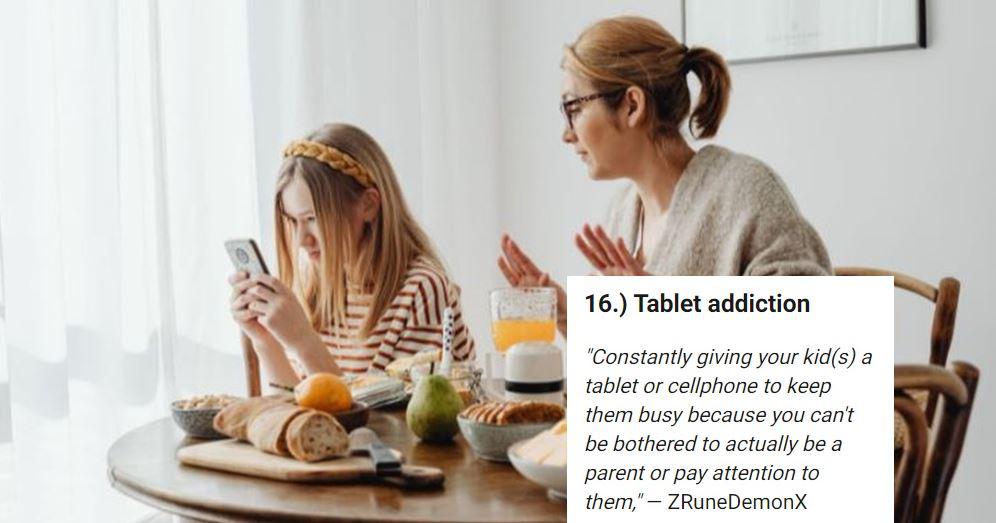
16. Tablet addiction

"Constantly giving your kid(s) a tablet or cellphone to keep them busy because you can't be bothered to actually be a parent or pay attention to them." — ZRuneDemonX

17. Letting the kid make all the choices

"I believe kids should have reasonable choices, like what their snack is and the character that's on their bedspread, but you can't let your 3 year old decide when you're allowed to leave your house. The world doesn't work that way." — cihojuda

18. Silence

"Saying 'what goes on in this house, stays in this house.' I know hundreds of victims of abuse, go through years of pain because of this phrase." — Dixie_Maclant

19. Birthdays

"The social media trend that keeps upping the expectations for birthday parties and any celebration connected to a kid. When I was a kid, birthdays consisted of a handmade invitation made by me, a cake from the grocery store, food that my Mom cooked and then inviting some friends and family over for games. Today's expectation is that every monthversary and half-birthday consist of a huge arch of balloons that will end up in the trash, a customized three-tier fondant cake, gift wrapping that color-coordinates with the themed party favors and of course, a very intentional outfit for the numerous photo ops that will take up most of the day. Anything for the 'gram, right? Don't even get me started on gender reveal announcements." — littlebunsenburner

20. Parent, not friend

"Trying to be your kid's 'friend,' not a parent. A parent is there to provide guidance and responsible behavior to model. Yes, sometimes making their actions have consequences and setting boundaries can be difficult and they'll not be too happy with you. That's part of the job. Ultimately I think that will result in a healthier relationship than being the "cool" permissive parent. I've seen results of that style of (not) parenting with very sad outcomes." — DataPlenty

21. You're not special

"Perpetuating the myth that one's children are somehow special. With about 97% certainty, they are not. Teaching them that they are just sets them up for crushing disappointment down the road. It's far better to raise kids to believe they are ordinary people with a few gifts, but also some flaws and weaknesses." — AssistantToTheSensei


This article originally appeared two years ago.

time off requests, pto, sick leave, gen z manager, manager positions, asking for time off

This Manager thinks PTO is for vacation, not "life changing events."

What does it take to be a good boss? You can answer this a million different ways—by being a clear communicator, earning employee trust, providing constructive feedback, and fostering a positive and supportive work environment while also being open to feedback and recognizing your team's contributions—but really, it all seems to stem from respecting your employees as fellow human beings.

Part of that means acknowledging that these employees have lives that are, frankly, more important to them than the job, and not penalizing them for it. One manager, and Gen Zer no less, seems to fully understand this basic principle, and folks are applauding her for it.


Elizabeth Beggs, who manages a five-person team for a packaging distribution company in Virginia, recently made a TikTok sharing which time-off requests she “rejects. ”You’ll see why “rejects” is in quotes shortly.

One example: when a female rep notified Beggs that she was likely having a miscarriage. After the team member asked how she can file for time off to see to the issue, Beggs immediately responded, “Girl, go to the doctor! We’re not submitting time off for that!”

In Beggs’ mind, PTO is for “vacation,” not medical emergencies. What a concept.

@bunchesofbeggs

Edited to clarify- 1. My team is all salary. 2. These examples are not all recent or from my current position. 3. My team works hard and hits thier KPIs above and beyond. Time off is meant to recharge and be used how you need it, not to handle life changing events #mangers #corporate #genzmanagers #sales #vetstocorporate #veterans

Beggs went on to explain a couple more situations, like when one employee—a parent—was “up all night” with their sick kid. And her last one wasn’t even negative—she had an employee who wanted to work a half-day to do something nice for their anniversary.

“Seriously, if any of these triggered anyone, then you need to evaluate how you run your team as a manager,” she concluded.

By and large, the response to Beggs’ management style has been overwhelmingly positive, and people seem to find it completely refreshing.

“You are not a manager, you’re a LEADER,” one person wrote.

@bunchesofbeggs

Everything you do should be to better your team, not to make your life easier #leadership #ownership #corporatelife #veteran #military

Another said, “The better you treat your employees, the more loyal they will be and the better work they will put out. Most people do not understand how management works.”

A few noted how this attitude seems to be more present among younger leaders. One person commented, "millennial manager here. My team members are human first, employees second. Like just go do what you want but get the work done too.”

Another joked that “Boomer managers could NEVER.”

Beggs would later clarify this doesn’t mean she doesn't have clear productivity expectations for her team (who work on salary). Perhaps if she had a team member not making their KPIs (key performance indicators), there would be an additional conversation surrounding time off, but there is still an inherent respect as a fellow human being. Which, to her, means treating bona fide time off as a way to “recharge and be used how you need it, not to handle life changing events.”

@bunchesofbeggs

If you’re planning does not account for people being human- it’s bad planning #genzleaders #armyvet #militaryvet #genz #corporatelife #corporate #manager #timeoff

Younger generations might get labeled “lazy” or “entitled,” but they are also the ones fighting to change the status quo so that we all may be treated less like cogs in the machine, and more like actual human beings. Its leaders like Beggs who show that operating in new ways doesn't compromise productivity—it, in fact, enhances it. We might not be able to change the global standard overnight, but we certainly aren’t going to get to a better place without leaders who choose to serve their community rather than a bottom line.

This article originally appeared in March.

batteries, energy, sustainability, power, breakthroughs

UCI doctoral candidate Mya Le Thai has developed a nanowire-based technology that allows lithium-ion batteries to be recharged hundreds of thousands of times.

A quote widely attributed to the Roman philosopher Seneca says, "Luck happens when preparation meets opportunity." In 2016, a doctoral candidate at the University of California Irvine proved that this is indeed the truth.

Nine years ago, Mya Le Thai, PhD was playing around in the lab when she made a colossal discovery that could lead to a rechargeable battery—that could last up to 400 years. That means longer-lasting appliances, laptops, smartphones, cars and so much more, plus fewer lithium ion batteries piling up in landfills.


A team of researchers at UCI had been experimenting with nanowires for potential use in batteries, but found that, over time, the thin fragile wires would break down and crack after too many charging cycles. A charge cycle is when a battery goes from completely full to completely empty and back to full again.

charging station, battery, charging battery, charge, batteries Phone charging.Canva Photos.

But one day on a whim, Thai coated a set of gold nanowires in manganese dioxide and a Plexiglas-like electrolyte gel.

"She started to cycle these gel capacitors, and that's when we got the surprise," said Reginald Penner, chair of the university's chemistry department. "She said, 'this thing has been cycling 10,000 cycles and it's still going.' She came back a few days later and said 'it's been cycling for 30,000 cycles.' That kept going on for a month."

This discovery is mind-blowing because the average laptop battery lasts 300 to 500 charge cycles. The nanobattery developed at UCI made it though 200,000 cycles in three months. That would extend the life of the average laptop battery by about 400 years. The rest of the device would have probably gone kaput decades before the battery, but the implications for a battery that lasts hundreds of years are pretty startling.

- YouTube www.youtube.com

“Mya was playing around, and she coated this whole thing with a very thin gel layer and started to cycle it,” Penner added. “She discovered that just by using this gel, she could cycle it hundreds of thousands of times without losing any capacity.”

“That was crazy,” he added, “because these things typically die in dramatic fashion after 5,000 or 6,000 or 7,000 cycles at most. ”"The big picture is that there may be a very simple way to stabilize nanowires of the type that we studied. If this turns out to be generally true, it would be a great advance for the community."

Not bad for just fooling around in the laboratory!

science, discovery, lab, batteries, Bill Nye, gif bill nye chemistry GIF by NETFLIX Giphy

Since her discovery, Mya Le Thai earned her PhD and has gone on to a successful career as the Principal Scientist with the Enevate Corporation, a company set "to develop innovative battery technologies that accelerate adoption of electrified mobility," according to their website.

She has also filed patents for her various inventions, the most recent of which being "Cells with blocking devices for delayed heat propagation" in July 2025. Her full list of patents can be found on Justia.

This article originally appeared eight years ago. It has been updated.

Education & Information

This surprising map reveals the real value of $100 in each state

Your purchasing power can swing by nearly 25 percent from state to state.

cheapest states, cost of living, finances, cost of living, $100

Map represents the value of 100 dollars across America.

As the cost of living in large cities continues to rise due to inflation, tariffs, and other economic factors, more and more people are realizing that the value of a dollar in the United States is a very relative concept. For decades, cost of living indices have sought to address and benchmark the inconsistencies in what money will buy, but they are often so specific they prevent a holistic picture or the ability to "browse" the data based on geographic location.

Each year, the Tax Foundation addresses many of these shortcomings using the most recent Bureau of Economic Analysis data to provide a familiar map of the United States overlaid with the relative value of what $100 is "worth" in each state. In recent years, they've further updated their data so that you can break down the value of your money across every single metro area in the United States. It's an incredibly valuable tool for the many people considering (or who have already acted and migrated from states like California to Florida), Texas and other states with friendly state taxes rates and more affordable housing options.


The map quantifies and presents the cost of living by geography in a brilliantly simple way. For instance, if you're looking for a beach lifestyle but don't want to pay California prices, try Florida, which is about as close to "average"—in terms of purchasing power, anyway—as any state in the Union. If you happen to earn (or luck) your way into Silicon Valley tax brackets, head to Hawaii, D.C., or New York. You'll burn through your money in no time. And in some of those places like Hawaii, there are quality of life measurements that often exceed raw purchasing power.

So, where does your dollar go the furthest in 2025? The financial planning site GoBankingRates.com compiled its own list of cash purchasing power across each state and found that in California, you get the least bang for your buck: only $87.42 in real purchasing power for every $100 of cash. The average person in California makes $96,344 annually, one of the higher income levels in the country. However, just living in California on average costs residents a staggering $86,408, leaving the average person with little flexibility for long-term financial planning projects like retirement, saving for a new home, or even buying a new car.

At the other end of the spectrum is Arkansas, where your dollar goes the furthest. In fact, that $100 bill burning a hole in your proverbial wallet is in fact worth more than its technical value, with a real value of $113.49. On top of that, the cost of living is only $37,067, less than half of that in California. Further, the average cost of a new home in Arkansas is $208,743, less than one-third of a new home in California. Not coincidentally, in 2023, Arkansas was the top destination for people moving to another state within the United States, followed by Texas.

family, moving, income, finances, $100 Family moving into a new home. Canva Photos.

How about Florida, which has received outsized attention in recent years for its overt efforts to draw residents from California and other states with higher costs of living? According to the most recent data, Florida is in fact much closer to California than Arkansas, coming in only in 40th place on the GoBankingRates rankings, with $100 in cash only being worth $96.55. However, the annual cost of living is still only slightly more than half of that in California, coming in at $53,505. And if you're looking to buy some real estate, the average home is valued at $404,924. That's still well outside the purchasing power of many Americans, but with built-in advantages such as warm weather and one of the top-ranked state education system in America, it's obvious why so many people, especially those with families, are choosing Florida over California in recent years.

florida, cost of living, finances, $100, education Driving Road Trip GIF by Rosen Hotels & Resorts Giphy

According to U.S. News and World Report's data analysis, California only has the nation's 23rd best education system and is ranked a paltry 37th overall in their state rankings. It's quite a contrast for a state that bills itself on the promise of opportunity, natural wonder, and positive lifestyle options. And with 2025's wildfires (as well as an annually-worsening wildfire season), the constant threat of earthquakes, and other factors, California clearly has challenges beyond economics if it wants to remain one of the more attractive states in the nation.

Of course, those numbers are always in flux, and political leaders in California have promised concrete reforms in order to address the state's high cost of living compared with the value of its social and emergency services. If you want proof of how quickly things can change, look at a similar analysis of the value of $100 in each state from 2015:

- YouTube youtu.be

However, those negative statistical trends aside, California continues to have an incredible pull on our collective imagination. Four hundred twenty-three thousand, one hundred ninety-four Americans left their state for California according to the most recent data in 2023, placing it in third behind our previously mentioned top two states, Arkansas and Texas.

So, it's clear there are a number of factors that determine the best place to live in America. When it comes to raw purchasing power, you cannot beat Arkansas. But there's so much else to consider: public resources like education and healthcare, job opportunities (you probably won't make nearly as much in Arkansas as you might in California) and other factors such as proximity to family, friends, and personal interests.

There's no doubt America is rapidly changing and that includes what people value the most when they decide where to live. In uncertain economic times, the face of America will likely change radically in the coming years with the political, economic, and social landscape shifting in meaningful ways.

This article originally appeared in August.

parents, kids, children, art, artwork, parenting hacks, parenting advice
All illustrations are provided by Soosh and used with permission.

A dad and daughter trying to share the same bed.

It's hard to truly describe the amazing bond between dads and their daughters.

Being a dad is an amazing job no matter the gender of the tiny humans we're raising. But there's something unique about the bond between fathers and daughters. Most dads know what it's like to struggle with braiding hair, but we also know that bonding time with our daughters is immensely valuable. In fact, studies have shown that women with actively involved fathers are more confident and more successful in school and business.

You know how a picture is worth a thousand words? I'll just let these images sum up the daddy-daughter bond.

A 37-year-old Ukrainian artist affectionately known as Soosh created some ridiculously heartwarming illustrations of the bond between a dad and his daughter and put them on her Instagram feed. Sadly, her father wasn't involved in her life when she was a kid. But she wants to be sure her 9-year-old son doesn't follow in those footsteps. "Part of the education for my kiddo, who I want to grow up to be a good man, is to understand what it's like to be one," Soosh told Upworthy.


“I always wanted to have a tender and loving relationship with my own father, but he didn’t know how to show his love so most of the time was distant and cold,” Soosh told The Huffington Post. "I drew what I lacked and very much wanted — to feel loved and protected by my big papa."

There are so many different ways fathers demonstrate their love for their little girls, and Soosh pretty much nails them all.

Get ready to run the full gamut of the feels.

1. Dads can do it all. Including hair.

parenting, dads, daughters, fathers, art, artwork A father does his daughter's hairAll illustrations are provided by Soosh and used with permission.

2. They also make pretty great game opponents.

parenting, dads, daughters, fathers, art, artwork, chess A father plays chess with his daughterAll illustrations are provided by Soosh and used with permission.


3. And the Hula-Hoop skills? Legendary.

parenting, dads, daughters, fathers, art, artwork, chess A father plays hula hoop with his daughterAll illustrations are provided by Soosh and used with permission.


4. Dads know there's always time for a tea party regardless of the mountain of work in front of them.

parenting, dads, daughters, fathers, art, artwork, tea party Tea time delight amidst piles of work.All illustrations are provided by Soosh and used with permission.


5. And their puppeteer skills totally belong on Broadway.

parenting, dads, daughters, fathers, art, artwork, puppets A dad performs a puppet show for his daughterAll illustrations are provided by Soosh and used with permission.


6. Dads help us see the world from different views.

parenting, dads, daughters, fathers, art, artwork, puppets, piggy back A dad walks with his daughter on his backAll illustrations are provided by Soosh and used with permission.


7. So much so that we never want them to leave.


parenting, dads, daughters, fathers, art, artwork, puppets, luggage A dad carries a suitcase that his daughter holds onto.All illustrations are provided by Soosh and used with permission.


8. They can make us feel protected, valued, and loved.

parenting, dads, daughters, fathers, art, artwork, bed time A dad holds his sleeping daughter.All illustrations are provided by Soosh and used with permission.


9. Especially when there are monsters hiding in places they shouldn't.


parenting, dads, daughters, fathers, art, artwork, super dad A superhero dad looks over his daughter.All illustrations are provided by Soosh and used with permission.


10. Seeing the daddy-daughter bond as art perfectly shows how beautiful fatherhood can be.

parenting, dads, daughters, fathers, art, artwork, bed time A dad takes the small corner of the bed with his dauthter.All illustrations are provided by Soosh and used with permission.


Soosh has made these paintings available for purchase for those who would love to have one of them grace their daughter's room. They're a rgeat reminder of how powerful the bond can be tween between a father and daughter. Take a look at Soosh's gallery here.

This article originally appeared nine years ago.

Michelle Obama, George Clooney, Kamala Harris, gen jones, generation jones

Generation Jones includes Michelle Obama, George Clooney, Kamala Harris, Keanu Reeves and more.

Did you know there are folks who don't quite fit into the main generational categories? That's boomers, Gen X, millennials, Gen Z and the up-and-coming Gen Alpha, of course. Sometimes, someone born a few months too early or late can make a world of difference in how they see the world. These in-betweeners, sometimes called "cuspers," are members of microgenerations that straddle two of the biggies.

"Xennial" is the nickname for those who fall on the cusp of Gen X and millennial, but there's also a lesser-known microgeneration that straddles Gen X and baby boomers. The folks born from 1954 to 1965 are known as Generation Jones, and they got thrust into the spotlight as Vice President Kamala Harris (born in 1964) became a presidential hopeful in 2024.


generations, gen jones, boomers, gen x, on the cusp between gen x and baby boomer Generation Jones was born between 1954 and 1965.Photo credit: Canva

Like President Obama before her, Harris is a Gen Jonesernot exactly a classic baby boomer but not quite Gen X. Born in October 1964, Harris falls just a few months shy of official Gen X territory. But what exactly differentiates Gen Jones from the boomers and Gen Xers that flank it?

"Generation Jones" was coined by writer, television producer and social commentator Jonathan Pontell to describe the decade of Americans who grew up in the '60s and '70s. As Pontell wrote of Gen Jonesers in Politico:

"We fill the space between Woodstock and Lollapalooza, between the Paris student riots and the anti-globalisation protests, and between Dylan going electric and Nirvana going unplugged. Jonesers have a unique identity separate from Boomers and GenXers. An avalanche of attitudinal and behavioural data corroborates this distinction."

Pontell describes Jonesers as "practical idealists" who were "forged in the fires of social upheaval while too young to play a part." They are the younger siblings of the boomer civil rights and anti-war activists who grew up witnessing and being moved by the passion of those movements but were met with a fatigued culture by the time they themselves came of age. Sometimes, they're described as the cool older siblings of Gen X. Unlike their older boomer counterparts, most Jonesers were not raised by WWII veteran fathers and were too young to be drafted into Vietnam, leaving them in between on military experience.

Gen Jones gets its name from the competitive "keeping up with the Joneses" spirit that spawned during their populous birth years, but also from the term "jonesin'," meaning an intense craving, that they coined—a drug reference but also a reflection of the yearning to make a difference that their "unrequited idealism" left them with. According to Pontell, their competitiveness and identity as a "generation aching to act" may make Jonesers particularly effective leaders:

"What makes us Jonesers also makes us uniquely positioned to bring about a new era in international affairs. Our practical idealism was created by witnessing the often unrealistic idealism of the 1960s. And we weren’t engaged in that era’s ideological battles; we were children playing with toys while boomers argued over issues. Our non-ideological pragmatism allows us to resolve intra-boomer skirmishes and to bridge that volatile Boomer-GenXer divide. We can lead."

@grownupdish

I found my people and we are Generation Jones! Get ready to re-live our childhoods and follow for more. #grownupdish #midlife #midlifewomen #boomer #babyboomer #generationx #genx #1963 #over50 #generationjones #generationalmarketing #adulting #greenscreen

However, generations aren't just calculated by birth year but by a person's cultural reality. Some on the cusp may find themselves identifying more with one generation than the other, such as being culturally more Gen X than boomer. And, of course, not everyone fits into whatever generality they happened to be born into, so stereotyping someone based on their birth year isn't a wise practice. Knowing about these microgenerational differences, however, can help us understand certain sociological realities better as well as help people feel like they have a "home" in the generational discourse.

As many Gen Jonesers have commented, it's nice to "find your people" when you haven't felt like you've fit into the generation you fall into by age. Perhaps in our fast-paced, ever-shifting, interconnected world where culture shifts so swiftly, we need to break generations into 10 year increments instead of 20 to 30 to give everyone a generation that better suits their sensibilities.

This article originally appeared last year and has been updated.