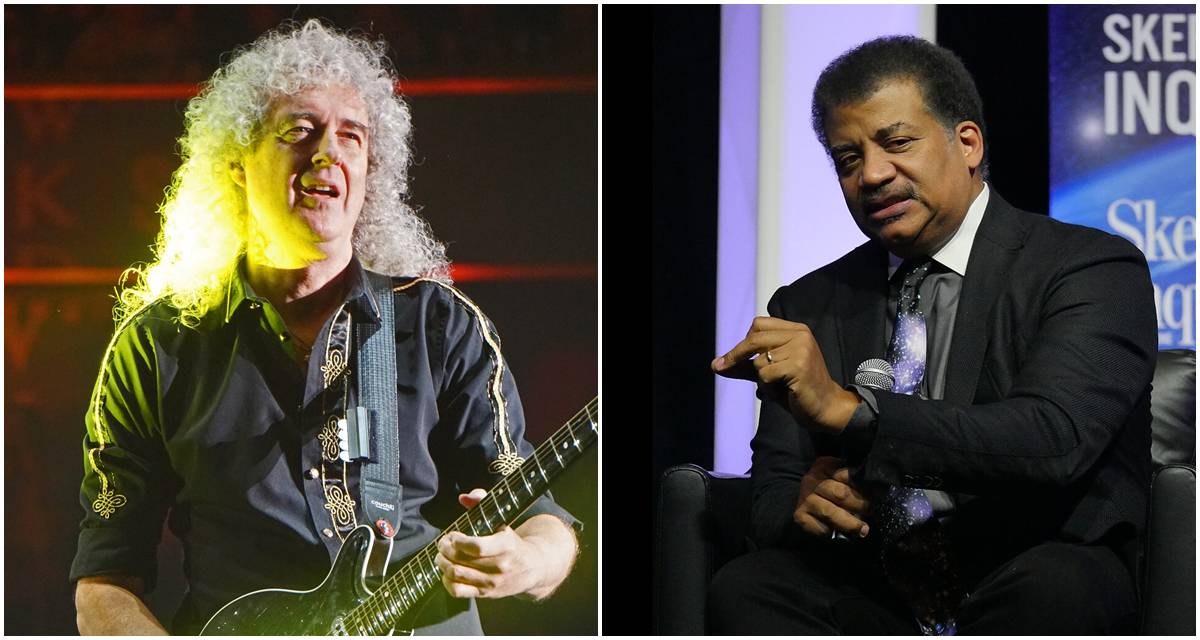
Released in 1975, Queen’s A Night at the Opera is the band’s top-selling album. It features massive hits, including “Bohemian Rhapsody,” “You’re My Best Friend,” and “Love of My Life.” The fifth song on the album, “’39,” written and sung by Brian May, has been called the band’s “most underrated,” by some because of its deceptively simple sci-fi folk premise.
The song is about a team of astronauts who go into space to find a new world and, after being gone for a year, return to Earth. Only, their year in space was 100 years on Earth. The main character in the song learns that his wife has passed away and is met by his daughter, who looks a lot like her. May cleverly cloaks the time change by mentioning that the astronauts left in ‘39 and returned in ‘39. So, they could have left in 2039 and returned in 2139.
“’39”
The song’s big reveal comes at the end:
In the year of ’39 came a ship in from the blue
The Volunteers came home that day
And they bring good news of a world so newly born
Though their hearts so heavily weight
For the Earth is old and grey
Little darling, we’ll away but, my love, this cannot be
For so many years are gone
Though I’m older but a year
Your mother’s eyes from your eyes cry to me
The song is a perfect example of the time dilation effect of Einstein’s theory of special relativity. In layperson’s terms, this means time can pass at different speeds. If you travel at an extremely fast speed or come close to an object with strong gravity, your clock runs slower than someone back home on Earth.
The song clearly came from May’s heart because he received a degree in physics in 1968 and a PhD in astrophysics in 2007, both from Imperial College London.
An astrophysicist and a rockstar
The time dilation premise of the song wasn’t lost on astrophysicist and host of the Star Talk podcast, Neil deGrasse Tyson. “[May] had a very strong interest in this. And I’ve met him only once,” Tyson said in an interview with Second Listen. “But it makes complete sense that the storyline would have come from him because it’s one of the fundamental things you learn in the beginning of modern physics.”
Tyson then explained the science behind time dilation. “It turns out when you travel at high speeds and other people don’t, then your coordinate system changes for you at a different rate than it does for others. If you travel in space, your space coordinate’s changing and other people isn’t,” Tyson continued. “So there is a speed and a time with which you can travel and stay away where if you come back after one of your years, Earth could have aged 10 years, 100 years or even a thousand years depending on how fast you moved. So in that sense, yes, we can go to the future.”
The many levels of ”’39”
The song features a traditional folksy arrangement that builds to a middle that’s pure, classic Queen. It has an atmospheric vocal lift-off with drummer Roger Taylor singing a magnificent high falsetto. In the ’70s, the band often played the song sea shanty-style with Freddie Mercury on vocals. In recent Queen + Adam Lambert shows, May has played the song on his acoustic alongside Opera staple “Love of My Life.”
“‘39” works on many levels. It can be seen first as a traditional folk song, second as a glimpse into the effects of time dilation, and finally, as a metaphor for May leaving familiar surroundings to pursue the rock and roll lifestyle. Though he gained famed and fortune, he was never really able to return home again.
“I felt a little like that about my home at the time, having been away and seen this vastly different world of rock music which was totally different from the way I was brought up,” May said, according to The Guardian. “People may not generally admit it, but I think that when most people write songs there is more than one level to them— they’ll be about one thing on the surface, but underneath they’re probably trying, maybe even unconsciously, to say something about their own life, their own experience—and in nearly all my stuff, there is a personal feeling.”
Great art can mean different things to different people, and “’39” is so packed with context it even has multiple meanings to its own composer. It’s another reason to keep your ears open when listening to new songs, because they may be about much more than they appear on the surface. Plus, you may even get a lesson in astrophysics.