upworthy
Add Upworthy to your Google News feed.
Google News Button
Identity

LeVar Burton shares thoughtful reaction to finding out he has a Confederate ancestor

“There’s some conflict roiling inside of me right now, but also oddly enough I feel a pathway opening up…"

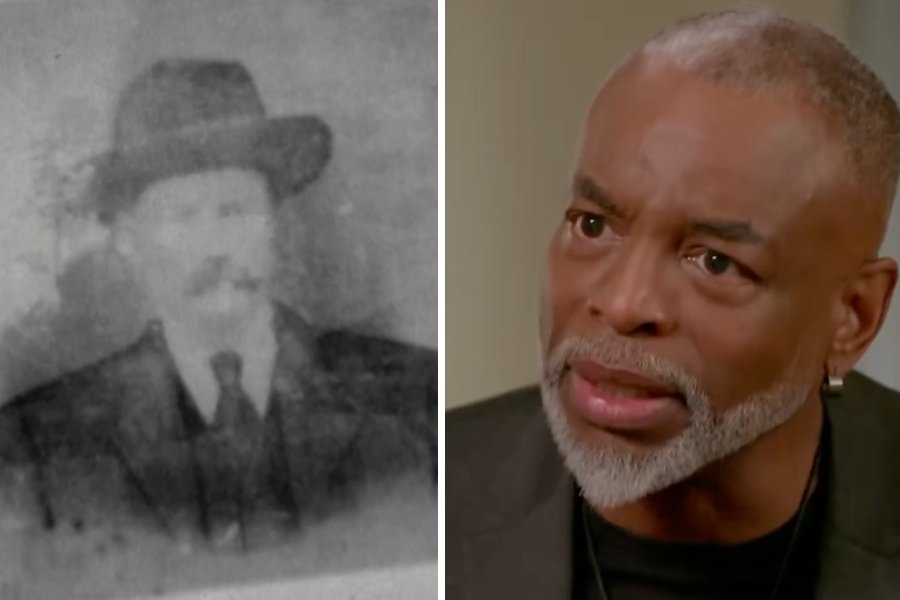
Black and white photo of LeVar Burton's great-great-grandfather and closeup of LeVar Burton's face

James Henry Dixon was a North Carolina farmer with a wife and children when he fathered Burton's great-grandmother.

The United States has long been seen as a "melting pot," a "nation of immigrants," and a country where people of diverse backgrounds mix and mingle together under the common banner of freedom and liberty.

It's a bit more complicated than that, though, especially for Black Americans whose ancestors came to the U.S. by force as part of the "peculiar institution" of human chattel slavery. Through the cruel system of buying, selling and breeding human beings for generations, many people's ancestral knowledge was stolen from them, a historical reality that prompted "Black" with a capital "B" as an ethnic and cultural identifier for people of the African diaspora.

Curiosity about the varied backgrounds of Americans is the basis of "Finding Your Roots," a PBS series hosted by Harvard professor Henry Gates, Jr. The show has revealed some surprises in some famous people's DNA, including the beloved "Reading Rainbow" host, LeVar Burton.


Burton sat down with Gates to go over what researchers had found out about his lineage, and what they discovered floored him. Burton said that his mom, who had raised him and his siblings as a single mother from the time he was 11, had never wanted to share anything about her own personal history, so he didn't know much about his ancestry.

As it turns out, the man who was on record as being Burton's great-great-grandfather, Louis Sills, was not actually his blood ancestor at all. The man who fathered Mary Sills, Burton's great-grandmother, was actually a white man named James Henry Dixon.

Burton knew Sills when he was a child and referred to her as "Granny." He had always been told that Granny had some Native American ancestry, but she was actually half white, her father being a North Carolina farmer who had a wife and children at the time Sills was born.

Not only that, but Dixon had served in the junior reserves for the Confederacy as a teenager, too young to be in active combat when the war broke out in 1861. So not only did Burton have a white direct ancestor but that ancestor was on the side of defending the enslavement of Black people.

"Are you kidding me?" was Burton's initial response to this news. "Oh my god. I did not see this coming."

Once the news sunk in, Burton thoughtfully reflected on what it might have meant.

“I often wonder about white men of the period and how they justify to themselves their relations with Black women, especially those in an unbalanced power dynamic," Burton said. "There has to be a powerful disconnect created emotionally and mentally. So it’s possible in my mind that he could’ve contemplated it and was conflicted at worst, maybe repentant at best. And then there’s the possibility that he didn’t think about it at all."

Through we don't know the nature of the sexual relationship between Sills and Dixon, sexual violence was a ubiquitous feature of enslavement in the U.S. and the power dynamic between white and Black people at that raises questions about whether any relations could be viewed as truly consensual. Previous episodes of "Finding Your Roots" has unveiled relationships that defy assumptions one way or the other, so that element of Burton's family history remains a mystery. However, Dixon fathered at least nine children and had at least 40 grandchildren, meaning Burton likely has white relatives scattered throughout the country.

When Gates asked Burton how this revelation of having a white Confederate great-great-grandfather made him feel, he said, "There's some conflict roiling inside of me right now, but it, it, it also, oddly enough, I feel, I, I feel a pathway opening up…I believe that as Americans, we need to have this conversation about who we are and how we got here. But yet I see that we're so polarized politically and racially. We're not talking to each other. And so I've been looking for an entry point to talk to white America."

"Well, that door just opened," said Gates.

"Here it is," responded Burton. "Here it is."

Some people didn't understand Burton's reaction, highlighting the complexity of racial identity and the history of race relations in the U.S. in particular due to the reality of race-based slavery. One of the things people love about "Finding Your Roots" is how it opens up entirely new perspectives in people's own life stories, which is a very personal thing.

As Burton wrote in response to a commenter on X, "It is one thing to know something on an intellectual level, another matter entirely to be introduced to an emotional truth that is both surprising and wholly unexpected."

Burton found out a lot more about his ancestry on both sides, including the fact that education and literacy—which Burton has dedicated much of his career to—can be traced back several generations through his father's side. His father left when he was 11 and he didn't know anything about his background, but he actually had educators in his family going back to at least 1880.

Though Burton said it was "overwhelming" to find all of this out about his lineage, he also said he was "ecstatic" to learn it.

"Never in a million years would I ever have imagined that you would find information like this for my family," Burton told Gates.

Watch Burton's entire ancestry being revealed on "Finding Your Roots," starting at the 12:00 mark and continuing again at 32:50:

ideas, homelessness, prodigy, social work, solutions
Photo credit: @ribalzebian on Instagram

Ribal Zebian is going to test a house he designed by living in it for a year.

Ribal Zebian, a student from the city of London in Ontario, Canada, already made headlines last year when he built an electric car out of wood and earned a $120,000 scholarship from it. Now, he's in the news again for something a little different. Concerned with homelessness in his hometown, Zebian got to work creating a different kind of affordable housing made from fiberglass material. In fact, he’s so confident in his idea that the 18-year-old plans on living in it for a year to test it out himself.

Currently an engineering student at Western University, Zebian was concerned by both the rising population of the unhoused in his community and the rising cost of housing overall. With that in mind, he conjured up a blueprint for a modular home that would help address both problems.


Zebian’s version of a modular home would be made of fiberglass panels and thermoplastic polyethylene terephthalate (PET) foam. He chose those materials because he believes they can make a sturdy dwelling in a short amount of time—specifically in just a single day.

“With fiberglass you can make extravagant molds, and you can replicate those,” Zebian told CTV News. “It can be duplicated. And for our roofing system, we’re not using the traditional truss method. We’re using actually an insulated core PET foam that supports the structure and structural integrity of the roof.”

Zebian also believes these homes don’t have to be purely utilitarian—they can also offer attractive design and customizable features to make them personal and appealing.

“Essentially, what I’m trying to do is bring a home to the public that could be built in one day, is affordable, and still carries some architecturally striking features,” he said to the London Free Press. “We don’t want to be bringing a house to Canadians that is just boxy and that not much thought was put into it.”

Beginning in May 2026, Zebian is putting his modular home prototype to the test by living inside of a unit for a full year with the hope of working out any and all kinks before approaching manufacturers.

“We want to see if we can make it through all four seasons- summer, winter, spring, and fall,” said Zebian. “But that’s not the only thing. When you live in something that long and use it, you can notice every single mistake and error, and you can optimize for the best experience.”

While Zebian knows that his modular homes aren't a long-term solution to either the homeless or housing crisis, he believes they could provide an inexpensive option to help people get the shelter they need until certain policies are reformed so the unhoused can find affordable permanent dwellings.

@hard.knock.gospel

What to buy for the homeless at the grocery store. 🛒 Most people get it wrong. After being there myself, these are the survival items that actually matter 💯 The 2nd to last one is about more than survival—it’s about DIGNITY. We are all one circumstance away from the same shoes 🙏 SAVE this for your next grocery run. 📌 IG@hardknockgospel Substack@ Outsiders_Anonymous #homelessness #helpingothers #kindness #payitforward #learnontiktok

Zebian’s proposal and experiment definitely inspires others to try to help, too. If you wish to lend a hand to the unhoused community in your area in the United States, but don’t know where to look, you can find a homeless shelter or charity near you through here. Whether it’s through volunteering or through a donation, you can help make a difference.

Friendship

An NFL reporter was criticized for consoling the losing coach, then fans came out to defend her

"You can call me fake all you want to, honey. I’ve been doing this a long time.”

reporters, journalists, tv, press conference, NFL, football, sports, coach, kindness, humanity

A reporter gave an NFL coach a pep talk after a loss, sparking a firestorm of criticism.

The Jacksonville Jaguars haven't won a playoff game in three years, and have just a handful of postseason victories in their short history. They have never been to a Super Bowl, making them just one of four teams in the NFL never to do so. That's why, after fielding one of the franchise's best teams in years, their latest quick playoff exit was a hard one for fans and the team itself to swallow. It was heartbreaking and gut-wrenching for nearly everyone in the Jacksonville area.

After suffering a narrow defeat at the hands of the Buffalo Bills this past weekend, head coach of the Jaguars Liam Coen took the podium to answer questions and accept accountability for the loss. Business as usual, despite how demoralized he was feeling.


One of the questions, however, was far from the usual fare. A Jacksonville Free Press associate editor named Lynn Jones-Turpin raised her hand and chose to use her time to give the coach words of encouragement instead of a hardball question.

"I’m going to tell you, congratulations on your success, young man," she said. "You hold your head up. You guys have had a most magnificent season. You did a great job out there today. You just hold your head up, OK? Ladies and gentlemen, Duval. You keep it going. We got another season. Much continued success to you and the entire team."

The warm, rousing words had a visible effect on Coen, who began beaming while nodding gracefully. "Thank you, ma'am," he said with genuine appreciation.

Talk about a legendary pep talk. You can watch the roughly 30-second moment here:

- YouTube www.youtube.com

The brief interaction was picked up by national sports reporters and celebrated as a wholesome moment of compassion between two professionals.

Adam Schefter of ESPN called it an "awesome" moment. His post highlighting the interview got nearly 20 million views on X.

Commenters found the compassionate exchange extremely refreshing coming from the usually cutthroat world of sports, where reporters and coaches spar and trade passive-aggressive barbs. They're often pitted against each other as enemies, with reporters seeking transparency and accountability and coaches just wanting to be left alone to coach. Coen and Jones-Turpin broke the mold—for one afternoon at least.

"Whoever she works for needs to give her a raise. We need more people like this in the world!" one wrote.

"This really is wonderful. It’s fun watching his facial gyrations while she talks to him like an aunty. You can see the kid in the man. Wonderful."

"Epically classy from that reporter. Not the finish they wanted, but this squad showed heart all year."

"This healed me and I’m not even a Jags fan" someone added.

While not strictly professional, the moment between Coen and Jones-Turpin was a rare thing of beauty. But that didn't stop the curmudgeons from questioning the reporter's professionalism and journalistic integrity.

Many fans (notably, of non-Jaguars teams) and members of legacy media were quick to point out that a reporter consoling a coach after a loss is not a good display of journalism ethics.

Hosts on Fox News Sports Radio said, "This is a No-No. She sounds like a fan."

Jemele Hill, a writer for The Atlantic, wrote on X, " It’s literally the first lesson you learn — you aren’t a fan. You can love sports. You can be a fan of competition and games. But you are absolutely not a fan," while expressing distaste at how Jones-Turpin handled the interaction.

AP reporter Mark Long, in a now deleted post, called the question "embarrassing" and questioned Jones-Turpin' credentials, calling her "fake news."

The back and forth between supporters appreciative of her words and people looking for journalists to hold a hard line in the sand became quite a kerfuffle in social media, racking up millions and millions of interactions.

Lynn Jones-Turpin was finally given a chance to respond in an interview on local Jacksonville news, and she defended herself beautifully: By not feeling the need to defend herself at all.

"It was just an overwhelming day. I can tell you that this entire city, this town, our team, our city, and our coach, we were overwhelmed. ... Coach came out, and he was just... emotions. He was totally immersed in his feelings. He had tears, he bit his lip."

She then had a chance to address her critics head on. "I don't take no offense to it. Listen, I've been in this business more than 25 years. I've interviewed from Barack Obama to Terry Bradshaw to Tiger Woods. He can say whatever he wants about fake news. I am a member of the Black Press," she said, adding that Black-run newspapers like hers have been around for longer than most modern media outlets. "Support the Black Press. You can call me fake all you want to, honey. I’ve been doing this a long time.”

Adding more context, journalist Phil Lewis writes, "The Black Press never agreed to conform to the mainstream media’s ideal of 'objectivity.' In fact, the first Black newspaper aimed to distinguish itself from other newspapers of its time. This is not to say the pursuit of truth isn’t important, but realizing that 'objectivity' has always reinforced white worldviews."

Jones-Turpin then joked that she was the new "grandma" or "auntie" of the team.

Especially after her earnest appearance and non-apologetic attitude for her approach, the support for Jones-Turpin has been far louder than the criticism.

In a way, coaches and the reporters who cover their teams are coworkers. They interact on a near daily basis, and while they butt heads frequently, they both do what they do out of a shared love for the sport and even for the city they work for.

The game is ultimately just a game, but the emotions and real-life stakes are very real.

When emotions are high, who's to say they're not allowed a brief moment of humanity and compassion for one another? There are far worse things happening in the world—that much is for certain.

washer, washing machine setting, how to use washing machine, laundry, laundry tips
Image courtesy of @granolabarpan/Instagram (with permission)

Stay-at-home mom Catrina shares shock at learning what the 'heavy' setting on her washer means.

Knocking out loads of laundry is a feeling of accomplishment that is unmatched. Depending on what needs to be washed, washing machines offer a variety of settings for the ideal clean. But even the most seasoned laundry pros can admit that they don't fully understand how to use them properly.

One stay-at-home mom shared her funny and relatable washing machine mistake. Catrina (@granolabarpan) got the shock of a lifetime when she realized that she had been using the "heavy" setting on her washer wrong for years.


"POV: today years old when it clicks why my blankets are sopping wet!!! I thought HEAVY meant heavy items being washed," she wrote in the video's overlay.

"Heavy on my machine means heavily soiled," she went on to add in the comments. "I thought it meant the stuff I was putting in the machine was heavy in weight/pounds."

Some moms are also realizing this for the first time. "Ok.. so I am 66 years old learning this???!! I always thought that heavy meant weight also😂," one person commented. Another person wrote, "Well I was today years old when I learned what heavy meant too…😂"

Others expressed confusion with so many settings, and reminiscing on simpler times. "Wait a minute. 😂. I think I need to for once go and read the manual because I have been wondering about all of the options," another user wrote. And another chimed in, "I want my old $250 3 options hot/warm/cold on/off washer back. It didn’t die it rusted out but took 25yrs to do it. I had 5 kids, plus my ex in-laws living with me."

Washing machine settings, explained

Struggling to understand the settings on your washing machine? You're not alone.

"Knowing these settings helps avoid common laundry mistakes, such as using the heavy cycle for heavy fabric weight instead of heavy soil, which can lead to ineffective cleaning or damage over time," Vanessa Ruiz, a professional organizer at Sparkly Maid San Antonio, tells Upworthy.

These are five washing machine settings and how they work:

1. Normal/Regular Cycle
Ruiz explains that this is your typical setting for day-to-day loads such as t-shirts, jeans, sheets, and underwear.

"These laundry loads are typically washed in warm water and the setting is rinsed with medium spin speeds through agitation in order to properly clean moderately soiled garments," she says. "This cycle is safe enough to wash a variety of different fabric content with a somewhat dirty load."

2. Delicate/Gentle Cycle
Ruiz notes that the delicate cycle is created specifically for delicate fabrics—lingerie, silk, lace, or embellished clothing—that may become damaged in a normal or regular wash.

"This cycle will use moderate spin speeds through gentle agitation to thoroughly dry clean and not damage clothes too easily," says Ruiz. "This is the preferred cycle when laundry items that require extra care or are labeled 'delicate' or 'hand wash' need to be washed."

3. Heavy Duty Cycle
The heavy duty cycle is specifically for heavily soiled items like work clothes, kitchen towels, and bedding.

"This setting uses higher water temperatures, longer wash times, and powerful agitation to remove stubborn dirt and grime. It’s perfect for those tough laundry jobs, but not recommended for delicate fabrics," explains Ruiz.

- YouTube www.youtube.com

4. Bulky/Bedding Cycle
This cycle is often confused with "heavy."

"This cycle accommodates larger, heavier items that absorb a lot of water, such as comforters, pillows, and sleeping bags," says Ruiz. "It uses more water, medium spin speeds, and longer wash times to thoroughly clean bulky items without causing damage or imbalance."

5. Quick Wash
In a rush? This is the perfect setting to use.

"It is an accelerated wash cycle designed for small loads of lightly soiled clothes, usually lasting 15 to 40 minutes," says Ruiz. "It’s great for when you need clean clothes fast and can save energy compared to longer cycles."

This article originally appeared last year.

Culture

The 'honk if you…' bumper sticker sparks spirited debate about what honking really means

"I am almost 80 and have never heard the second interpretation. That is ridiculous."

honk bumper sticker, bumper sticker, driving, car honking, internet debate, car horn
Photo credit: Canva, aleksandrkondratov (left, cropped) / rofapic (text box) / Aflo Images from アフロ(Aflo) (right, cropped)

What does the honking mean in a "honk if you..." bumper sticker?

Novelty bumper stickers come in many varieties: proud displays of solidarity, cultural and political co-signs, and even unhinged silliness. But if you ask someone to name a famous example, there's a good chance they'll choose one that starts with the phrase "Honk if you…"

What exactly are these stickers trying to express, though? If one reads "Honk if you love dogs," does honking simply mean you also love dogs? Apparently there are two very different schools of thought, and dozens of people went online to debate how we should be interpreting these seemingly simple messages.


- YouTube www.youtube.com

Fandom or snark?

"So what I've heard is that those 'honk if you like ice cream🍦' license plates can be read two different ways," one user wrote on Reddit. "1. The idea is that this person is broadcasting that they like this particular thing a lot. 2. It's kind of a joke that they're going to ignore you honking at them, because you must just be responding to the bumper sticker, not saying they're a bad driver. It's meant to be kinda snarky."

The responses seem roughly split 50/50, with tons of people expressing their shock in both directions. Here are some of the top comments:

"Not sure if it's bulls--- or not but I have never until this moment considered option 2"

"I am almost 80 and have never heard the second interpretation. That is ridiculous."

"I always thought of it the first way, it was recently explained to me to be the second—I forget which show I was watching, maybe Gilmore Girls, and she was doing an experiment to honk at people who have 'honk if you like _____' stickers and the drivers would get mad at her for honking. So she was theorizing that people who have those types of bumper stickers don't actually want you to honk at them. Which I guess makes it option two in reality and that's the joke."

honking, car honking, car horn, honk debate, bumper sticker Someone honks a car horn. Photo credit: Canva, rattanakun

"Yeah I always took it the first way. 'I like ice cream and I want to get excited about it with other people who also like ice cream!' And I always thought it was stupid. Never even considered it the other way, which is also stupid."

"I've never considered it to be anything other than a person broadcasting their fandom."

"I always thought it was just a poll type thing until recently lol I learned of the #2 option. So bizarre"

"That's correct. It's meant to be interpreted the second way. It's a joke that if they are honking at you for driving poorly, you will ignore and assume they like pizza or whatever the sticker says."

"I think this is historical revisionism. I never heard definition #2 until a couple years ago. I've always taken it as definition #1."

"Hi. I have always seen the 2nd interpretation, because the first one makes no sense. Honking is not like making small talk in line at the grocery. Nobody wants every car to honk at each other to communicate their likes and dislikes."

"I've only seen the second explanation on social media in the last few months, which leads me to believe it's another TikTok originating thing along the lines of trying to redefine what '9 to 5' means."

@ellaellaw

Replying to @WILL (hozier’s version)

"It took me a really long time to grasp"

As for the TikTok mention, that user could be referring to a viral post from content creator Ella, who explained the second interpretation. "It took me a really long time to grasp," they said. "It's more like a 'ha, the joke's on you' from the car that you're honking at with that sticker on."

Thousands of other users weighed in with their reactions, including many instances of the popular response "WHAT?"

On a related note, lots of people have recently experienced a "today years old" learning moment related to a specific "honk" bumper sticker. In a Reddit thread, one user admitted, "I just realized the phrase 'honk if you're horny' is a pun about horns," and they weren't the only one making that realization. "I even hear this phrase a lot," someone added, "but never made the connection."

negativity, thumbs down, man in suit, judgement, no good, bad

A man giving a big thumbs down.

Everyone has that person in their life who casts everything in a negative light. You go out for a great meal, only to hear them complain about the service. They never highlight anyone's positive qualities, just their faults, and the only joy they seem to get comes from putting down the things you love.

It's like they are programmed to be antagonistic about absolutely everything. The problem is that, whether they're friends, family members, or co-workers, we're stuck dealing with people who drain our energy and have a knack for ruining a good time.


Fortunately for us, communication expert Jefferson Fisher recently shared a three-step reset method on YouTube for dealing with these impossible people. Fisher, who has become massively popular on social media, offers tips "to help people argue less and talk more."


How to deal with negative people

Here is Fisher's three-step reset method for dealing with negative energy:

1. Don't absorb the negativity

"Don't absorb what they said," Fisher says. "Instead, we're going to call it out. You're going to say it out loud. That means when you claim it, you control it. Meaning, you control your own reactions to it. That's the takeaway there."

Examples include:

"This feels tense."

"This feels heated."

"I'm sensing some negativity."

2. Call out the truth, not the tone

"When that happens to the negative energy, you're going to send it right back by having them repeat it," he says. "How? It's very similar to how I recommend handling insults. See, they can't repackage it in the same way again when you ask them to repeat it the same way. They can't say it the same way. Then they just look terrible."

@arnaldo.sifre

Master Negative Energy_ React to Truth, Not Tone Discover the simple but powerful technique Jefferson Fisher uses to stop negative energy without arguing or escalating. Instead of reacting to someone’s tone, you focus on the truth behind their words. The method? ➡️ Ask them to repeat what they said. Most passive-aggressive people cannot package their negativity the same way twice. When they repeat it, the tone weakens and the truth comes out. If it’s still negative, calmly ask again: “I need you to say that again—better.” This forces clarity, removes hostility, and shifts the power back to you. Stop reacting to tone. Start uncovering truth. Transform every interaction starting today. #fyp #CommunicationSkills #JeffersonFisher #ConfidenceTips #EmotionalIntelligence #StopNegativity #PassiveAggressive #BetterConversations #MindsetMatters #HealthyBoundaries #LifeSkills #SpeakUp #PersonalGrowth #RelationshipSkills #foryourpage

3. Protect your presence

"You cannot control another person's mood," he adds. "You cannot make somebody happier. That is their choice. … Big takeaway: you are making sure that your mind acknowledges the negative energy, but it neither matches it nor tries to attach to it. That's the difference. That's how you handle the negative energy."

Here's the whole video:

- YouTube youtu.be

Why are some people so negative?

A primary reason some people are overwhelmingly negative is that they are extremely fearful and hyperfocus on the negative aspects of life.

"In brief, almost all negativity has its roots in one of three deep-seated fears: the fear of being disrespected by others, the fear of not being loved by others, and the fear that 'bad things' are going to happen," Raj Raghunathan, PhD, writes in Psychology Today.

Humans also have a negativity bias, which means we're more primed to respond to negative than positive stimuli. That's why we remember insults far more often than praise and are more likely to recall negative moments than positive ones.

Why all the negativity? It's a survival technique. People who can detect danger and harmful situations are much more likely to survive than those who focus on the positive. Unfortunately, we sometimes have to make a conscious effort to see the good in the world.

Even though negative people can be a burden to be around, taking Fisher's advice and refusing to let them affect our presence can turn them into a reminder to reset and refocus on the positive in life.