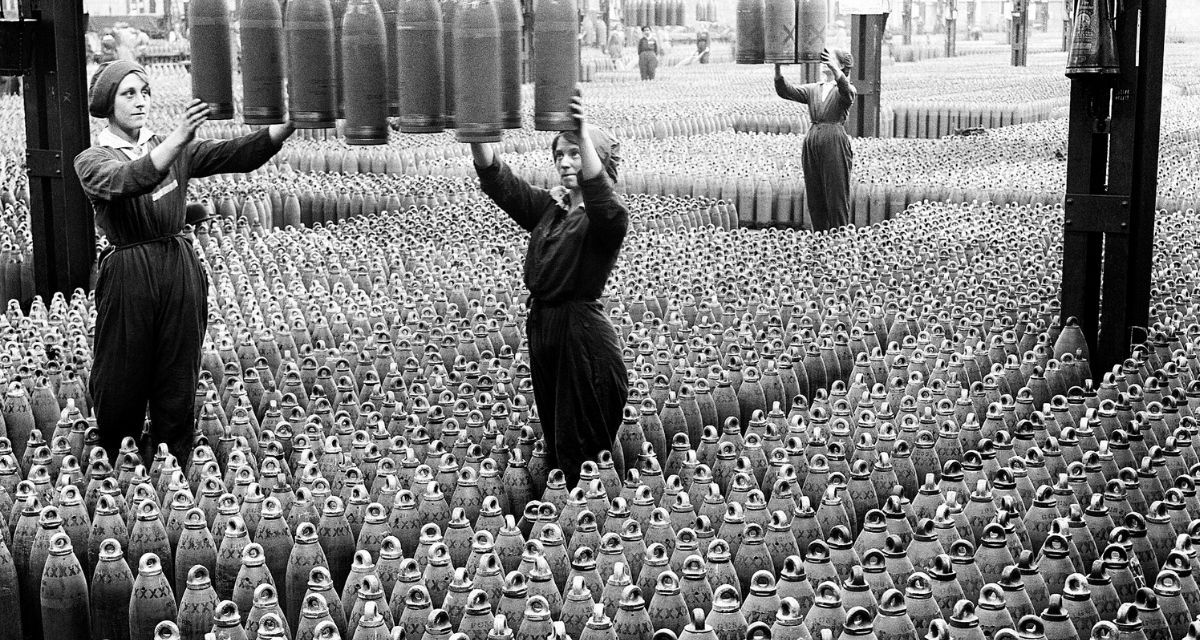
In the early 1900s, there was a growing push to improve working conditions for women. In particular, reformers were fighting for shorter hours, safer workspaces, and protection from exploitation.
These efforts came from genuine concern for women’s rights. However, it would quickly become clear that nobody actually asked these working women what they needed…especially when the topic of night shifts came into the conversation.
“Protection” that cost women their jobs
Following the 1911 Triangle Shirtwaist Factory fire in New York, wherein 146 workers died as a result of neglected safety measures, a law took effect that banned women from working overnight in factories. The reasoning was that women, particularly mothers who should be at home at night with their children, needed protection from these dangerous working conditions. This law began in New York but would be adopted by other states as well.
For Ella M. Sherwin, a printer and Linotype operator in Buffalo whose work mainly involved preparing newspapers each night for the next morning, this shift meant losing her job. She did eventually find a day job, but with less pay and longer working hours. Understandably, she wasn’t exactly appreciative of this “protection.”
Similarly, Margaret Hinchey, a transit guard, and Mary A. Murray, a ticket agent, also found themselves out of a job thanks to a law meant to protect them.
Murray’s dilemma in particular made it clear that these restrictions didn’t actually serve those they claimed to protect. As a widow raising five children, working a day job was next to impossible to fit in between raising her kids. When she finally did find daytime work, she made $18 a week, compared to the $32 a week she made as a ticket agent.
Enter: the Women’s Equal Opportunity League
The three would eventually find one another and team up to become leaders in the Women’s Equal Opportunity League, an organization founded by female printers who, like Sherwin, lost jobs due to the new reform.
This league would fight for “industrial equality” under the prevailing argument that if a job was safe and suitable for a man, no law should automatically deem that a woman could not handle it.

Later historical research would prove that the bigger economic reason for this law was less about protecting women from unsavory working conditions and more about protecting men from having to compete with them for jobs. Even so, the league would also end up going head-to-head with other women’s organizations that supported the protective legislation.
Still, the league maintained its position that while working conditions should be regulated, those regulations should not take opportunities away from women simply because they are women. And eventually, that argument won. Night work restrictions were repealed in multiple occupations, including printing and transit work.
Bottom line: progress is a never-ending conversation
It’s hard to think of another issue that has been interpreted and debated in quite so many different ways as women’s rights. Across generations, people have argued over what women truly need and want, whether they should be treated differently than men, and, if so, in what ways.
Sometimes, those arguments have led to enormous gains. Other times, they have put limitations on women under the guise of protection. This feels particularly relevant to remember now, as many hard-won acts of progress for women’s equality are being challenged, rolled back, or treated as though they were never actually settled in the first place.
Still, as Sherwin, Hinchey, and Murray’s story conveys, it’s helpful to know that progress is never a destination that society arrives at. It is constantly being challenged, redefined, and, most importantly, shaped by the people whose lives are actually affected by it.