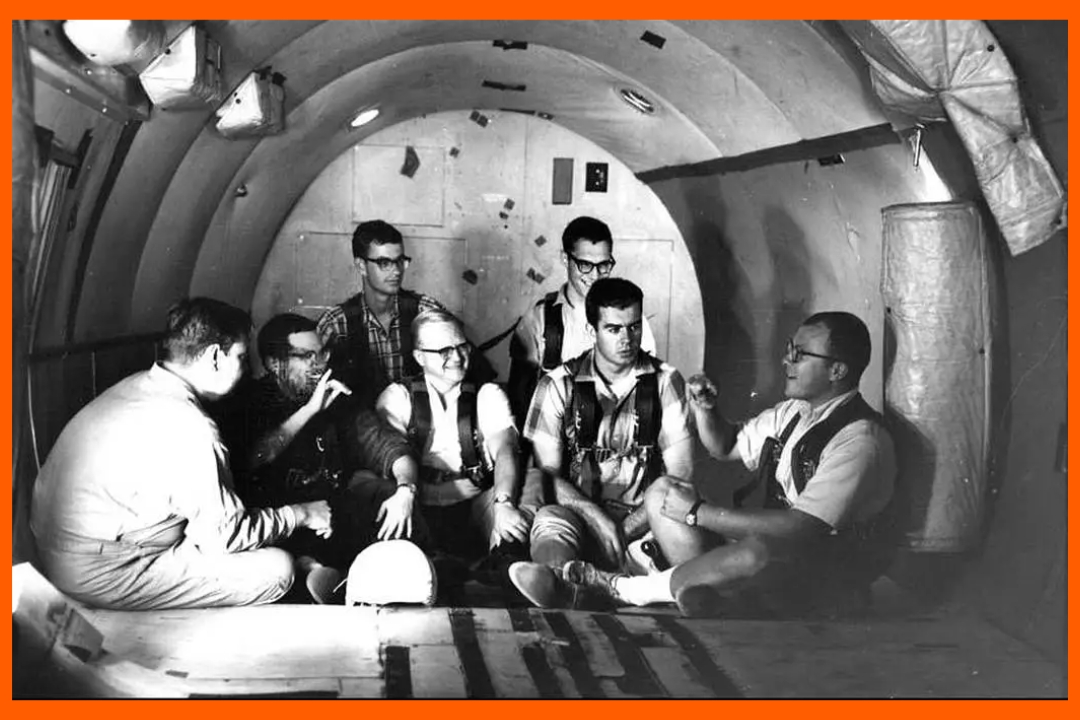
We are constantly being reminded of Isaac Newton’s famous quote, “If I have seen further, it is by standing on the shoulders of giants.” Eleven such giants were recruited as volunteers from Gallaudet University (then Gallaudet College) in Washington, D.C. in 1958. Their task was to help researchers understand the effects of weightlessness on Deaf people who didn’t experience motion sickness.
Deemed the Gallaudet Eleven, they helped pave the way for hundreds of space flights, including the most recent Artemis II. Ranging in age from 25 to 48 years, the eleven men included Harold Domich, Robert Greenmun, Barron Gulak, Raymond Harper, Jerald Jordan, Harry Larson, David Myers, Donald Peterson, Raymond Piper, Alvin Steele, and John Zakutney. Each and every one of them selflessly gave their time and their bodies to what would become monstrous breakthroughs in astrophysics.
Houston had a problem
Actor and Deaf activist, Nyle DiMarco, recently took to social media to share the historical tidbit, lest people forget. In an Instagram reel, he wrote,
“Everyone’s talking about Artemis II. The first humans to travel to the moon in 50 years. Historic mission. But nobody’s talking about the Deaf men who made it possible.
In the late 1950s, NASA had a problem. They needed to understand what weightlessness does to the human body. But every test subject kept getting violently motion sick.
So they came to Gallaudet.
Eleven Deaf men. Most of them had lost their hearing to spinal meningitis as children, which also damaged their vestibular system. Their inner ears couldn’t be overwhelmed. They were immune to motion sickness.
NASA put them in centrifuges. Zero-gravity flights. A rotating room for twelve straight days. One experiment on a ferry in choppy Nova Scotia waters. The researchers got so seasick they had to cancel it. The Gallaudet Eleven? They were playing cards.
Their bodies gave NASA the data it needed to send humans into space.
No Gallaudet Eleven — no Mercury. No Mercury — no Apollo. No Apollo — no Artemis II.
Sixty years later, four astronauts just flew 252,000 miles from Earth and came home safely. They stood on the shoulders of eleven Deaf men most people have never heard of. Now you know! #nasa #gallaudet11 #artemisii @nasa”
The post has already received nearly 400,000 likes and over 6,000 comments. One Instagrammer writes, “Diversity in all its forms is what makes us great. And all of us working together is what helps us advance as a civilization! Thank you for sharing this and bringing visibility to this piece of history, and thank you Gallaudet 11 for your contribution.”
The tests
The official NASA website shared some of the tests in which the brave volunteers took part. “One test saw four subjects spend 12 straight days inside a 20-foot slow rotation room, which remained in a constant motion of ten revolutions per minute.”
Then, of course, there were the zero-g flights. “In another scenario, subjects participated in a series of zero-g flights in the notorious ‘Vomit Comet’ aircraft to understand connections between body orientation and gravitational cues.”
They even took the volunteers to Nova Scotia to test big waves. “Another experiment, conducted in a ferry off the coast of Nova Scotia, tested the subjects’ reactions to the choppy seas. While the test subjects played cards and enjoyed one another’s company, the researchers themselves were so overcome with seasickness that the experiment had to be canceled. The Gallaudet test subjects reported no adverse physical effects and, in fact, enjoyed the experience.”
“We were young and adventurous”
The test subjects themselves shared their experiences. Barron Gulak reminisced, “In retrospect, yes, it was scary…but at the same time we were young and adventurous.”
On DiMarco’s identical Facebook post, Harry Larson’s child, “Moose” Larson, shared a photo and wrote, “They were recently recognized with a cool plaque at Gallaudet! My dad is one of them and, funny enough, never really talked about it.” A commenter responded, “I’ve worked with your dad a lot on this project during the museum exhibition several years ago. He’s been so wonderful, always willing to come to events. I’m so glad he’s sharing his story now.”