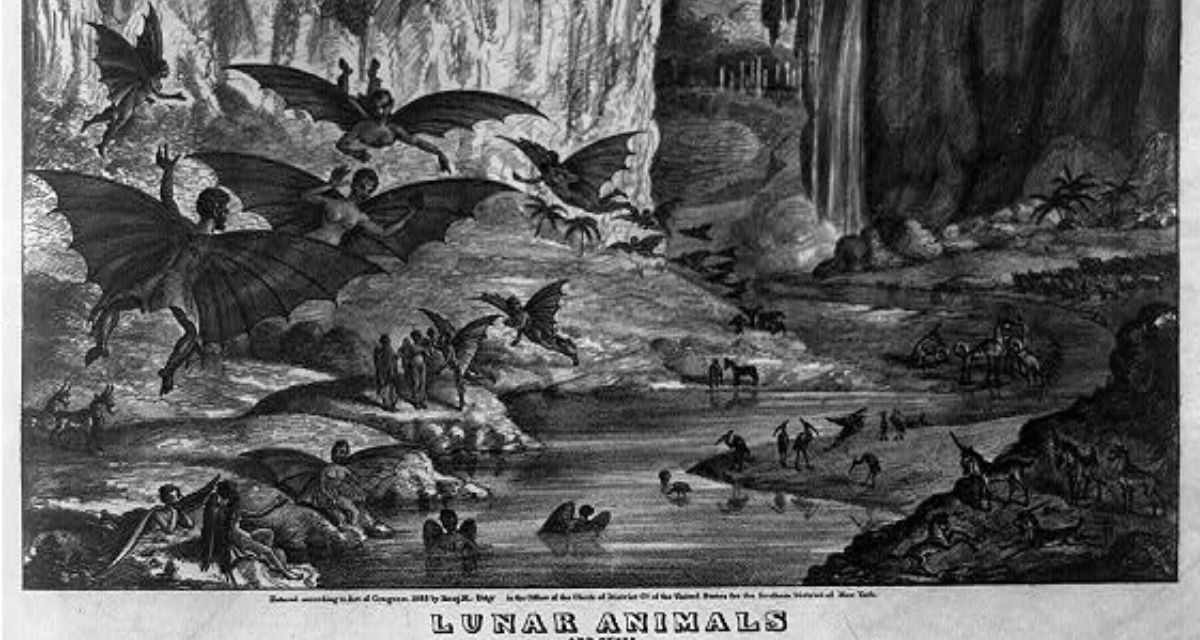
Extraterrestrials fascinate humans, and we are always searching for proof of life beyond our planet. In 1835, a New York City newspaper created one of the earliest media hoaxes, convincing readers that scientists discovered life on the moon. Today, it’s referred to as the Great Moon Hoax.
On August 25, 1835, The Sun printed the first of a six-part series of articles that made headlines worldwide. But it was all fake news.
Claims of life on the moon
British writer Richard Adams Locke wrote the story that deceived the world under the pen name Dr. Andrew Grant, making it appear to be a scientific report. In the articles, Locke described Grant as a colleague of British astronomer Sir John Herschel—the man who discovered the planet Uranus, according to Britannica. Locke wrote that Grant was helping Herschel with his research and had the inside scoop.
Writing as Grant, Locke reported that Herschel built an “immense” telescope to observe the moon from Herschel’s South African observatory, and what he found was truly shocking. To make the claims seem more legit, Locke alleged that Herschel’s findings had been submitted to the British Royal Society and appeared in the Edinburgh Journal of Science.
Locke (pretending to be Grant) declared, “We will state at once, that by means of a telescope of vast dimensions and an entirely new principle, the younger Herschel, at his observatory in the Southern Hemisphere, has already made the most extraordinary discoveries in every planet of our solar system…has obtained a distinct view of objects in the moon, fully equal to that which the naked eye commands of terrestrial objects at the distance of a hundred yards…has affirmatively settled the question whether this satellite be inhabited, and by what order of beings.”
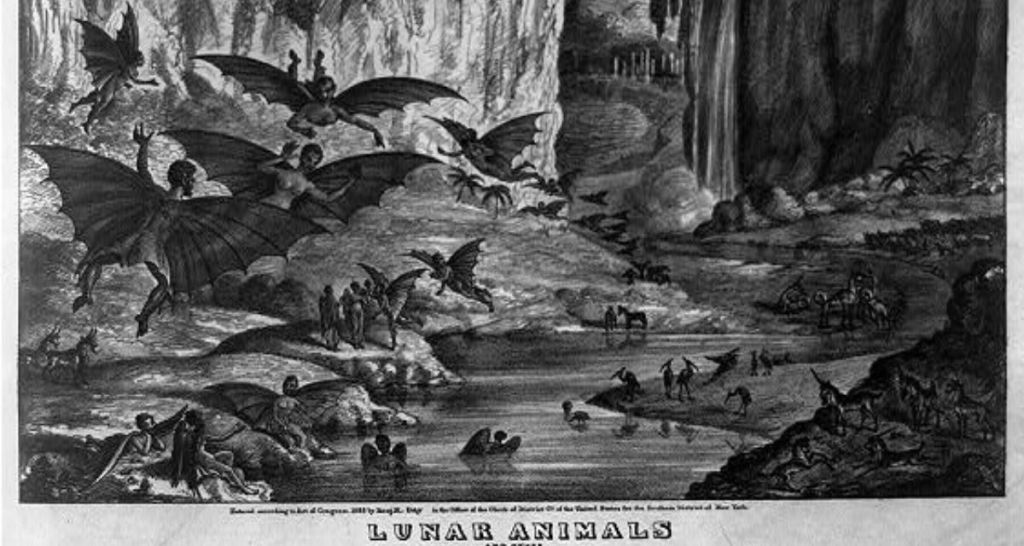
Photo credit: Library of Congress
The ‘lunar animals’
Readers were hooked. The Sun‘s usual distribution was 8,000, but by day three of the articles, circulation approached 15,000, according to The New York Times.
Locke’s vivid descriptions of the creatures and the landscapes Grant and Herschel allegedly saw on the moon sucked people in.
“In the shade of the woods we beheld continuous herds of brown quadrupeds, having all the external characteristics of the bison, but more diminutive than any species of the bos genus in our natural history…Its tail was like that of our bos gruniens; but in its semi-circular horns, the hump on its shoulders, the depth of its dew-lap, and the length of its shaggy hair, it closely resembled the species to which we have com-pared it,” he wrote.
Then there were the human-bat hybrids. Locke described how Grant and Herschel “were thrilled with aston- ishment to perceive four succes- sive flocks of birds descend with a slow, even motion from the cliffs… About half the first party had passed from our canvas, but of all the others we had a perfectly distinct and de-liberate view…They averaged four feet in height, were covered, except on the face, with short and glossy copper-colored hair, and had hair, and had wings composed of thin membranes without hair, lying snugly [sic] upon their backs, from the top of the shoulders to the calves of the legs.”
Locke also wrote that the moon was home to unicorns, “thirty-eight species of trees, more than seventy different plants, nine mammal species, and five kinds of birds.” According to The University of Michigan’s William L. Clements Library, in the final stories he also reported the discovery of a large temple made of blue stone.
The end of the hoax and the fallout
On day six of his reporting, Locke sadly informed readers that Herschel’s telescope was destroyed by sun rays, which burned a hole “fifteen feet in circumfer- ence” through its reflecting chamber.
A few days later, The New York Times noted that Locke admitted his authorship in an unguarded moment while chatting with a reporter for the Journal of Commerce. The jig was up.
Locke claimed he wrote the articles as satire and never thought people would actually believe his stories. He asserted that he parodied other writers who, at the time, were hotly debating whether life could ever exist on the moon.
The New York Times reported that, rather than turning against Locke, the public seemed “more amused than offended.” Locke would go on to publish all six of his articles in one volume in 1859, titled The moon hoax, or A discovery that the moon has a vast population of human beings.