Did you know there's a Guinness world record for the most people making sandwiches simultaneously?
I mean, of course there is; the Guinness Book of World Records was literally invented to entertain people with inane information while they're hanging out with friends.
Still, most of us probably don't think about simultaneous sandwich-making, especially not on a massive, record-breaking scale.
But then, most of us didn't create a brilliant dining app that saves people money when they eat out and also helps to feed the hungry at the same time.
A photo posted by TangoTab (@tangotab) on
That's the basic idea behind TangoTab, a Dallas-based startup that connects people and food when they need it.
Founded in 2011 by Andre Angel, a successful serial entrepreneur, TangoTab is a free app that lets restaurants offer discounts, coupons, and other incentives to diners, usually during off-peak hours.
It's a great model. Diners get some kind of perk like a free appetizer then spend more money on other delicious cuisine. Meanwhile the restaurant brings in business during its downtime, making money it otherwise wouldn't.
But it's not this clever discounting system that makes TangoTab special.
Every time you use the app, TangoTab also feeds a person in need through partnerships with local food banks and national hunger-related charities.
Every day, there are nearly 50 million Americans who don't know where their next meal is coming from. Meanwhile, more than half the country goes out to eat at least once a week, and countless restaurants are struggling to balance their wait-lists with all those hours the dining room is dead. So TangoTab connected the dots and thought: What if we connect all these groups for the benefit of everyone?
Since its inception, TangoTab has provided free meals for nearly 1.5 million people in need, and the operation has expanded from the Dallas/Fort Worth area to include Austin, Houston, New York City, Oklahoma City, San Diego, and the Bay Area, with more restaurants being added every day.
Food. Charity. Discounts. Food. What's not to love?
And as of Feb. 27, 2016, TangoTab also holds the Guinness world record for the most people making a sandwich simultaneously.
(You didn't think I'd forgotten about that part, did you?)
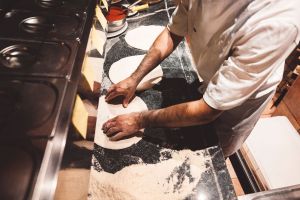
TangoTab rallied more than 2,500 people on a Saturday morning at the Dallas Convention Center, all of whom worked together to build 32,000 sandwiches to benefit area food banks.
This wasn't the first time that TangoTab broke the record, either. They had 1,363 people simultaneously making sandwiches back in February 2014, but their crown was usurped by Subway in August 2015 with 1,481 simultaneous sandwich makers celebrating the company's 50th anniversary.
The fact that a small company like TangoTab could mobilize an additional thousand people with their team of fewer than 20 full-time employees is already pretty remarkable. The fact that they did it all for charity was even better.
The success of companies like TangoTab reminds us what we already know: People like to help each other.
"Feeling good about your purchases and your role in the world" is not just some passing craze. To most of us, making a difference actually matters — and it makes a difference for how we spend our money.
According to Cone Communications, for example, 73% of millennials are willing to try a new product just because it supports a good cause, and 26% are willing to pay more for a product if they know their purchase will have a positive impact in some way. You can look at any of the in-depth research from The Millennial Impact project, and it'll tell you the same thing.
It's the same model followed by companies like TOMs, for example, which gives a pair of shoes to a person in need every time someone purchases a pair of shoes from them. There's also Newman's Own, which donates 100% of its after-tax profits on its delicious drinks and salad dressings to charitable groups for children.







A woman is getting angry at her coworker.via
A man with tape over his mouth.via
A husband is angry with his wife. via 
a man sitting at a desk with his head on his arms Photo by
Can a warm cup of tea help you sleep better? If you believe it, then yes. Photo by 
Three women sit on a blanket in the park. 
Two women engaging in a pleasant conversation inside a coffee shop
Two men engaging in a peaceful disagreement.
Resurfaced video of French skier's groin incident has people giving the announcer a gold medal
"The boys took a beating on that one."
Downhill skiing is a sport rife with injuries, but not usually this kind.
A good commentator can make all the difference when watching sports, even when an event goes smoothly. But it's when something goes wrong that great announcers rise to the top, and there's no better example of a great announcer in a surprise moment than when French skier Yannick Bertrand took a gate to the groin in a 2007 super-G race.
Competitive skiers fly down runs at incredible speeds, often exceeding 60 mph. Hitting something hard at that speed would definitely hurt, but hitting something hard with a particularly sensitive part of your body would be excruciating. So when Bertrand slammed right into a gate family-jewels-first, his high-pitched scream was unsurprising. What was surprising was the perfect commentary that immediately followed.
This is a clip you really just have to see and hear to fully appreciate:
- YouTube youtu.be
It's unclear who the announcer is, even after multiple Google inquiries, which is unfortunate because that gentleman deserves a medal. The commentary gets better with each repeated viewing, with highlights like:
"The gate the groin for Yannick Bertrand, and you could hear it. And if you're a man, you could feel it."
"Oh, the Frenchman. Oh-ho, monsieurrrrrr."
"The boys took a beating on that one."
"That guy needs a hug."
"Those are the moments that change your life if you're a man, I tell you what."
"When you crash through a gate, when you do it at high rate of speed, it's gonna hurt and it's going to leave a mark in most cases. And in this particular case, not the area where you want to leave a mark."
Imagine watching a man take a hit to the privates at 60 mph and having to make impromptu commentary, straddling the line between professionalism and acknowledging the universally understood reality of what just happened. There are certain things you can't say on network television that you might feel compelled to say. There's a visceral element to this scenario that could easily be taken too far in the commentary, and the inherent humor element could be seen as insenstive and offensive if not handled just right.
The announcer nailed it. 10/10. No notes.
The clip frequently resurfaces during the Winter Olympic Games, though the incident didn't happen during an Olympic event. Yannick Bertrand was competing at the FIS World Cup super-G race in Kvitfjell, Norway in 2007, when the unfortunate accident occurred. Bertrand had competed at the Turin Olympics the year before, however, coming in 24th in the downhill and super-G events.
As painful as the gate to the groin clearly as, Bertrand did not appear to suffer any damage that kept him from the sport. In fact, he continued competing in international downhill and super-G races until 2014.
Alpine skiing is a notoriously dangerous sport, with a reported injury rate of 36.7 per 100 World Cup athletes per season, according to a 2018 study. Of course, it's the knees and not the coin purse that are the most common casualty of ski racing, which we saw clearly in U.S. skiier Lindsey Vonn's harrowing experiences at the 2026 Olympics. Vonn was competing with a torn ACL and ended up being helicoptered off of the mountain after an ugly crash that did additional damage to her legs, requiring multiple surgeries (though what caused the crash was reportedly unrelated to her ACL tear). Still, she says she has no regrets.
As Bertrand's return to the slopes shows, the risk of injury doesn't stop those who live for the thrill of victory, even when the agony of defeat hits them right in the rocks.