It’s no secret that there are certain mannerisms and speech patterns we often associate with being gay. The phenomenon of so-called “gay mannerisms” and voice has actually been the subject of quite a bit of scientific research. One study from 2002 found that people were able to accurately predict the sexual orientation of a speaker just by hearing their voice about 62% of the time. Researchers theorize that some, but certainly not all, gay men may adopt more feminine mannerisms and voice patterns as a form of subconscious social signaling.
It’s much more complicated than that, though. The way gay men speak and behave is as diverse and varied as the community itself: which is to say, very.
But one more pressing question remains: If “gay mannerisms” can be categorized and studied, can those of the heterosexual male be quantified? And, more importantly, can they be learned?
Comedic experiment ensues
Content creator Kai Cameron was up to the challenge. The openly gay TikTok star recently launched a tongue-in-cheek 30-day challenge where he attempts to learn how to do and say things “like a straight man.”
On Day 1, Cameron’s brother teaches him how to sit down like a straight man. On Day 4, they move onto answering the phone. Day 7 features more advanced material: entering a party the way a straight man would. Cameron learns to sway his hips less, talk in a deeper tone of voice, and suppress any hint of enthusiasm.
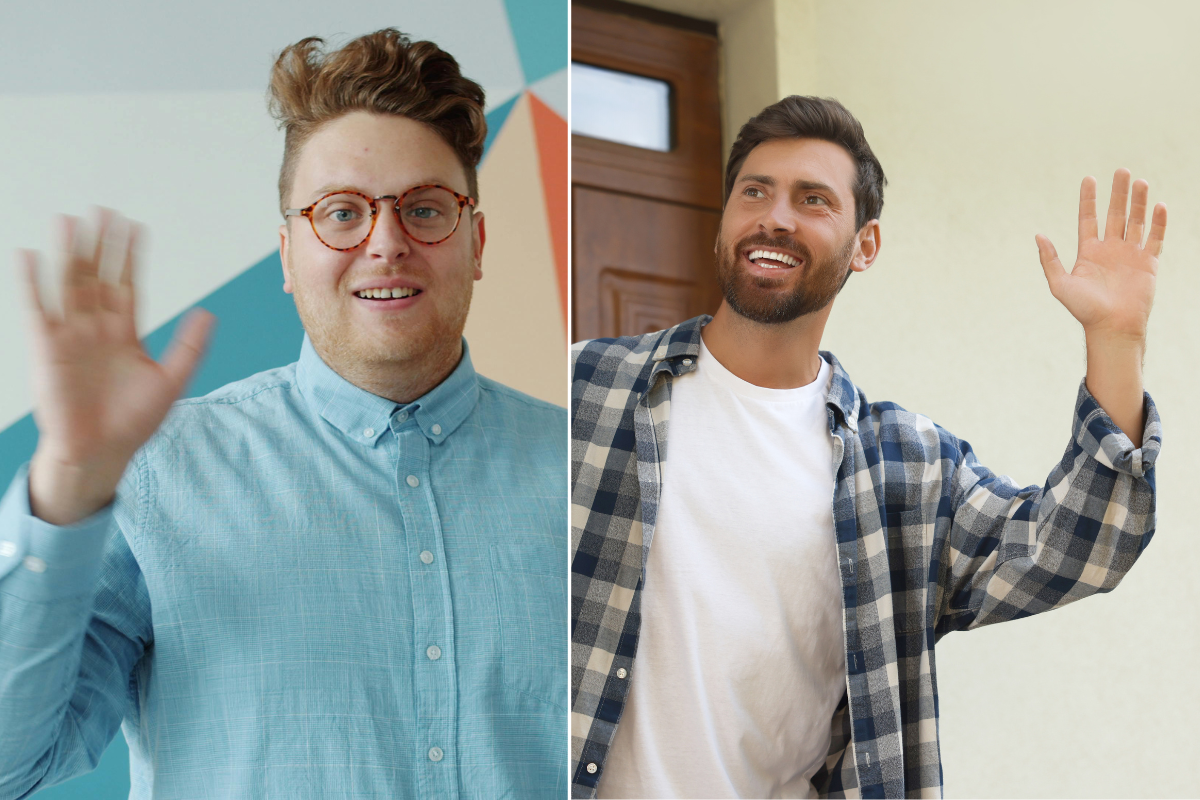
On Day 11, Cameron was ready to tackle the simple but crucial task of saying “Goodbye,” to a friend. His instructor in the clip, this time actor and filmmaker Peter Falls, demonstrates a textbook, nonchalant “Alright, see ya later,” with a barely perceptible hand-gesture-wave-kind-of-thing. Straight guys will instantly recognize it and notice Falls’ impeccable form.
The words come easily enough for Cameron, but he gets stuck on the hand movements. “Can you do the finger thing again?” he asks, before trying it with a dramatic wave. “That’s way too much,” Falls says.
After a little more practice, though, Cameron’s mostly got it. He confidently walks forward, chest puffed out, body stiff, and drops his voice a few octaves before muttering “See ya, man,” with a small (for him) flick of the wrist.
Close enough!
Viewers find the videos hilarious but revealing
Does the video series mine humor at the expense of people who exhibit “gay mannerisms?” On the contrary: thousands of commenters say that it’s rare to see such a brilliant dissection of the straight man.
Many noticed that so much of the demeanor comes from the eyes:
“U just have to lose the light in your eyes,” one commenter wrote.
“I love how the light leaves your eyes everytime and then comes right back,” said another.
“It’s the dead eyes when channeling straight man,” another echoed.
Other viewers went even deeper and more philosophical:
“No whimsy, no enthusiasm, nothing,” someone said.
“Watching [your] content has taught me a lot about what it looks like from the outside to be a straight guy. Just beat up by life. Body language which clearly indicates no one cares about you, so you stay reserved,” one commenter noted.
“I think some cultures have done a ton of damage by brainwashing boys and men into hiding vulnerability, sensitivity or even just being themselves. That takes a psychological toll. A lot of men don’t stay reserved because no one cares but because society (other men) teach them that tough men have to keep it all in. It is not healthy for you,” another said.
A third summed it up: “Basically just act depressed while doing all things and you got it!
The fascinating origins of voice, body language, and mannerisms
Cameron’s social media video series is incredible comedy and entertainment, but it’s also a brilliant educational demonstration.
“Straight voice” isn’t just the absence of the more feminine qualities of “gay voice.” It is, itself, a learned and socially constructed behavior.
“When men enjoy doing things that are typically associated with women or femininity such as shopping, grooming their nails, giggling, etc., they are often quickly labeled as gay or soft and are negatively evaluated by many members of society,” Ayana Ali, a clinical social worker and therapist, told AskMen.
Even many gay men feel self-conscious about their voice and mannerisms, and may even mask them to adopt more traditionally masculine qualities in certain situations.
It’s an incredibly complex web of social conditioning, how we’re raised, biology, sociology, culture, gender norms, and more.
But it’s never been more hilariously deconstructed than in Cameron’s 30-day challenge.