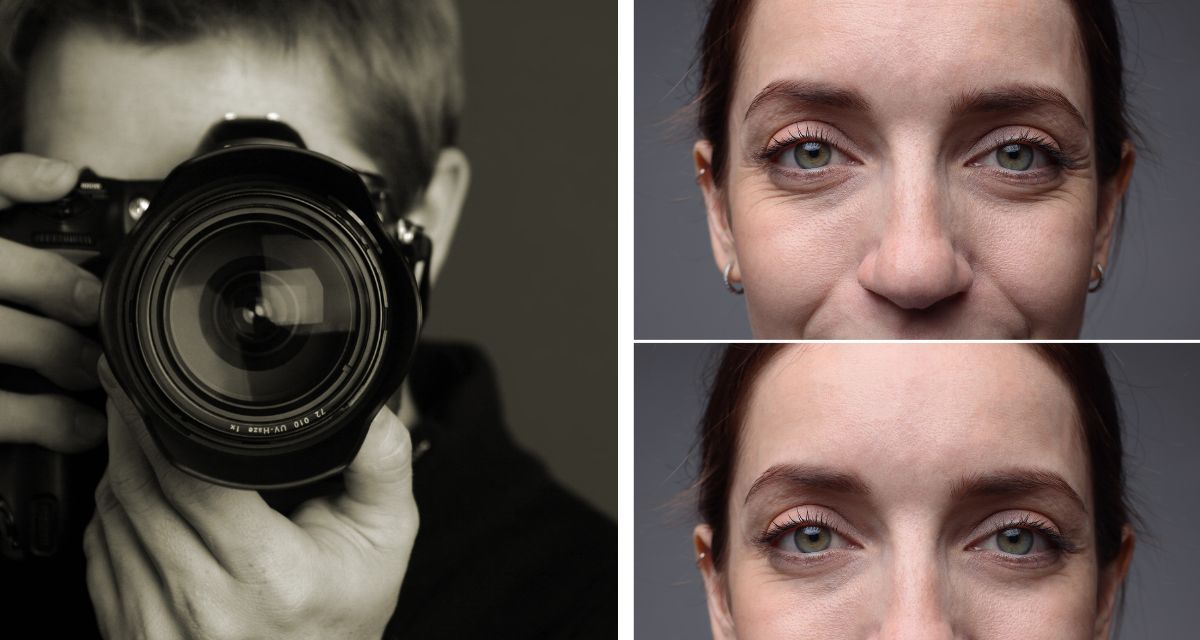
A picture is worth a thousand words, or so the saying goes. But sometimes those thousand words reveal more about the person looking at the picture than the person in it. Back in 2013, Australian photographer Jay Weinstein explored that idea in his project, so i asked them to smile. As the title implied, the series paired portraits of strangers taken before and after he asked them to smile.
The idea came to Weinstein while wandering the streets of Bikaner, India, his longtime home. He noticed an interesting-looking man standing near some motorcycles and wanted to photograph him, but felt hesitant to ask. Just then, the man shouted, “Take my picture too!” and, instinctively, Weinstein responded, “Smile,” before snapping a photo.
Weinstein then had two images: one of the man smiling and one of him with a straight face. Seeing the images side by side, he couldn’t help but notice how vastly different they were. In essence, it felt like he had photos of two entirely different people.
The same face can tell an entirely different story
He began exploring this idea by photographing strangers around the world, from China to Singapore, Australia, Kenya, Nepal, and beyond. Each time, he would snap a photo before and after asking these strangers to smile.
The collection of side-by-side portraits became an intriguing thought experiment about first impressions. They show how quickly we fill in the blanks when looking at an image. Research from the University of Glasgow suggests that we naturally look for meaning in faces, even when a neutral expression gives us relatively little information. Add a smile, and the same face can suddenly seem more open and approachable, even though the person hasn’t told us anything new about themselves.
That’s what makes this series so effective. The second photograph doesn’t necessarily tell us more about the person. Instead, it gives us a chance to notice how quickly we change our interpretation when we’re given one additional piece of visual information.
Over the course of the project, Weinstein would also notice differences in how different cultures respond to smiling for the camera
In Fort Kochi, India, for example, people would sometimes smile while talking with Weinstein, then lose their smiles when he raised the camera. Once he lowered it, the smiles returned.
Meanwhile, in Beijing, young people were often completely comfortable being photographed and would happily offer a grin and a playful pose.
In rural Chinese villages, older people often wanted to check a mirror before agreeing to be photographed. People in rural Indian villages, however, often posed immediately. In Bengal, he noticed people sometimes smiled and then covered their teeth with a hand while being photographed.
The project has taken a few unexpected and delightful (even profound) pivots since it started
Weinstein eventually turned the project into a traveling photography exhibition, bringing his portraits to audiences around the world. Then the COVID-19 pandemic made travel difficult and put masks over the smiles that had become central to his work. In a 2021 interview, Weinstein said the collective experience made the project “even more relevant,” because “the common smile we took for granted” was suddenly hidden from view.
Then, while photographing strangers in Kenya, one man turned the camera on Weinstein and asked to take his photograph. He even asked Weinstein to give him the same smile he had requested from strangers for years. A fitting twist, to say the least.
In the end, Weinstein’s photographs don’t give us the answers to who these strangers are. But they do give us a chance to acknowledge how quickly our minds try to find those answers, and how easily one small change can make us reconsider the story we’ve already started telling ourselves.
Be sure to follow the ongoing so i asked them to smile project on Instagram for even more thought-provoking images.