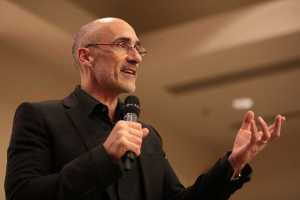
Robert Kaplinsky is one of the most sought-after and referenced math educators in the world. He’s a longtime teacher who specializes in empowering students and encouraging deeper-level thinking.
So it’s no surprise that he loves to challenge his students with difficult puzzles, logic tests, and riddles.
Teacher challenges students with ‘nonsensical’ shepherd riddle
Years ago, Kaplinsky shared a post on his blog about how he presented his students with an impossible puzzle.
The question seemed simple enough: “There are 125 sheep and 5 dogs in a flock. How old is the shepherd?”
Professor Katherine K. Merseth created the riddle in 1993 based on research conducted in the 1980s.
Most students calculate a numerical answer to the problem
It’s clear to most adults that the shepherd problem does not include enough information. The number of sheep and dogs has nothing to do with the shepherd’s age. He could be 25, 57, 80, or 102. The numbers provided in the problem are mostly unrelated.
But that’s the trick of the problem.
Kaplinsky had read the research and hypothesized that about half of his students would calculate an answer using the numbers presented in the problem.
It turned out to be even more. Closer to 75% of students answered with a concrete number. What’s fascinating is that the kids ran the gamut, covering nearly every possible computation with the numbers 125 and 5.
Kaplinsky writes:”2 students calculated the answer to be 130 (125 + 5) … 2 students calculated the answer to be 120 (125 – 5) … 12 students calculated the answer to be 25 (125 ÷ 5)”
A couple of students just guessed, choosing not to calculate anything at all.
There was just one student who very nearly got it.
Only one student (almost) figured out the problem
One of Kaplinsky’s students initially answered that the shepherd was 120 years old, the total they arrived at after subtracting the number of the dogs from the sheep.
But then, Kaplinsky writes, the student realized that it couldn’t be correct and made a second attempt.
“The student who got 120, then said that you don’t have enough information to figure out the shepherd’s age.”
However, even though the student was so close to getting it, they ultimately guessed 90 years old. Kaplinsky says the student was “uncomfortable” with not providing an answer to the question.
Professor Merseth writes in her essay that about three out of four schoolchildren will provide a numerical answer to the impossible problem, which matches Kaplinsky’s result exactly. She, too, found the most common answer to be 25—because 120 and 130 were considered too old.
So what’s going on here? Why does this nonsensical riddle trip up so many kids, and what can we learn from it?
Merseth’s paper addresses misconceptions students in America have about mathematics and why American kids routinely perform below many of their international peers in the subject.
“In a child’s world, mathematics is seen as a set of rules — a collection of procedures, actually — that must first be memorized and then correctly applied to produce the answer,” she writes. “How frequently teachers see this eagerness to begin writing and manipulating numbers before the situation is fully understood!”
It’s not the students’ computation that’s the problem. It’s their understanding of what the question is asking, given the information it provides. But even beyond that, it’s a question of something Kaplinsky calls “intellectual autonomy.”
“Many of the students knew I was crazy for asking them this question, yet they felt like they couldn’t question the questioner and were obligated to answer me,” he writes. “So, they repressed that feeling and gave me an answer anyway. That’s certainly not where we want students to be.”
Studies have shown this doesn’t just affect children. In the famous Asch Conformity Experiments, participants would willingly go along with an obviously wrong answer to a test if others in the room did.
Funny enough, about 75% of volunteers felt pressure to conform; similar results to the shepherd problem.
It takes courage to break from the pack or confront an authority figure when you think they’re wrong. Kaplinsky’s use of the shepherd problem not only encouraged the kids to think more critically and understand problems holistically before trying to solve them, but also taught them a valuable lesson in trusting their instincts.