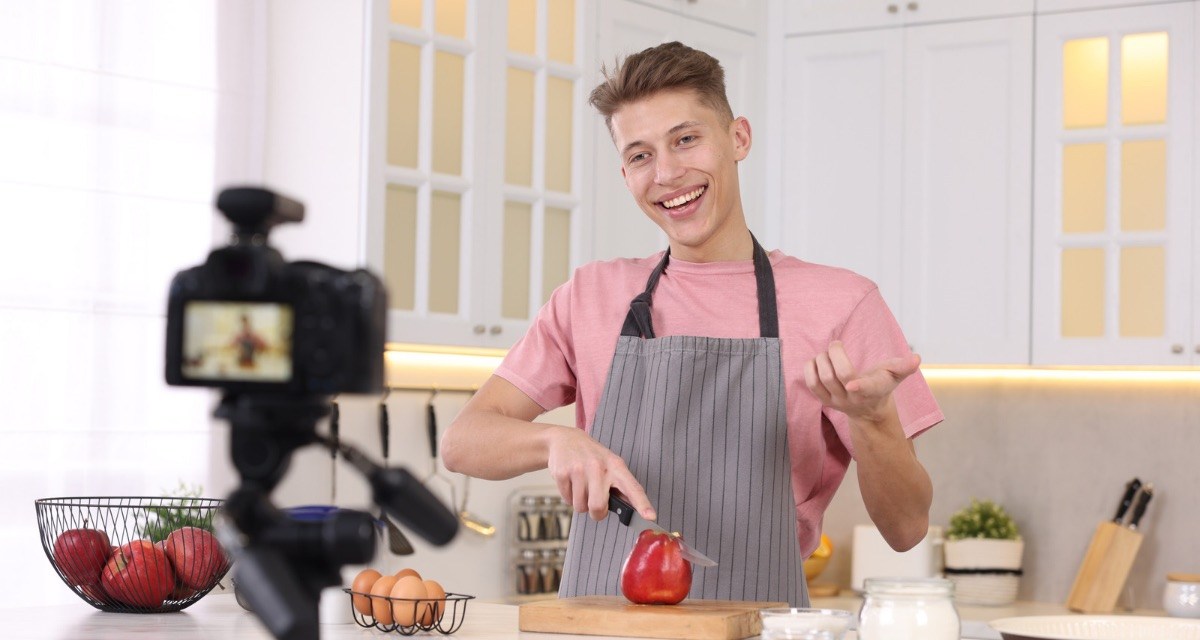
You’re scrolling through your Facebook, Instagram, or TikTok feed when a strikingly handsome food influencer catches your eye. He’s in the kitchen mixing ingredients, explaining the nutritional benefits of each, and making a delicious-looking, healthy recipe you definitely want to try.
The only problem is, he’s not real. And neither is that recipe.
A loved one recently sent me a Facebook Reel from an account called Nico Reeves Health. The page has 17,000 Facebook followers. The person who sent it to me thought the recipe looked “Yum.” But to me, it felt “off.”
The guy was too beautiful. The finished recipe looked too perfect. I checked out a few other videos on the Facebook account, and it quickly became clear that the entire account was AI-generated.
I found an Instagram account with the same name that has only eight followers and a few videos. On Instagram, the account profile is clearly labeled as AI-generated. On the Facebook page, it is not. The Facebook video I was sent has over 865,000 views—quite a revenue generator for the account. But it’s fake, fake, fake.
How to spot an AI-generated account
Many of these videos have an “AI content” label, but most people won’t assume that means the entire account is AI-generated.
In the early days of AI content, it was pretty easy to spot when an image or video was fake. People in them had extra fingers and limbs, faces didn’t look real, and so on. Now, AI-generated people may look slightly too perfect, but even that’s changing. It’s getting harder and harder to tell whether a person in a video is real, and it’s only going to get more difficult.
Some people insist they can tell when a person is AI-generated by their eyes. That may be true most of the time, but AI-generated people are becoming more realistic every day. There’s still a slightly uncanny quality to AI-generated people, something that’s hard to pinpoint but just feels “off,” but how much longer will that be the case?
Another AI-generated health account, Marlon Cade Health on TikTok, is quite convincing at first blush. Check this out:
The TikTok profile says Cade is a “Retired NFL Nutritionist” who shares “Simple habits. Real food. Better living.” The page has over 200,000 followers. The profile doesn’t mention AI use, but individual videos include a note that says “Creator labeled as AI-generated.” Still, many people in the comments can’t tell that the guy himself isn’t a real human.
At this point, it’s not the “people” in these videos, but everything else that provides the clearest AI “tells.” Here’s what to look for:
The devil’s in the (background) details
When we look past the person and focus on the background in these videos, especially across multiple clips, it becomes much clearer that they are AI-generated.
Every Nico Reeves video has an American flag in the background, but in a couple of videos, there are two U.S. flags, one right on top of the other. That alone is weird. But if you look at the bottom flag, the number of stars is wrong. In the first video in this article, the flag behind the speaker only has 11 stripes instead of 13, like a real flag. AI struggles to consistently get the flag right.
Another big tell is the kitchen itself. In some videos, the cabinets are green; in some, they’re white; in some, they’re oak. Countertops change, too.
In the Marlon Cade videos, small inconsistencies in his tattoos, both within and between videos, are a dead giveaway. The details in his intricate right arm sleeve change, and some small tattoos on his left arm or chest appear and disappear at different times. You wouldn’t notice it unless you looked for it. (And judging by many commenters, they’re too busy gazing at his beautiful eyes to notice much else.)
Looking around throughout each video and comparing details across them is key to spotting an entirely AI account.
The problem with AI-generated ‘health’ accounts
Another big giveaway with these accounts, once you watch enough videos, is how unrealistic many of the recipes and other food tips are. Some are perfectly fine, but others don’t really make sense, and the finished product definitely would not come out the way they show.
Of course, there’s a lot of conflicting health and nutrition information out there anyway, but when an account is entirely AI-generated, where is the accountability?
These accounts claim to be sharing how food affects health, immunity, longevity, and more, but in reality, they’re money-making machines. Not only do they generate revenue with video views (the Marlon Cade Health account has many videos with hundreds of thousands and even millions of views), but they also direct-message commenters who respond with the prompt word (such as “yes” or “recipe”) to get them into a sales funnel for books, subscriptions, and more.
It’s one thing for an actual nutritionist to create real videos to sell a real product. It’s entirely another for who-knows-who with who-knows-what credentials to create an AI-generated account to sell a product that is most likely also AI-generated. Sure, it’s grifty, but it could also be unsafe.
I don’t love giving these accounts more views by sharing them, but we’ll be seeing more and more as AI gets more convincing. It’s good to know what to watch for in the meantime, and to share this information with our loved ones so they don’t find themselves duped.