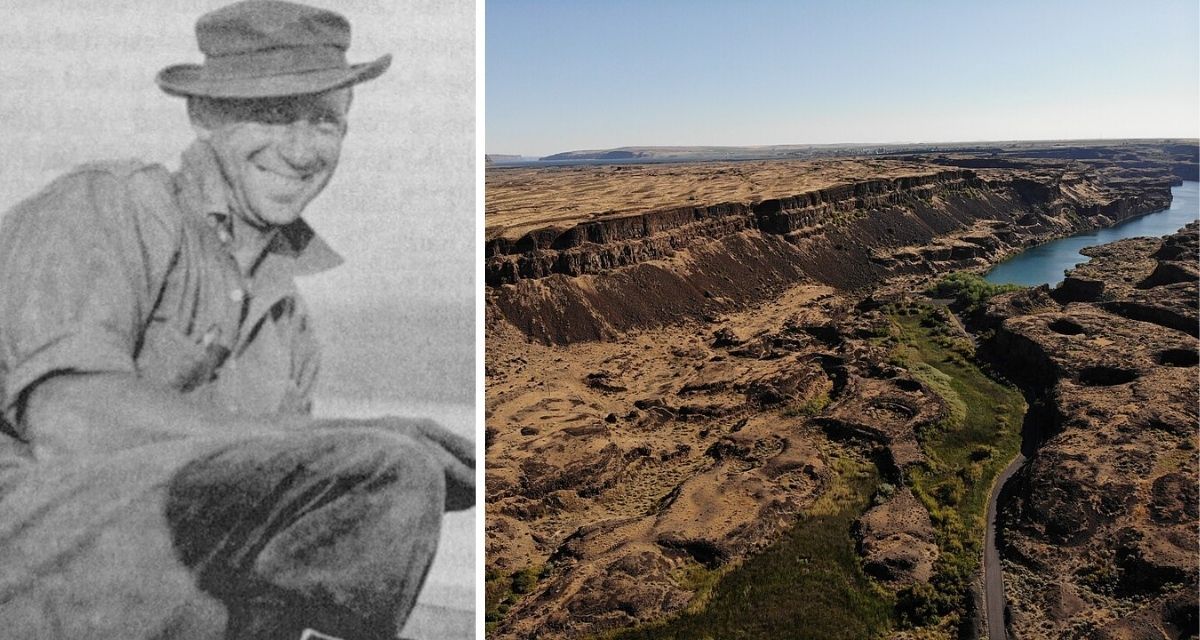
When geologist J. Harlen Bretz proposed the idea that the rugged canyons and buttes of Eastern Washington weren’t formed gradually, but carved out in days by a cataclysmic flood, his colleagues called him a quack. Everyone in 1923 knew that geology is measured in millennia, not days. Massive canyons and buttes simply could not be created overnight.
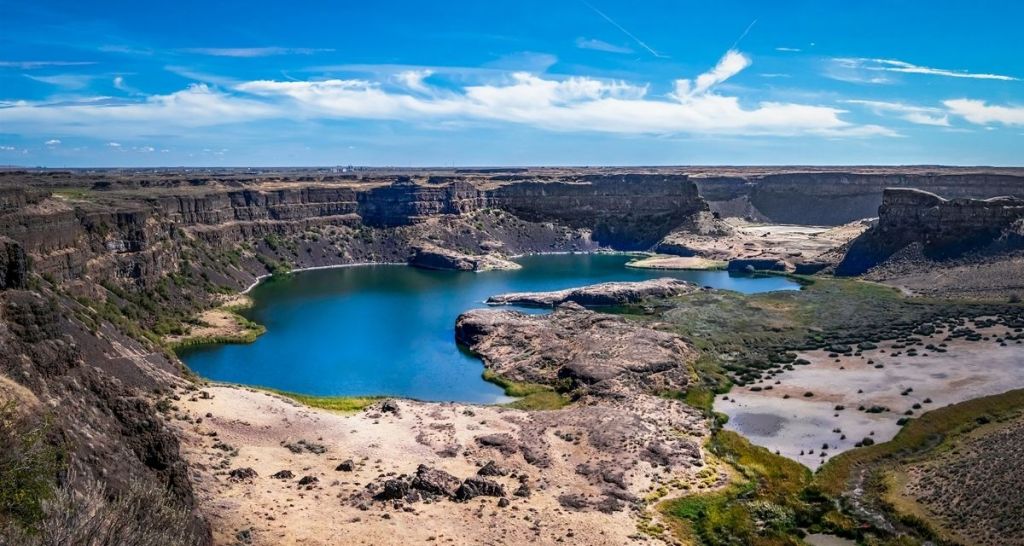
Bretz would spend over a decade being ridiculed for his “preposterous” idea, but he was right. The Channeled Scablands of Eastern Washington were indeed created by flood. Bretz had spent years conducting on-the-ground fieldwork, mapping out the region’s unique topography with remarkable precision. He saw what those who had never visited the area couldn’t—channels instead of valleys, dramatic erosive changes that were “nothing short of amazing.”
The only problem? He couldn’t figure out where that cataclysmic floodwater could’ve come from.
Explaining Washington’s most unexpected landscape
Most people associate Washington with evergreen forests, misty mountains, and rain, but only part of the state has those features. Much of Eastern Washington is exactly the opposite: arid, sunny high desert as far as the eye can see, a barren, sagebrush-covered landscape that looks nothing like Twilight or Twin Peaks.
Bretz found Eastern Washington’s topography fascinating. Every summer, he took students to study the deep basalt canyons, mysteriously rippled bedrock, giant coulees, glacial erratics, and other geologic oddities that other scientists didn’t bother to examine closely. He named the region the Channeled Scablands, a nod to the land’s partially healed wounds from a major catastrophe.
Years of detailed observation made it clear to Bretz that a flood of gargantuan proportions had sculpted this land. But it took another geologist, Joseph Pardee, to find the flood source: Glacial Lake Missoula in Montana.
The massive flood that formed the Channeled Scablands
Montana is two states away from Washington…how big a flood are we talking about?
Big. Huge. Glacial Lake Missoula was the size of Lake Erie and Lake Ontario combined, formed when the Clark Fork River backed up and pooled behind a 2,000-foot-high ice dam. Near the end of the last Ice Age, that ice dam broke, and the lake emptied westward in two days. Here’s how the National Park Service describes that event:
“A wall of water hundreds of feet high thundered downstream at 65 miles per hour (105 km/hour) with ten times more water than all the world’s rivers today. This massive flood of water, ice, and debris shook the ground as it raced westward over 16,000 square miles (41,440 km2) in present-day Montana, Idaho, Washington, and Oregon.”
The force of that volume of water being released all at once would indeed be cataclysmic. For anyone living nearby 15,000 to 18,000 years ago, it would have felt downright apocalyptic.
At first, Bretz believed that a single flood had carved out this topography, but it eventually became clear that Lake Missoula actually backed up and flooded multiple times.
Bretz was vindicated, finally getting his flowers at age 97
When Bretz proposed his flood theory, mainstream geologists firmly held to the idea of uniformitarianism, the belief that geologic formations formed over thousands or millions of years. Bretz’s catastrophism proposal—the idea that a cataclysmic event could shape a landscape dramatically in a short period of time—was brushed off as unscientific.
“Bretz became a pariah to other members of the geologic community who preferred to envision scenarios of slow, gradual change over hundreds of thousands of years, not a short-lived flood that smacked of Biblical catastrophe,” Bretz biographer John Soennichsen wrote in his Channeled Scablands guidebook.
Ultimately, Bretz was vindicated. His discovery changed geology and what humanity thought was possible. However, it took until the 1970s for catastrophism to be fully accepted in the geology world and for Bretz to be fully recognized for his contributions. In 1979, at age 97, Bretz was awarded the Penrose Medal, the Geological Society of America’s highest award.
He said of receiving the award: “Perhaps I can be credited with reviving and demystifying legendary catastrophism and challenging a too rigorous uniformitarianism.” He also reportedly joked to his son, “All my enemies are dead, so I have no one to gloat over.”