upworthy
Add Upworthy to your Google News feed.
Google News Button
More

11 fascinating facts—and one myth—about the American flag that you probably didn't know

Did you know this famous symbol of freedom came from a B- school project?

America, flag, facts, history
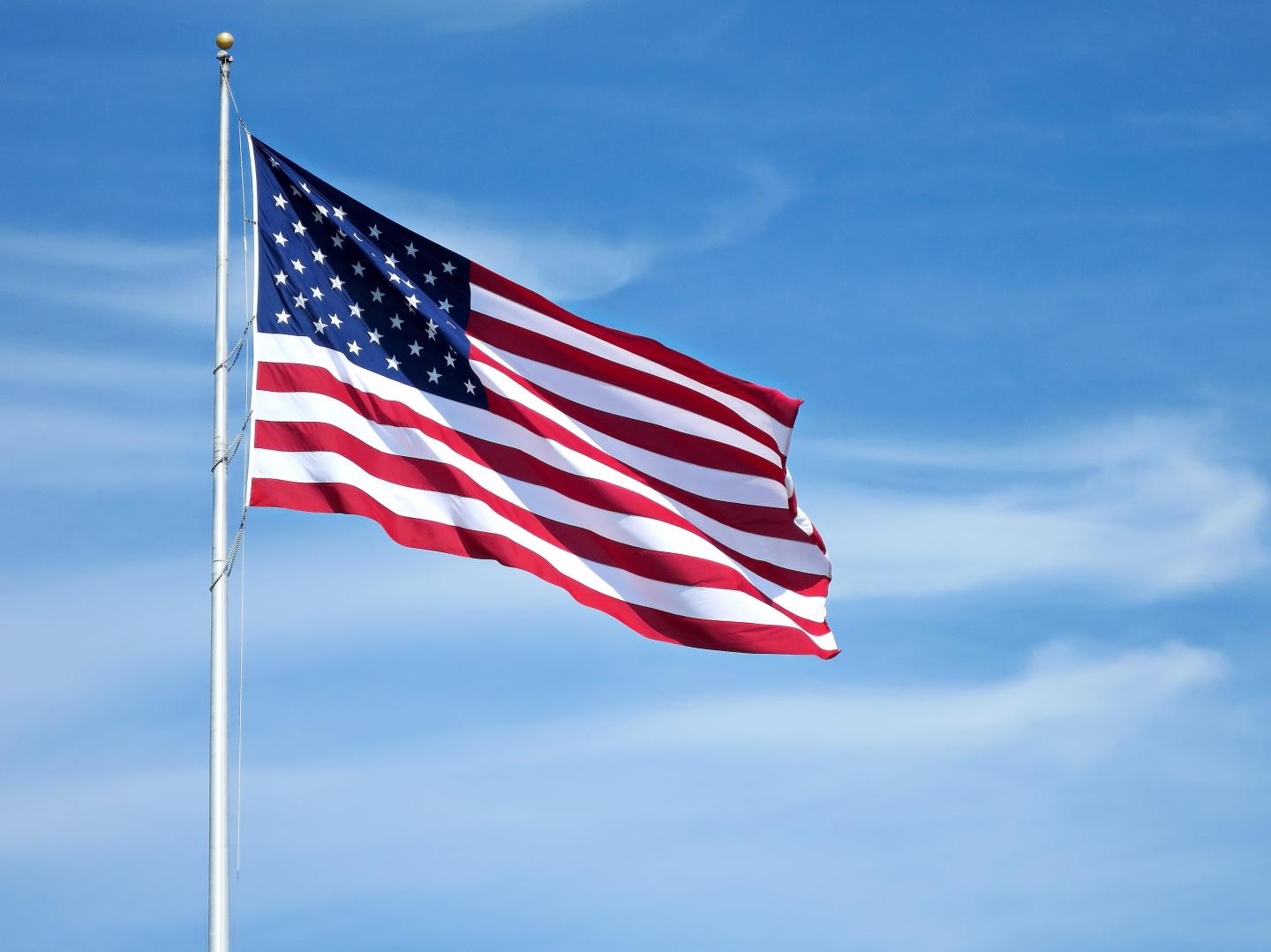
Photo by Robert Linder on Unsplash

There's a whole lot of story behind the American flag.

The Stars and Stripes, Old Glory, the Star-Spangled Banner — whatever you call it, the United States flag is one of the most recognizable symbols on Earth.

As famous as it is, there's still a lot you might not know about our shining symbol of freedom. For instance, did you know that on some flags, the stars used to point in different directions? Or that there used to be more than 13 stripes? How about a gut-check on all those star-spangled swimsuits you see popping up in stores around the Fourth of July?

We'll explore these topics and more in this fun list of 12 facts about the U.S. flag that you might not know about.


1. Betsy Ross, the woman often credited with sewing the first American flag, probably didn't — or at the very least, there's no proof that she did.

Legend has it that in 1776, a seamstress named Betsy Ross was approached in her shop by George Washington himself and was asked to help develop a flag for this soon-to-be-nation. Supposedly, she rejected the designs Washington presented to her and made a number of suggestions that would end up in the final version of the first American flag.

It's a great story that humanizes Washington as a man humble enough to take feedback and gives Ross a boost as being uncharacteristically assertive for a woman in 18th-century America.

But the bad news is that this probably never happened. It was nearly 100 years before anybody spoke of Betsy Ross or her role in designing the flag. Most of what we know of this story came from her grandson, William Canby.

Unfortunately, though historians have long tried to verify any of the facts involved in Canby's story, there's nothing to suggest that Washington set out to commission a flag in 1776. In fact, it wasn't until 1777 that Congress even passed a resolution ordering a flag to be made. Sure, it's possible that Camby's account of his grandmother's story happened, but it's more likely that this is simply an unverifiable piece of American lore.

2. It wasn't until 1912 that the government standardized the proportions of the flag and the arrangement of its stars.

While most countries's flags are rectangular, there are a few exceptions. In 1912, President Taft issued an executive order creating a uniform look for the flag — as prior to that, there were some interesting designs, with multiple flags sometimes in use simultaneously.

The executive order mandated that stars on the flag point upward, all in the same direction, and be placed in six horizontal rows of eight.

3. We all know the flag has 13 stripes, but for 23 years, it had 15.

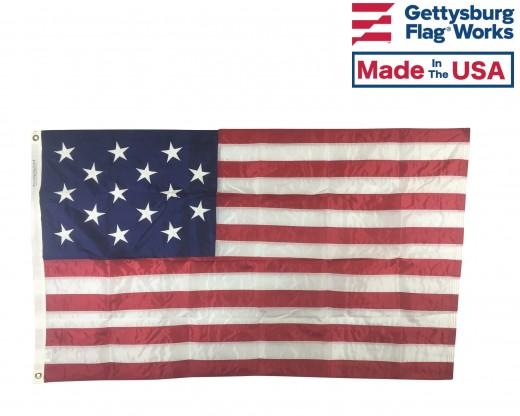
Up until 1795, the flag had one stripe and one star for each of the 13 states. After Vermont and Kentucky were added to the union in 1791 and 1792, respectively, the flag was due for its first major redesign in the country's history. Not only were two stars added to the blue field to represent the new states (a tradition that continues to this day), but designers also added two stripes.

The 15-star, 15-stripe flag existed from 1795 until 1818, when five more states were added. Designers realized that adding more stripes would quickly become unwieldy, so they dropped the stripe count back to 13.
Kentucky, Vermont, American flag, Union, 1795

After Kentucky and Vermont joined the union 2 stripes and stars were added to the flag.

www.gettysburgflag.com

4. We still honor the 15-star, 15-stripe flag today, as it's the specific flag that inspired Francis Scott Key to write "The Star-Spangled Banner."

The outcast of all American flags lives on through the power of song. Key wrote "Defence of Fort M'Henry," a poem about his experience watching from the Baltimore harbor as an American fort took fire from British troops during the War of 1812. In 1916, more than 100 years after its first publication, Key's poem became our national anthem.

5. Yes, the Flag Code is the law. No, there's no penalty for breaking it.

The U.S. Flag Code was signed into law by President Roosevelt on June 22, 1942. While it's filed under Title 18 of the U.S. Code ("Crimes and Criminal Procedure"), the Flag Code exists as more of an etiquette guide than anything else.

So if you leave your flag up past sundown, that's technically illegal — but no one's going to arrest you for it.

6. When it comes to showing respect for the flag, there are 11 specific instructions to follow.

There's a whole section of the U.S. Flag Code on how to show respect for the flag. Since this is a topic that gets discussed quite a bit lately, it's worth a quick review of some of the highlights:

  • Unless you're trying to signal distress "in instances of extreme danger to life or property," you shouldn't display it with the union (the field of blue with white stars) facing downward.
  • The flag should never touch the floor and should never be carried horizontally or flat, but "always aloft and free."
  • You're not supposed to wear the flag nor print its image on "anything that is designed for temporary use" (napkins, for example). Don't use it in advertisements, either.
  • "No part of the flag should ever be used as a costume or athletic uniform."

7. You're supposed to fly the flag on Christmas.

The Code says that "the flag should be displayed on all days," but puts special emphasis on the following holidays: New Year's Day, Inauguration Day, Lincoln's Birthday, Washington's Birthday, Easter, Mother's Day, Armed Forces Day, Memorial Day (the flag should be displayed at half-staff until noon), Flag Day, Independence Day, Labor Day, Constitution Day, Columbus Day, Navy Day, Veterans Day, Thanksgiving, and Christmas.

The Code adds that states should display the U.S. flag on the anniversary of their admission to the union, on state holidays, and on any day observed by presidential proclamation.

8. If the U.S. ever adds a 51st state, the flag won't be updated until the following Independence Day.

The flag won't be getting any major redesigns in the near future, save for the addition of a star here and there. The Code reads:

"On the admission of a new State into the Union one star shall be added to the union of the flag; and such addition shall take effect on the fourth day of July then next succeeding such admission."

9. Flag Day dates back to the 1880s but wasn't made an official U.S. holiday until 1949.

It's thought that schoolteacher Bernard J. Cigrand was the first person to celebrate Flag Day, commemorating the 108th anniversary of the 1777 Flag Resolution (which outlined the flag's basic design) on June 14, 1885. The tradition caught on among schools and, eventually, states.

In 1916, President Wilson established Flag Day through proclamation. In 1949, Congress passed and President Truman signed a bill making the holiday official.

10. The design for the current 50-star flag came from a high school student's U.S. history project — which initially got a B-.

In 1958, Bob Heft was a junior in high school. In a 2009 interview with StoryCorps, Heft recounted what happened when he turned in a history project featuring a 50-star flag. Heft's teacher gave him a B-, noting that he had the wrong number of stars on the flag (at the time, there were only 48 states).

When Heft expressed disappointment, his teacher said, "If you don't like the grade, get it accepted in Washington, then come back and see me."

After Alaska and Hawaii became states, the U.S. adopted Heft's flag. He got a call from President Eisenhower and, more importantly, an updated grade on his project.

11. The Pledge of Allegiance was, in part, created as a gimmick to sell U.S. flags to schools.

The pledge's history is fascinating and filled with controversy. Many know that it wasn't until 1954 that the words "under God" were added to the pledge in response to the Red Scare, but what's less discussed is the origin and purpose of the pledge itself.

Socialist minister Francis Bellamy penned the original pledge for an 1892 issue of The Youth's Companion as a way to mark the 400th anniversary of Columbus' journey. The magazine offered U.S. flags to subscribers, and Bellamy and the magazine lobbied public schools to adopt his pledge as a show of patriotism. It was successful, too, selling tens of thousands of new subscriptions and flags. In hindsight, it's a bit ironic that this lasting ode to America began as a socialist's capitalist experiment.

12. No one is sure why we chose red, white, and blue as the color of our flag, but an explanation was made retroactively.

In 1782, Secretary of Congress Charles Thomson explained the significance of the colors red, white, and blue during the design of the official seal of the U.S.:

“The colours of the pales are those used in the flag of the United States of America; White signifies purity and innocence, Red, hardiness and valour, and Blue, the colour of the Chief signifies vigilance, perseverance, and justice."

Ever since, we've just gone with that.


This article originally appeared on 4.3.16

parenting, teens, raising teens, teen hangout, high school, game night for teens, activities for teens, parenthood

Amy White explains how her house became "the house" for her teens.

I grew up in "the house." In high school, my home was the designated place where my friends gathered, sometimes in big groups, sometimes just my small core squad. My three best friends spent the night there almost every Friday and/or Saturday night for four years straight. We devoured Totino's frozen pizzas by the dozen, inhaled soda, and laid waste to any snacks or leftovers that were brave enough to survive in the kitchen. Not only that, but my house was pretty small — four teenage boys took up a lot of space in the living room (the whole thing) and made a lot of noise playing video games deep into the night. It must have driven my parents and older brothers crazy. It's a wonder anyone put up with it.

Or so I thought when I was younger. When I became a parent myself, I started to understand a little more why my mom and dad were so willing to host and feed all my friends and me every single weekend. Why the outrageous grocery bill and constant chaos in the house were probably a small price to pay.


Mom explains how to make your house 'the house' where teenagers hang

One mom has perfectly encapsulated the value of turning your home into "the house" for your kids and their friends, and exactly how she did it for her family.

teens, teen house, teens hanging out, teens having fun, teenagers Teens hanging out in a living room.via Canva/Photos

Amy White shared a reel on Instagram showing her college-aged son hanging in her dining room with a group of friends playing cards. The text overlay reads "What makes your kids' high school friends want to come over, play cards & spend the night on their College Christmas Break." I think most parents can agree that we want our kids to keep coming home as long as possible! So how exactly did White pull this off?

Her explanation in the caption was spot-on.

First, White says that you have to start early. Become "the hang out house" in high school or even earlier. Then you have a better chance of holding onto the mantle into your kid's college years.


Next, be ready to stock the house with snacks and drinks, and don't make a fuss when your kid's friends have at it. "The kids knew we had food," she writes, "BUT they also knew I didn't care what they had. They knew they could eat anything in my pantry and fridge."

Third, and this is a big one, don't mistake being the "cool house" for being "the house." Some parents choose to allow their underage kids and friends to drink alcohol under their supervision, but you don't have to bend your morals and the law to lure the squad over to your place. Pizza and Coke is plenty to keep most teens happy. "We were not the house that served alcohol or even allowed the kids to bring alcohol to our house. And Guess What?? The kids still came and wanted to hang at our house!"

teens, teen house, teens hanging out, teens having fun, teenagers Teenagers eating pizza.via Canva/Photos

Fourth, always say Yes (as often as possible, anyway) when your kids want to have friends over. "They know my answer is 99% of the time YES," White writes. "You have to have your kids take the leadership of offering your home and if your home was 'open' to their friends in high school, they know it will be 'open' to their friends in college."

As a bonus tip, White pleas with parents not to worry about the mess having friends over makes. "I love a clean house and organization, BUT I would much rather have a crazy messy house for the kids where memories are made than a quiet house with nothing going on just to keep my house 'clean.'"

Should parents allow teens to drink at home?

There's an age-old debate over whether parents should allow teens to drink at home because it's better than if they do is unsupervised or keep their home dry as a bone. A recent study out of the University of Buffalo found that kids who grew up drinking at home had a greater chance of having addiction problems when they got older. "A robust relationship was found between parental permission to use alcohol during adolescence and increased alcohol use frequency and quantity, alcohol use disorder symptoms, and alcohol-related harms in young adulthood," the study says.

White writes, "It's worth being 'the house', so let go of control & get to know your kids friends." Commenters agreed.

White's video went viral to the tune of 8.5 million views and hundreds of comments. Parents shared their own experiences of what it's like being the default hang out house.

"Our house was the high school hangout for my son and friends... every weekend... I loved it!! Miss it now that they are all college graduates and have moved away. I love seeing them when they do come home for the holidays"

"A wise man once said don't be the house with the alcohol. Be the house with the food."

"Amy 1000% agree!!! My house is full of teenagers on the weekends and I love every bit of it. Even though I wake up to a kitchen that looked much different from when I left it"


teens, teen house, teens hanging out, teens having fun, teenagers Teenagers eating pizza.via Canva/Photos

"We never allowed alcohol, drugs, bad language, always respectful, and guess what, our house was always the house where the kids hung out. First my daughter, then my son. Through grade school, high school, then when my kids went out of state for college their college friends would come spend a couple weeks during the summer. I always thought of it this way, I loved knowing my kids friends and, who knows, maybe some of those kids, especially during the younger years, just maybe those kids just needed an adult to care. Anyway, it was always fun to have them here!"

"It used to crack me up when my daughter would bring over a bunch of her friends (girls and boys) in high school and instead of hanging out in the family room they all wanted to crowd into either the kitchen with me or our tiny office and happily share all the gossip with me."

Experts say that knowing your kids' friends, and their parents, can have huge benefits. Not only will it bring you the peace of mind of knowing where your kid is and who they're with when they get to those crucial high school years, it has been shown to tangibly improve kids ability to create positive relationships and problem-solve collaboratively. Plus, it can actually be really fun! Kids and teens are the funniest, silliest, most interesting people on the planet. Having a house full of them is messy and loud, but it's always a good time.

One caveat: "don’t feel bad if your house isn’t the chosen house," one commenter reminds us. "Just be happy your kid has a good group of friends and be thankful they have somewhere safe to hang out."

This article originally appeared last year.

babies, baby names, kids, parents, parenting, names, naming babies, moms, dads, motherhood, fatherhood, family

A couple laughing and a baby crying.

Naming your baby is a really special experience that can help shape who they become, honor the legacy of close friends and family members, and carry personal meaning through symbolism. It's a hard process to get just right, and unfortunately, there are a lot of horrible ways it can go wrong.

One couple with a rather unfortunate last name recently took to social media to playfully mourn all the names they "absolutely can't" use for their impending baby.


Quince and Zach have built a following of more than three million people across Instagram and TikTok, where they share relatable, funny content about life as young parents to a two-year-old daughter, with another baby on the way.

There's just one problem for Quince and Zach, and it's their last name: Cox.

There's nothing wrong with Cox on the surface; it's a perfectly normal and respectable last name. It wasn't until the couple started brainstorming names for their soon-to-be baby girl that they realized Cox was, let's say, problematic.

In a hilarious post on Instagram, the couple recently shared a lengthy, exhaustive list of names they immediately knew would be a no-go:

  • Holden Cox
  • Anita Cox
  • Harry Cox
  • Sawyer Cox
  • Sharon Cox

Check out the fantastic, tongue-in-cheek post here:

More than 400,000 people interacted with the viral post, including thousands of comments from people eager to share their own close calls with unfortunate baby names.

"Maiden name was Dix. I'm now a Cox. I wish I was joking," wrote Shenai Cox.

"My maiden last name is cox. Definitely couldn't hyphenate with my husband. His last name is Oancea (pronounced want-cha) want-cha cox? No thank you," another user wrote.

"My last name is Muncher soooo..." wrote Amber Muncher.

There were even a few people who could only wish their parents had shown the same foresight as Quince and Zach.

Harry Wang, a commenter, wrote, "Wish my parents though like that," before adding, "It's a part of me now, gotta wear it with pride."

In any case, the public service announcement was much appreciated by all:

"As a former cox (maiden name) more people need to be this aware some Cox’s are shockingly blase out here about what they are naming their kids," someone wrote.

In part two of the post, Quince added more names to the cross-off list and revealed why she couldn't hyphenate her last name after getting married.

"I mean we could always hyphenate my maiden name 'Pullen'" she joked in the caption before officially eliminating Hugh Cox, Olive Cox, and Ophelia Cox.

You may laugh, but variations of Olive are some of the most popular names in America.

A few labor and delivery nurses even chimed in on Quince's post to voice their support, saying they wished more parents would be mindful of names that could one day humiliate their children.

There are more ways a name can go wrong than just having phallic undertones. There could be easy rhymes, embarrassing abbreviations, or even an unfortunate "first initial, last name" combination that makes emailing an unpleasant experience for a child one day. Nurses who meet babies all day, every day have seen some horror stories:

@issabelvictoria_

Baby names are so fun🥰 #nicunurse #neonatalnurse #nursesoftiktok #newgradnurse #newgradnurses #nursetok #nursingschool #nursetiktok #nursing #fyp #nurse

While there are only a handful of names that are strictly illegal in the United States—depending on the state, you may have trouble naming your baby Hitler, Santa Claus, or King—parents are urged to take precautions against names that could make life difficult for their child.

Some helpful methods include saying the name out loud (both the full and shortened versions), spelling it out, checking the initials, and watching for embarrassing nicknames, to start.

Gen Z; Millennials; technology; cell phones; social media; teens and technology; teens social media

Gen Z is the first generation less cognitively capable than their parents. Denmark has the solution.

Nearly every parent hopes their child will be better off than they are: smarter, more secure, and more well-adjusted. Many parents see this as a stamp of successful parenting, but something has changed for children growing up today. While younger generations are known for their empathy, their cognitive capabilities seem to be lagging behind those of previous generations for the first time in history.

Dr. Jared Cooney Horvath, a teacher turned cognitive neuroscientist who focuses on human learning, appeared before Congress to discuss concerns about cognitive development in children. In his address to the members of Congress, he says, "A sad fact that our generation has to face is this: our kids are less cognitively capable than we were at their age. Since we've been standardizing and measuring cognitive development since the late 1800s, every generation has outperformed their parents, and that's exactly what we want. We want sharper kids."


kids, intelligence, sharp kids, generations, education, cognitive abilities Student smiling in a classroom, working on a laptop.Photo credit: Canva

Horvath explains that the reason this happens is that each generation has gone to school longer than the previous generation. Gen Z is no exception to the longer duration of time spent in school, but they're the first ones who aren't meeting this normal increase in cognitive development. According to the cognitive neuroscientist, the decline is due to the introduction of screens in the classroom, which started around 2010.

"Across 80 countries, as Jean was just saying, if you look at the data, once countries adopt digital technology widely in schools, performance goes down significantly. To the point where kids who use computers about five hours per day in school for learning purposes will score over two-thirds of a standard deviation less than kids who rarely or never touch tech at school," Horvath reveals.

In most cases, the decline in performance doesn't result in better strategies. The neuroscientist shares that the standardized testing has been adjusted to accommodate lower expectations and shorter attention spans. This is an approach that educators, scientists, and researchers went to Capitol Hill to express wasn't working. But not every country is taking the approach of lowering standards to meet lowered cognitive ability. Denmark went in the opposite direction when it realized their students were slipping behind.

France24 recently interviewed educators in Denmark following their seemingly novel approach to students struggling with cognitive development. Since the beginning of the 2025/2026 school year, Denmark has not only been having students turn in their cellphones, but they've also taken tablets, laptops, and computers out of the classroom. No more digital learning for the majority of the school day. Danes went old school by bringing back physical textbooks, workbooks, and writing assignments. The results have been undeniable. Even the students can't seem to deny the success of the countrywide shift in educational approach.

"I think the biggest issue has been that, because we kind of got rid of the books and started using screens instead, that we've noticed that a lot of the kids have trouble concentrating, so it's pretty easy to swipe with three fingers over to a different screen and have a video game going, for example, in class," Copenhagen English teacher, Islam Dijab tells France24.

Now, instead of computers being part of every lesson, Denmark uses computers very sparingly and with strict supervision. One student says that it has been nice not having screen time at school because she loves to read and write. But it wasn't just the lack of attention span children were developing, they were also developing low self-esteem and poor mental health due to the amount of time spent on devices.

kids, intelligence, sharp kids, generations, education, cognitive abilities Students focused and ready to learn in the classroom.Photo credit: Canva

The data showing the negative impact of screens on teens' brains has prompted a nationwide change in Denmark that extends outside of the classroom. Afterschool activities are eliminating or extremely limiting electronic use. There is also a national No Phone Day that encourages everyone to put away their devices for the day, and Imran Rashid, a physician and digital health expert, is petitioning parliament to ban social media use for children under the age of 15. The no phone movement in Denmark is a nationwide effort that hopes to right the ship before another generation feels the effects.

abraham lincoln, president abraham lincoln, president lincoln, abraham lincoln quote, abraham lincoln quotes

President Abraham Lincoln'.

Abraham Lincoln, the 16th President of the United States, was full of wisdom. His pursuit of knowledge remained steadfast throughout his life.

"His ambition was a little engine that knew no rest," Lincoln's law partner said of him, according to the National Archives.


Although his life was infamously cut short by assassin John Wilkes Booth on Friday, April 14, 1865, his words continue to inspire people years after his death. One of Lincoln's most famous quotes about how he achieved success centers on his reliance on loyal friendship and is twinged with self deprecation:

- YouTube www.youtube.com

"I’m a success today because I had a friend who believed in me and I didn’t have the heart to let him down."

There has been some debate about whether Lincoln really said this—and there are no historical documents confirming he did. However, the attribution has stuck.

Showcasing Lincoln's humor, the quote represents how Lincoln relied on friends and the strength and encouragement he received from them during personal hardships and his political career to carry him through.

There are many examples from Lincoln's life that support the importance he placed on his friendships. One example came from Illinois businessman, G.S. Hubbard, who said about Lincoln: "We were thrown much together, our intimacy increasing. I never had a friend to whom I was more warmly attached. His character was nearly faultless. Possessing a warm, generous heart, genial, affable, honest, courteous to his opponents, persevering, industrious in research, never losing sight of the principal point under discussion."

abraham lincoln, abe lincoln, abraham lincoln photo, president lincoln, president abraham lincoln Abraham Lincoln portrait by Alexander Gardner in 1865.Photo credit: Canva

One of Lincoln's closest friendships was with a man named Joshua Speed, who befriended Lincoln long before his presidency back in Springfield, Illinois, in 1837. According to Smithsonian Magazine, Speed helped the future president make it through two "serious, suicidal bouts of depression."

Lincoln battled depression throughout his life, notably after the start of his political career in the mid 1830s, and in 1840 when he shockingly broke off his engagement to Mary Todd, with whom he would later marry in 1842 and welcome four sons.

By 1846, Lincoln was elected to the U.S. House of Representatives and was deemed one of the most successful attorneys in Illinois. However, "Lincoln still suffered from bouts of depression, sorrow over the death of his son Edward Baker Lincoln, and disappointment after two failed runs for the U.S. Senate," according to the National Park Service.

- YouTube www.youtube.com

However, Lincoln was also buoyed by friends, especially during his run for president. One in particular was David Davis, a circuit judge who met Lincoln in Illinois while he was still a practicing attorney.

"The two became close friends, and Davis worked diligently as Lincoln's campaign manager at the 1860 Republican nominating convention in Chicago. Along the way, Davis went from a circuit-riding lawyer to a U.S. Supreme Court Associate Justice and maintained a long-time friendship with Abraham Lincoln," according to Davis's website.

And it was Lincoln's sense of humor that helped him through his darkest times and drew friends to him. Lincoln's longtime friend from Illinois, lawyer Thomas W. S. Kidd, wrote of him: "He enjoyed a joke or good story, and possessing an inexhaustible fund of both, they were ever at hand or within reach when occasion required them for his own or the amusement of his friends. They certainly attracted to him more friends that stuck to him, whether on the calm or stormy side of life, than any other influence he could use to draw them."

Lincoln's quote on friendship highlighted the president's sense of humor and humility and shows that without friends and the support of others, his success may not have been possible.

Science

Helicopters dump 6,000 logs into rivers in the Pactific Northwest, fixing a decades-old mistake

Forty years ago, restoration workers thought logs were the problem. They were wrong.

river restoration, washington, river fish, restoration, Yakama Nation, indigenous land, indigenoues tribes, salmon, trout, pacific northwest

Restoration workers now see how "critical" wood is to the natural habitat.

For decades, river restoration in the Northwestern United States followed a simple rule: if you saw logs in the water, take them out. Clean streams were seen as healthy streams, fast-moving water was seen as optimal, and wood was treated like a "barrier" to natural processes, particularly those of the local fish.

Now, helicopters are flying thousands of tree trunks back into rivers to undo that thinking.


In central Washington, one of the largest river restoration efforts ever attempted in the region is underway. More than 6,000 logs are being placed along roughly 38 kilometers, or 24 miles, of rivers and streams across the Yakama Reservation and surrounding ceded lands.

Nearly 40 years ago, Scott Nicolai was doing the opposite kind of work, all in the name of restoration.

"(Back then) the fish heads — what I call the fisheries folks — we stood on the banks, and we looked at the stream," Nicolai, a Yakama Nation habitat biologist, told Oregon Public Broadcasting. "If we saw a big log jam, we thought, 'Oh, that's a barrier to fish. We want the stream to flow.'"

river restoration, washington, river fish, restoration, Yakama Nation, indigenous land, indigenoues tribes, salmon, trout, pacific northwest Fish find shelter for spawning in the nooks and crannies of wood. Photo credit: Canva

At the time, logs were removed in an effort to simplify the habitat. However, it soon became clear that wood provided vital "complexity," creating sheltered pockets for salmon and bull trout to spawn and supporting algae that feed aquatic insects. Logs also slow water, spread it across floodplains, and allow it to soak into the groundwater. That water is then slowly released back into streams, helping keep them flowing and cooler during hot, dry periods.

The consequences of removing this "critical part of the system" (in addition to overgrazing, railroad construction, and splash dam logging) were made all too clear over the years as the rivers dried up and wildlife populations declined.

"We're trying to learn from our mistakes and find a better way to manage," said Phil Rigdon, director of the Yakama Nation Department of Natural Resources.

That's why Nicolai is now helping lead a project for the Yakama Nation aimed at rebuilding river complexity by returning logs to their rightful place. Many of these streams are now unreachable by road, which is why helicopters are used. Logs are flown from staging areas and carefully placed at precise drop locations marked with pink and blue flagging tape.

river restoration, washington, river fish, restoration, Yakama Nation, indigenous land, indigenoues tribes, salmon, trout, pacific northwest Many of these streams are now unreachable by road, which is why helicopters are used.Photo credit: Canva

The wood comes from forest-thinning projects led by The Nature Conservancy and includes species such as Douglas fir, grand fir, and cedar. Although some of the timber could have been sold, it is instead being used as river infrastructure.

For tribal leaders, the work carries even deeper meaning. During the helicopter flights, they gathered along the Little Naches River for a ceremony and prayer.

river restoration, washington, river fish, restoration, Yakama Nation, indigenous land, indigenoues tribes, salmon, trout, pacific northwest Tribal leaders gathered by the Little Naches River for a ceremony and prayer.Photo credit: Canva

"It was very simple: to bring what was rightfully part of this land back to us," said former tribal chairman Jerry Meninick.

The aftermath of the original restoration project illustrates how human concepts, such as the belief in the superiority of "cleanliness," can be limited and sometimes cause more harm than good. The miracle of nature, however, is that when left to her own devices, she can heal herself.