Jeffrey Tousey

  • 21 years ago, Halle Berry made history by turning a Razzie into one of her most iconic performances
    Halle Berry made history by turning a Razzie into one of her most iconic performances.Photo credit: Razzie Channel/YouTube & Canva

    In 2004, the film Catwoman (directed by a French visual effects supervisor known simply as Pitof) was unleashed on the world, and it did not go well. The movie received scathing reviews, landing at 8% on Rotten Tomatoes (with an audience score of 18%). This didn’t go unnoticed by the Golden Raspberry committee, which bestowed seven nominations on the film, including Worst Picture, Worst Screenplay, and Worst Actress for Halle Berry.

    Did this stop Berry from having a good time? Absolutely not. In 2005, she created one of the most iconic power moves Hollywood has ever seen.

    For those unaware, the Golden Raspberry Awards (better known as the Razzies) began in 1981 as a satirical antithesis to the Oscars. The idea was that if filmmakers received prizes for “good work,” they should also have to accept awards for the “best worst” movies.

    So when Berry “won,” she didn’t just take it in stride. She used it as a reminder that she’s one of the entertainment business’ most incredible performers.

    Posted on the Razzie YouTube page, we see two presenters announce her name: “Halle Berry for Catwoman.” The crowd claps and laughs as we see a clip of Berry in the film, sniffing catnip manically.

    “Ladies and gentlemen—Halle Berry.” The crowd erupts as Berry, clad in a beautiful black dress, comes roaring onto the stage holding both her Razzie and her Oscar, which she received in 2002 for her work in Monster’s Ball. She feigns shock and excitement as the crowd jumps to its feet for a standing ovation.

    Berry’s speech

    “Oh my gosh,” she yells into the mic while milking every cheer. She pretends to hyperventilate, perhaps even tearing up a bit. “Thank you, guys! Thank you so much! I never in my life thought I’d be up here winning a Razzie.” The crowd laughs uproariously. “I mean, it’s not like I ever aspired to be here, but thank you!”

    What she does next is on another level. She holds up her Oscar and screams, “And no, I don’t have to give this back—it’s got my name on it!” Now the audience knows she’s in charge. She composes herself and says, “Ya know? I’ve got so many people to thank, because you won’t win a Razzie without a lot of help from a lot of people. So please indulge me and let me go through this.”

    Spoofing an Academy Award acceptance speech, she begins her list of “gratitude.” “First of all, I want to thank Warner Bros. Thank you for putting me in a piece-of-s–t, God-awful movie! It was just what my career needed, ya know? I was at the top, and then Catwoman just plummeted me to the bottom. Love it!”

    She pauses, then says, “It’s hard being on top. It’s much better being on the bottom.” The list continues. “I want to thank my manager, Vincent Cirrincione,” she says, and ushers him onto the stage. Cirrincione humbly listens while she kids, “This guy loves me. He loves me so much that he tells me I’m the greatest actress who ever was. He loves me so much that he convinces me to do projects even when he knows they’re s–t!”

    He humbly nods and plays along. “My only advice to you, Vinnie, is next time I do a movie—if I get a chance to do another movie—maybe you should read the script? Just counting the zeroes behind the one really isn’t enough. You’ve really got to read the script. Love you, man. Love you!”

    Berry is far from done.

    “I want to thank my agent and lawyers, who obviously don’t give a s–t. They’re not here tonight, but love you guys! I want to thank the writers—all twenty of them—for thinking this was a good idea.” She adds, “You tried, hey.”

    She couldn’t do it alone

    Now it’s time for her fellow actors to receive some love.

    “I want to thank the cast. You know, it’s really important. In order to give a bad performance like I did, you need a lot of bad actors around. So I want to thank all of them for being bad right along with me! One of them is here—Alex Borstein. Come on out!”

    Borstein, who played Sally, the “sassy best friend,” mugs and chews the scenery onstage as she stumbles out with fake tears. The crowd cheers. After they calm down a bit, Berry gets more serious. “One of the best things about Catwoman is I got to make some really wonderful lifelong friendships, and this lady is one of them.”

    Borstein composes herself and gazes into Berry’s eyes. She continues, “And you know what? I want to thank you for every single day looking up at me and telling me I was doing a great job—that I was the best Catwoman you ever saw. I want to thank you for lying straight to my face every day. You know, in Hollywood they lie behind your back, but she lied straight to my face!”

    Again, the crowd goes wild as Berry refocuses her energy. “I also want to thank our director, Pitof—you know, that one-name French guy? Thank you very much.” She admits his accent made it hard to take direction. “I mean, I didn’t know what the hell he was saying, but I’m sure it showed in my performance. But it was truly a joy and a pleasure.”

    Her acting coach is now on deck: “I want to thank my acting coach, Ivana Chubbuck. She just wrote a book called The Power of the Actor. You all should rush to get it. It could change your life too.”

    Berry ends on a serious note, saying, “When I was a kid, my mother told me that if you could not be a good loser, then there’s no way you could be a good winner. If you weren’t able to take criticism, then you were not worthy of getting your praise.”

    She then shares a story of having begun in beauty pageants and learning to control her rage when she lost. “So as you can imagine, I wanted to slap the s–t out of the Razzie people that brought me here tonight. But I won’t do that. I’ll do what my mother taught me and I’ll stand here graciously. I’ll take the criticism—take it as a lesson learned—and hope to God I never see these people ever again. Thank you all!”

    The response

    The audience claps with joyous applause. So did the comment section. On the official YouTube page, there are over 4,000 comments, with one reading, “This lady is classy as hell! Anyone who accepts their Razzie in person has my respect, and the delivery was absolutely priceless!”

    Another comment references the time Adrien Brody gave a six-minute speech for his Best Actor win for the film The Brutalist. The YouTuber jokes, “This speech is longer than Adrien Brody’s 6-minute speech, and hers is undeniably not a second wasted.”

    A clip circulating on Instagram has nearly 18,000 likes and a heap of support for her talent and her sense of humor. One person jokes, “The fact that she brought her Oscar…”

  • Teacher ‘refusing to pay $175/hour’ for therapy shares the no-cost mental health resources they use instead
    A teacher shares affordable mental health services.Photo credit: Canva

    Mental health therapy in the United States is expensive. According to a 2024 study that analyzed over 175,000 psychotherapy providers, the average cost of a therapy session was $143.26 for those paying cash without insurance coverage.

    Unfortunately, the high costs of mental health services and support can prevent many people from getting the help they need. According to the National Alliance on Mental Illness (NAMI), nearly half of Americans with mental health needs go without treatment.

    To help others, a teacher on Reddit making a “teacher salary” with “teacher mental health needs” shared the affordable mental health resources they discovered to help them stay well on a small budget after “refusing to pay $175/hour.”

    “Spent a summer researching what actually exists between ‘expensive therapy’ and ‘suffer alone.’ More options than I expected,” they wrote.

    They found several mental health services that were both free and low-cost. “Total: under $100/month for real, human support,” they added, noting that they receive monthly therapy at a community health clinic for $35, peer support calls between sessions for about $50 per month, and a free NAMI support group twice monthly.

    “It’s not perfect. I’d love weekly therapy with a specialist,” they shared. “But this is sustainable on my salary and it’s genuinely helping.”

    These are some of the helpful resources they found, along with additional suggestions from frugal Redditors who shared how they afford mental health services.

    Free mental health resources

    According to the site, “Warmlines (also known as peer support warmlines or peer-operated behavioral health warmlines) are phone, chat, or text lines that provide empathetic listening and peer support to individuals who may be experiencing distress or loneliness, or those seeking validation from a peer with lived experience who identifies with their concerns and can offer a confidential and non-judgmental space for connection and self-directed exploration of possible solutions and alternatives.”

    • Support groups

    The teacher noted that they use NAMI support groups, online and in-person, twice a month.

    Another Redditor shared: “I just want to add that there are many other free support groups as well: Sharewell, HeyPeers, Depressed Anonymous, Emotions Anonymous, The Tribe, SMART Recovery (if addictions to anything are part of the problem), etc.”

    7 Cups is an online therapy resource. The teacher explained that, in their experience, “quality varies, but it’s free.”

    • Library books

    The teacher shared that CBT (Cognitive Behavioral Therapy) and DBT (Dialectical Behavior Therapy) books available for free through their local library are “surprisingly helpful.”

    Another Redditor noted, “a lot of public libraries now offer free access to meditation and mental health apps through their digital services. My library gives free Headspace access and also has Libby for audiobooks — there’s a surprising amount of good CBT and mindfulness stuff in audiobook form that you can just listen to on a walk.”

    A fellow Redditor shared a link to Mental Health at Home, a free resource for mental health workbooks.

    “I’d like to add a fairly large collection of free therapy workbooks,” they wrote.

    The U.S. Department of Veterans Affairs offers veterans a number of options for free mental health support.

    “In the USA if you are a military veteran who served in a combat zone, you can go to a Vet Center and get mental health support for as long as you need it,” another Redditor shared. “For me that will be for the rest of my life. Not just for people who served in a combat zone, several other qualifiers– drone operators, Coast Guard drug patrols, military sexual trauma, and a few other I can’t remember. Call and ask and they will tell you. It saved my life.”

    • Apps

    Redditors also shared their favorite free mental health apps.

    “Chiming in with my favorite free resource: freeCBT app on iOS and Android. parts of CBT are so formulaic it can literally be a … form,” one explained. “Anyway this has definitely helped me when I remember to use it.”

    Another shared: “There is also a free [mindfulness meditation] app by UCLA called Mindful worth looking into, to at least help ppl get started.”

    Low-cost mental health resources

    There are also a number of “cheaper” mental health resources available:

    • Community mental health centers

    The teacher noted that these offer a “sliding scale based on income.”

    The teacher noted that Open Path Collective can also help you find affordable therapists through its membership-based model.

    • University training clinics

    Some local universities offer low-cost services through training clinics.

    The teacher shared that you may be able to find affordable care, noting that in their experience they found help for “$20-50 with supervised grad students.”

    One Redditor also shared that this helped them: “The university training clinic tip is gold. I did therapy there for a year, paid $25/session, and the grad student I worked with was excellent. They’re motivated and current on research.”

    Another Redditor added that they were “also seconding the university training clinic tip. The grad students are usually way more up-to-date on current research than some private practice therapists who haven’t read a new paper in 15 years. And they’re supervised by licensed clinicians so it’s not like you’re getting unqualified help.”

  • Texan who moved to the UK shares 3 ‘mortifying’ experiences that almost made her want to leave
    A woman in a cowboy hat and a woman in a phone booth in the UK. Photo credit: Canva

    If you’re looking to move abroad from the United States, the United Kingdom seems like a natural candidate on its face. After all, moving to the UK means you’ll already speak the language, be relatively familiar with the country’s political structure, and exist within a similar pop culture and media ecosystem.

    But many people who move to London or its surrounding areas are stunned to learn just how different American and British cultures can be.

    Ashley Jackson recently moved from Amarillo, Texas, to South Manchester. She’s been documenting her journey acclimating to the new culture on her TikTok channel. Recently, she shared three “mortifying” experiences that almost made her rethink her new life in the UK.

    texas, london, uk, america, americans, living abroad, UK culture, american culture, cultural differences
    London at night. Photo credit: barnyz/Flickr

    In the tongue-in-cheek post, she reiterates that despite the difficulties and hilarious flops that have arisen from her new life, she’s still having a great time living in Manchester. But things were certainly touch-and-go for a while at first.

    “One, I’ve had a full-on conversation with a person and I didn’t understand a lick of it. She had a very different accent I couldn’t understand,” Jackson says.

    Accents and regional dialects in the UK are among the most diverse and wide-ranging in the world. In the U.S., there are subtle differences between Southern, Cajun, and Northeastern accents, for example. But that’s nothing compared to what even locals encounter in the UK. Even they sometimes have a hard time understanding more niche or obscure dialects like Glaswegian or Devonian. Most Americans are woefully unprepared for the accents they encounter there.

    Issue number two for Jackson? “It hailstoned. While on a hike up a hill, it rained, hailstone, my daughter was crying. Everyone was wet, soggy, feet muddy. Quite traumatizing for all of us, but we’re still here.”

    Weather in the UK can be all over the map, but one thing the region is famous for is rain and hail. Heatwaves and climate change have only contributed to hailstones becoming larger and more frequent. In another video, Jackson says acclimating to the weather in the UK has been a challenge, noting that she had to “toughen up.”

    And finally, issue number three: “I was cut off by my GP (general practitioner) after the 10-minute mark. I didn’t realize there were 10-minute time slots for doctor’s appointments. Learned that one the hard way.”

    One big appeal of living in the UK is the mostly free healthcare provided through the NHS. However, appointments can be hard to come by, and many doctors are strict about keeping visits under 10 minutes so they can manage their patient load. Jackson was stunned to be “cut off” in the middle of a visit, but for locals, that’s just the way it goes.

    Americans moving to the UK often experience extreme culture shock. We sometimes expect the cultures to be so similar that the small differences that do exist catch us completely off guard.

    The language, though fundamentally similar, can take Americans a while to pick up on. British culture is full of slang, regional dialects, and colloquialisms that can be confusing for outsiders. One American who moved there, for example, was baffled when everyone kept calling her cookies “biscuits.”

    A lot of American daily conveniences either don’t exist in the UK or are far more rare. Air conditioning and garbage disposals, for example, are hard to come by. Houses and living quarters in general are much smaller than what most Americans are used to as well.

    Work culture is very different in the UK as well. Citizens usually have a stronger work-life balance and a government-mandated minimum of five weeks of paid vacation.

    In short, moving from America to the UK won’t necessarily be easy just because of the common language. Whether you ultimately enjoy American or British culture more is a matter of taste, but it will take some getting used to—that’s for sure.

    As for Jackson, she says in her videos that even if the adjustment wasn’t easy, she loves the rain, the NHS, and the walkability of life in the UK. She just had to stick it out through a few embarrassing faux pas before she could start enjoying all the perks.

  • What is the 30-day sprint method? How this viral goal-setting technique works.
    "Sprint months" are transforming lives in 30 days or less. Photo credit: Canva

    A new trend is sweeping the Internet, and it goes something like this: A person posts a TikTok. They say they’re doing a “sprint month.” Then they disappear and return a few weeks later with a follow-up video. They’ve transformed. They’re calmer, more focused, and, in a weird way, more themselves. The comment section goes appropriately wild

    In May 2025, TikTok user Kelli (@growwithkelli) shared a video titled “A Sprint Month Changed the Trajectory of My Life,” which garnered over 58,000 likes and has been viewed nearly 700,000 times. In it, Kelli explains the sprint month phenomenon: “A few months ago, I did what’s called a ‘sprint month,’ and it absolutely changed the trajectory of my life. I feel like I’ve jumped timelines into becoming a different version of myself.”

    “A sprint month is basically a process where, for thirty days, you become the person you want to be. You act as that person. Before long, you start to notice all the excuses you’ve been using for so long that have prevented you or stopped you [in the past]. For thirty days, you put those excuses to the side, and you sprint towards ‘the goal’ or the one thing that you know will move your life in monumental ways.”
    – Kelli

    She goes on to detail her sprint month goals (technically, “sprint months”—Kelli kept this going for two consecutive months): she wanted to eat healthier, show up more at the gym, and pursue her passions outside her nine-to-five job.

    Yes, you can accomplish a sprint month while holding down a full-time job. 

    This is more than a social media fad: it’s a certified movement supported by leading psychology. There’s a reason this concept has connected with hundreds of thousands of people on TikTok, Instagram, and wellness blogs. Sprint months tap directly into how our brains process time, motivation, and personal transformation. And we’re sharing the secrets to running your sprint month safely, the history of the trend, and the psychology of “locking in.”

    The Internet’s reaction

    Kelli finished back-to-back sprint months while holding down a full-time job. Seems like a lot, right? That’s exactly the point. In her viral video, she goes on to detail the positive effects she noticed during her sprint months: “When you start acting in alignment with who you feel like you’re meant to become, it creates this ripple effect in every area of your life.” 

    She provides examples: Over the past few months, she’s landed a job that’s more aligned with her personal passions. She started a social club that’s improving every day. Her anxiety softened. Her relationship with her partner improved. The best part? Those weren’t even her sprint month goals.

    productivity, hacks, viral, sprint, month
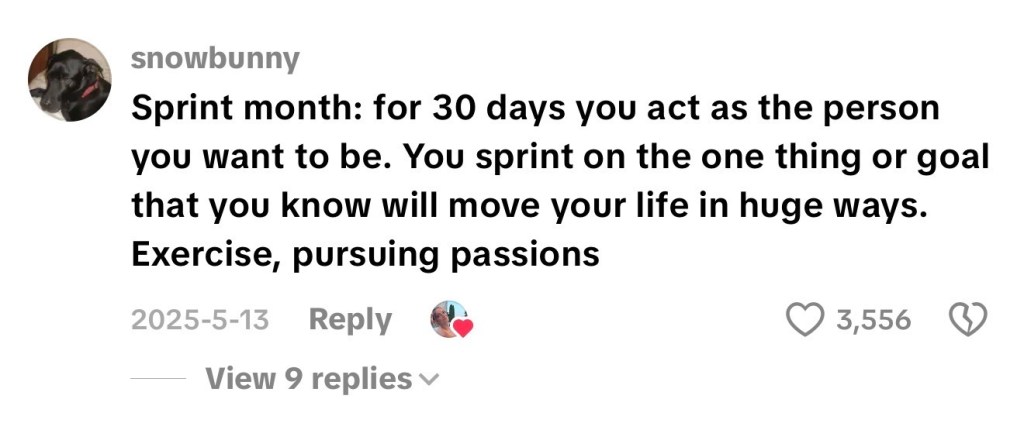
    A comment from Kelli’s viral video. Photo credit: Screenshot

    “These things happened, even though I wasn’t prioritizing those specific [areas],” says Kelli. “I was just focusing on a few key areas. That’s the power of a sprint month.” 

    Kelli’s comment section erupted, with other users chiming in with their own sprint month experiences. “I did that for a couple of months, and now I’m living in France in my dream apartment,” wrote one commenter. “The less you resist, the more you receive!” chirped another. 

    Hollie Fleischman (@hmfleischmann) wrote: “I saw your video and did one in March, and continue to do one every month. March was weight loss, April was studying for my certificate, and May is my financial month! I’ve lost over 25 pounds since then and saved over $3,000! Thank you for the idea!!” 

    Kelli isn’t alone. Search “sprint month” on TikTok, and you’ll find hundreds of videos—made overwhelmingly by young women—showing how they drastically changed their lives in just 30 days.

    @kellylmatthews

    August is sprint month on Team Limitless! Shoutout to the OP of sprint month @Kelli ❤️‍🔥 sprint month #sprintmonth #productivity #gymgirl #gymmotivation

    ♬ original sound – Kelly Matthews

    In a video titled “A Sprint Month could change your life,” Grace (@graciesecrist) shared her sprint month wishlist with the platform. “I’ve seen people posting about [sprint months] before, and I would always think, ‘Oh, I’ll start on the first of the month,’ or, ‘I’ll start on a Monday.’ But I need to stop making excuses for myself. Because at the end of the day, I’m only wasting more time,” she tells viewers. She’s aiming to walk 10,000 steps per day, break her doomscrolling habit, and explore New York City.

    For people who don’t know where to start, a video posted by Kelly Matthews (@kellylmatthews) details a general template designed for those who want to “accelerate the timeline” toward becoming a different person. She recommends aiming for 10,000 steps a day (8,000 minimum), planning three gym sessions a week (and putting them on your calendar ahead of time), eating one gram of protein per pound of body weight per day (plus 25 grams of fiber), and putting your phone away half an hour before bed.

    She ends the video with a challenge. “So what’s it going to be?” she asks. “Are you going to walk towards the goals you have? Or are you going to sprint? 30 days. That’s it. We can do it.” 

    From software teams to your TikTok For You Page

    “Sprint months” didn’t come from the self-help world. The term “sprint” is actually lifted from Scrum, an agile project management framework developed for software engineering in the early 1990s. In the Scrum Guide (which details the product’s accountabilities, events, artifacts, and rules), co-creators Jeff Sutherland and Ken Schwaber define a sprint as “a fixed-length event of one month or less.” Sprints are designed to give developers a clear goal, a set timeframe, and an opportunity to review progress at the end.

    sprint, scrum, programming, time, management
    Man “sprinting” up the stairs. Photo credit: Canva

    Sprints entered the personal growth stratosphere when productivity writer J.D. Meier introduced the “Monthly Improvement Sprints” method. Instead of chasing a single long-term goal, his personal growth framework centers on a series of twelve monthly themes each year. “This way, each month would be a fresh start,” he writes. “What I generally notice is that a lot of the hurdles I hit in my first week are gone by week 2. Little improvements each day add up quickly.”

    Meier adds suggestions for sprint month themes: 

    • Make progress on a dream (chip away at a big dream or [invent] a little dream and make it happen).
    • Sharpen a skill.
    • Try your hand at something new.
    • Reshape your body.
    • Adopt a new habit.

    TikTok users discovered this framework and, no pun intended, ran with it. Creator @kellylmatthews pumps up sprinters in her viral clip:

    “For thirty days, you’re not going to walk towards your goals. You’ll be sprinting towards all the things you want to accomplish this year. This isn’t about toxic hustle culture. It’s not ‘I’ll sleep when I’m dead.’ It’s about increasing the amount of work that you’re willing to put in.”

    Why 30 days hits that perfect sweet spot

    Besides glowing anecdotes and enthusiastic letters of recommendation, there’s a decent chunk of psychology and science backing 30-day sprints. The “Fresh Start Effect” helps explain the psychology behind sprint months and why this 30-day challenge feels so motivating. Researchers from the Wharton School found that people are more likely to work toward their goals after a “temporal landmark,” like the start of a new week, a birthday, or the first of the month.

    Temporal landmarks provide us with a mental clean slate. They are moments that help us distinguish our “past self” (who might feel discouraged by past struggles or perceived failures) from our “future self,” whom we believe will succeed. A sprint month transforms the beginning of the month into a portal: accept the challenge, and you’re given a fresh opportunity to embody the person you’re meant to become.

    @heycoachpatrice

    I saw @Sprint Month / vaere_wellness talking about the sprint month and I’m all in! Let’s gooooo! 1) Nutrition Coaching Certification 2) Maintain calorie deficit- for weight loss 3) Save a specific amount/ No excess spending #sprintmonth #fyp #over40

    ♬ original sound – Coach P | Fitness + Wellness

    Laurel van der Toorn, a therapist and clinical director at the Laurel Therapy Collectivefurther demystifies the magic behind the 30-day window:

    “While consistency over time is important, we can’t always put considerable effort toward one thing for a year. Having a clear start date and a clear end date enables us to push more than we usually would on something. The structure and containment of sprint months is what makes them so powerful and useful.”

    But the psychological trick that makes 30-day sprints feel like productivity sorcery lies in the speed at which you see results. Research by Ayelet Fishbach and Kaitlin Woolley at the University of Chicago Booth School of Business found that immediate rewards are a more powerful motivator for goal persistence than delayed outcomes, even more than how much someone values the goal itself. 

    While we normally pursue long-term goals (like exercising) to receive delayed rewards (like improved health), that mindset can be counterintuitive. Fishbach and Woolley found the opposite: immediate rewards—such as enjoyment, fun, or positive experiences—better indicate whether a person will stick with an activity. Immediacy creates a perceptual fusion between the activity and its reward, linking the two. In the context of “sprint months,” when you see results in such a short time span, your brain begins to associate your progress with pleasure. The activity itself—whether it be working out, eating better, or lowering your screen time—starts to feel rewarding. That’s incredibly powerful.

    A daily feeling of achievement, a visible streak on a tracker, or encouragement from a TikTok accountability group can all act as immediate rewards that help keep motivation high.

    How sprint months compare to other viral challenges

    You may not have encountered sprint months before, but you’ve likely heard of their buddies: “75 Hard,” “The Winter Arc,” and “The Great Lock-In.”

    working, out, goals, fitness, productivity
    Sprint months are part of a rising number of fitness challenges on TikTok. Photo credit: Canva

    Sprint months don’t exist in a vacuum. They’ve emerged as part of a rising trend of short-term self-improvement challenges popular among Gen Z and Millennials. 

    75 Hard, created by entrepreneur Andy Frisella, is a grueling program in which participants must complete five intense daily tasks for 75 consecutive days: two 45-minute workouts (one outdoors), drinking a gallon of water, following a strict diet with no cheat meals or alcohol, reading 10 pages of nonfiction, and taking a daily progress photo. If you miss a single day, you have to start over.

    “This is not a fitness challenge,” Frisella warns on his website. “I spent years feeling like I was nothing, trying program after program to get back on track…only to fall off right after I completed it. Then I realized that the root cause of all my problems was not addressed by any existing program.” 

    The Winter Arc rose to fame on TikTok in late 2024. This self-improvement trend avoids the “new year, new me” trap and urges people to jump-start their personal growth well before the ball drops on January 1. Miami-based influencer Carly Berges (known as @carlyupgraded) is widely credited as the creator of the Winter Arc; her TikTok about it has garnered over 4.8 million views.

    “If you’re seeing this video before October 1st, then you are just in time for your Winter Arc,” says Berges. “This is a time where people tend to let their foot off the gas, but there are still three months left in the year.” She goes on to reframe October, November, and December as an opportunity to “dial the f*** in” and get serious about your personal transformation goals. 

    Unlike the severity of 75 Hard, the Winter Arc has no fixed ruleset. Instead, participants typically build a personal list of around 10 daily self-improvement habits they commit to for the duration, usually spanning fitness, sleep, mental health, nutrition, and relationships. The hashtag #winterarc quickly climbed to fifth on TikTok’s U.S. trending chart, accumulating over 250,000 videos.

    Finally, there’s the Great Lock-In, which also encourages people to “follow specific regimens for shorter bursts of time in hopes that they will be more likely to meet their goals.” In her video, “Building self-trust step-by-step for lasting change,” Kadie Glenn (@kadieglenn) outlines the trend’s parameters, which are noticeably more relaxed than those of 75 Hard:

    1. Start with small actions you can consistently show up for.
    2. Track your wins visibly and daily (Glenn suggests using a daily habit tracker or sticky notes).
    3. Adopt the “never miss twice” rule. You can skip one day, but never miss two. Create friction for bad habits (removing harmful apps from your phone, for example) and enable flow for desirable ones (like laying out your gym clothes the night before).

    Writer Cal Newport noted that “lock in” was voted the “most useful” term of 2024 by the American Dialect Society, stating that the concept reflects Gen Z’s desire for undistracted focus amid constant notifications.

    In comparison to their counterparts, sprint months are shorter and more focused. These 30-day challenges are meant to be more accessible, and missing a day (or two!) doesn’t mean starting over, which provides a more realistic way to build habits.

    The part no one talks about: Burnout

    Now the not-so-fun part. When pushed to the extreme, sprint months can be dangerous, and it’s important to recognize that.

    Dr. Meghan Marcum, chief psychologist at AMFM Healthcare, warns participants not to slip into all-or-nothing perfectionism. A single missed day should not feel like a total failure. Clinical psychologist Jamie Evan Bichelman echoes this: “Where this trend could become unhealthy is the act of comparison: seeing influencers who obsessively post about their progress…and comparing their achievements to your busy life.” 

    burnout, tiktok, trend, mental, health
    Planning a sprint month? Beware of burnout and perfectionism. Photo credit: Canva

    Research consistently shows that sustained effort over time leads to lasting change rather than a single spurt of intensity. A 2024 study found that long-term transformation results from “two to five months of small, consistent actions, not a frantic three-week sprint.” Keep that in mind before hopping on this trend.

    How to build a sprint month that works

    Still up for the challenge? Here’s a sprint month template that’s backed by psychology and self-development research: 

    1. Choose a single goal that feels meaningful and somewhat uncomfortable. Start with just one, not five.
    2. Get clear about your definition of “success.” What does being “done” look like on day 30?
    3. Establish short, achievable minimums for tough days. Even five minutes spent toward your goal counts. Remember that perfection isn’t what you’re after, and be gentle with yourself.
    4. Break your sprint goal into daily actions with a specific time and place. Prioritize these actions in your schedule.
    5. Include an immediate reward during or after your daily action. It should be enjoyable, like listening to a favorite song, having a good coffee, or taking a walk outside.
    6. Track your progress. Use a wall chart or journal: a visible streak reinforces motivation and momentum better than digital apps or nothing at all.
    7. Be honest in your assessment on day 30. If you’re burned out, take a break; you’ve cleared the hardest hurdle. If you remain energized, keep going.
    8. If the habit sticks, why stop? Keep in mind it may take up to two months (66 days) to reach true habit automaticity.

    The momentum lives beyond the month

    Here’s a truth that gets overlooked: the 30-day sprint isn’t the finish line. It’s just the beginning.

    The feeling you get when you complete a goal, or set your mind to something—and achieve it—feels like magic. But in reality, it’s the logical result of a combination of structure and intent. Yes, a concentrated 30-day effort builds the type of momentum needed to push through initial resistance. However, the habit won’t be second nature—not yet. But you’ve already done the hardest part: showing up.

    Sometimes, that’s exactly the start you need.

  • Job recruiter says people will never get hired if they keep getting this easy interview question wrong
    A career coach warns against relying on AI to answer job interview questions.Photo credit: Canva

    As workers struggle to land good jobs and employers struggle to find ideal candidates in the ever-changing job market, a new trend is emerging. Many applicants are turning to artificial intelligence to give them an edge—with mixed results at best. Because interviews are one of the most stressful parts of the job search, it’s become common for folks to input questions into ChatGPT to find the “perfect” response. However, a former recruiter warns that this is a bad idea, noting that you end up “sounding so fake” when using it.

    Former recruiter turned career coach Madeline Mann showed an example of why ChatGPT shouldn’t be used to answer written interview questions. In a TikTok video, Mann shared a ChatGPT response to the question, “Why did you leave your last role?” ChatGPT replied with the following:

    “I decided to move from independent work to a team environment so I can build deeper lifecycle expertise and learn from a strong mission-driven leadership team.”

    @selfmademillennial

    It is common to use AI to help write your job interview answers, but often they are sounding too verbose and not human. If you are reading your interview answers from a script, you are likely to be rejected in the job interview and not get the job offer. Here is an example of how to sound more normal and like a coworker during a hiring process. Follow for more job interview tips, and job search strategies! #jobsearch #jobsearchtips #jobinterviewtips #jobinterview

    ♬ original sound – Madeline Mann

    Did that sound like something a human would say? Mann argued that ChatGPT used so much professional jargon that it sounded like a robot wrote it (because it did). Mann said that in interviews, it’s best to “sound like a coworker.”

    “If you do not already sound like their coworker, they will have trouble picturing you as their coworker, and they won’t give you the job offer,” said Mann.

    Mann said that a better response would be a quick and simple: “After freelancing for X years, I really missed being on a team.” She said that a reply like that is sincere, direct, and more like how a person would normally speak to a coworker. She added that if you were to use AI for interview responses, you should edit them down and remove any “bungle” to “talk like a person.”

    AI experts and employers weigh in

    Upworthy spoke to AI pros, business leaders, and recruiters about using artificial intelligence for job interviews. The majority arrived at the same conclusion: If you choose to use AI, it can be a useful tool for interview preparation. However, it shouldn’t sub in to do the actual interview for you.

    “AI can be a useful tool for preparing for an interview,” said Megan Sweeney, public relations director at the American Staffing Association. “However, at the end of the day, the interviewer still needs to know you’re capable of doing the job.”

    “If a company requests written interview questions, then using AI as a starting point is fair game in my book,” said Russell Taris, an expert on how managers can best use AI in the workplace. “The key statement, though, is ‘as a starting point.’”

    “Candidates should use AI to organize their thoughts and firm up their language, but the examples and experiences need to be their own,” said Taris. “Managers can now tell right away when someone submits a response straight from ChatGPT without any editing. Smart candidates use AI the way you’d use a good friend who happens to be a great editor.”

    Authenticity is key

    “The problem is being authentic,” said Magical Brands CEO Mark Coffie. “Candidates who prepare and deliver scripted, overly polished answers tend to fail when asked questions spontaneously. You can use AI to outline your ideas but speak and answer questions in your own voice. That’s different from reading something generated. Interviews are a testing of judgment, communication, and problem-solving…Technology cannot substitute for that.”

    “Using AI to pressure test your answers ahead of time can truly benefit candidates,” said Taris. “Run your ‘Why did you leave your last role?’ answer through it and ask it to poke holes, or practice your ‘greatest weakness’ answer until it’s specific and honest. The best answers I hear in interviews aren’t the most polished; they’re the ones where the candidate clearly thought it through beforehand and can go deeper, if needed. AI is one of the best prep tools available right now, and most candidates aren’t taking advantage of it.”

    “Using AI for interview prep is helpful, but you will be the one being evaluated,” concluded Sweeney.

  • Mississippi church posts new ‘loud kid policy’ on Facebook and people are raving
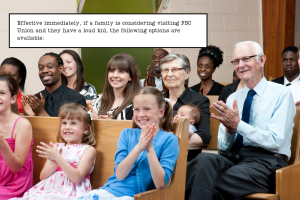
    A church went viral for its tongue-in-cheek new policy regarding “loud kids.”Photo credit: First Baptist Union/Facebook & Canva

    It seems kids are becoming less and less welcome in public spaces. For one thing, fewer Americans are choosing to have children at all. Couple that with social media, and the trend has only served to amplify the disruption kids cause in traditionally adult spaces like breweries and brunch spots. An eternal struggle exists between busy parents with no babysitter who still want to enjoy avocado toast and the folks who’d prefer to do so without noisy kids around.

    But surely, one place where families are always welcome would have to be church—the original community gathering space. A place where all are not only welcome, but embraced. Even loud kids. However, this has turned out not to be strictly true either.

    Over the years, many churches have separated children from the main worship space and instead provided them with age-appropriate activities. It’s a noble idea, but many parents say the practice feels exclusionary and forces families to spend that time apart. Even in the supposedly loving environment of church, there are plenty of folks who want to hear the service without the wail of a toddler in a tantrum.

    Julie, a blogger and pastor’s wife, writes, “If you walk into a church that doesn’t have a heart for kids, you’ll know almost instantly. Congregants will look annoyed at childlike behavior and sounds, they’ll strongly discourage children from staying in the worship service, and folks will appear generally disinterested in them.”

    One church is going viral for its cleverly worded “new policy” when it comes to noisy kids attending services.

    church, family, kids, children, noisy kids, child free, kid free spaces, kids in public, parenting, kids at church
    Many churches don’t allow children in the main worship area, or at least frown upon it. Photo credit: Canva

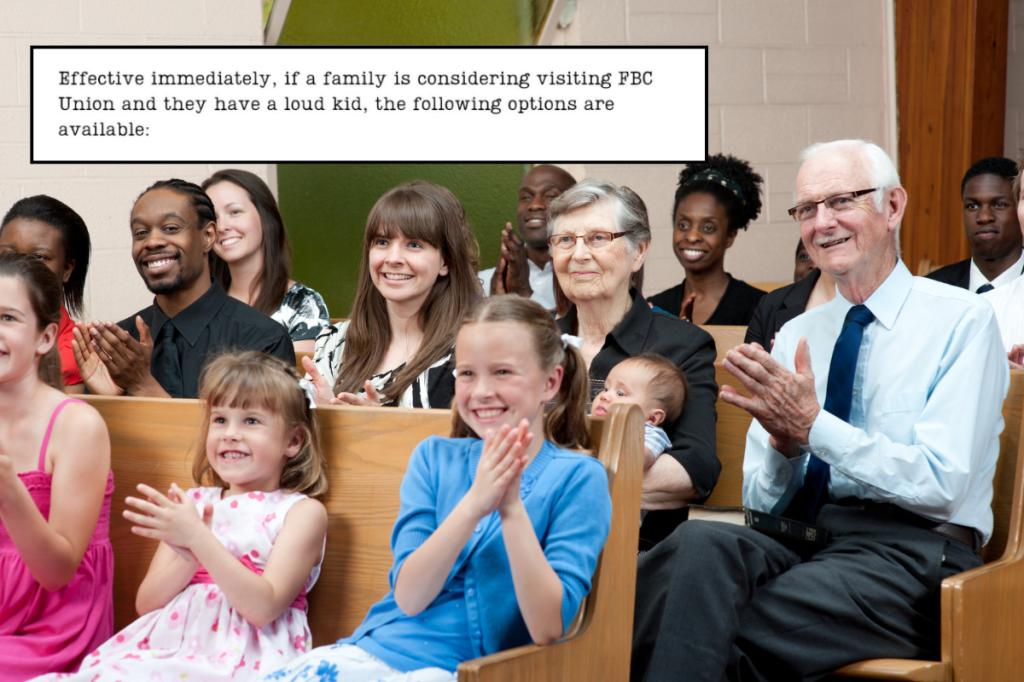
    First Baptist Union in Union, Mississippi, recently posted an announcement on its Facebook page regarding loud kids at church.

    “There have been updates to the Loud Kid Policy at FB Union,” the post read. “If you have a loud kid, then this is for you. I know it might ruffle some feathers, but we had to do the right thing.”

    The whole memo has to be read to be fully appreciated, but in short, church leaders announced they would offer “five” options for families who wanted to visit with loud children. With a little clever wordplay, all of the options amounted to the same thing: Bring them.

    “We believe the sound of children in worship is not a distraction. It is evidence of life, growth, and the future of the church. If your child makes noise, you are not bothering us. You are blessing us.”

    The post was a viral hit. Not only was it re-shared hundreds of times by the Union community, but it also reached far beyond Mississippi. The original memo and slight alterations of it were posted by churches across the country.

    Reactions were largely positive. Many parents and church members chimed in to comment on how much they appreciated the tongue-in-cheek gesture:

    “I’m not even a member of FBC so I’m unsure as to why I’m seeing this, however, this is great. A pastor once said that a church without children is the signs of a dying church. Bring in the little ones!!”

    “A friend shared your post with me and wow! What a relief! Someone from leadership [at my church] called me and told me that my 18month old foster son was very distracting and then he asked me 1) Do I know we have a nursery? And 2) Why am I not utilizing it. I was livid.”

    “I once heard a preacher say, ‘If I can’t preach over a crying kid, it’s time for me to stop preaching,’ when someone got up to take a loud child out of the sanctuary.”

    “Not a member but I love this. When I first came to our church I was so worried cuz all of my kids are loud. When they would be loud id look at the older adults and would see smiles. Now I bring our baby in and they all love seeing him. Its so nice not to feel like I can’t sit thru a service because my baby is fussy.”

    However, not everyone was on board with the sentiment, especially as the announcement began reaching a wider audience. After New York Times columnist David French reposted it, a few folks took umbrage.

    “I don’t love it at all. If your child is being unruly, loud, or disruptive during a church service, you should be considerate of everyone else and step out with them. If they’re old enough, they should be disciplined appropriately. Assuming it’s acceptable to let a child scream and whine through the service is ridiculous.”

    “No. When the Word of God is preached, we should have an environment that eliminates distractions. I have 5 beautiful children, but if they’re starting to fuss, or just be a normal 2-4 year-old, we remove them and take them to children’s church or out in the foyer.”

    With its post about loud kids at church, First Baptist Union unintentionally sparked a fascinating debate about the presence of children in public, even in family-friendly spaces. Whether we like it or not, children come pre-packaged with noise, movement, and disruption—and it’s not always the result of poor parenting. Whether you find their childish chaos beautiful and invigorating or extremely annoying is a matter of personal taste.

    One thing is for sure. With more and more breweries outright banning children and airlines separating young children from their parents during the seating process, thereby sparking wars in the economy section, it’s refreshing to see at least one place take a stand and allow kids to be seen and heard. No matter how loud.

  • Happiness researcher shares 4 ‘big habits’ the world’s happiest people engage in daily
    Happiness can be nurtured with certain habits.Photo credit: Canva

    The pursuit of happiness is seen as such an inseparable element of being human that the founders of the United States put it in the first sentence of the Declaration of Independence. Everyone wants to be happy. And yet, so many find happiness elusive.

    Harvard University social scientist Dr. Arthur C. Brooks has made human happiness (and the pursuit of it) the central focus of his research. In his studies, he has identified four habits that the happiest people practice each day.

    Defining happiness

    How are “the happiest people in the world” measured? Brooks explained the happiest people are those who score highest on what he calls the “macronutrients of happiness”: enjoyment, satisfaction, and meaning.

    Enjoyment doesn’t mean pleasure, Brooks said at a John F. Kennedy Jr. Forum in 2024. “The pursuit of pleasure is a great way to ruin your life,” he said. “Enjoyment takes the source of pleasure and adds two things: people and memory.”

    A man looks up at the sky with a big smile on his face
    What makes someone happy? Photo credit: Canva

    Satisfaction involves both achievement and detachment. We are satisfied when we successfully achieve a goal. We are also satisfied when we want less.

    Meaning is the most important of these macronutrients. “Meaning is about coherence—why do things happen the way they do? Purpose. What is my direction and goals? And significance. Why does it matter that I am alive?” Brooks said.

    People who score highest in these areas tend to engage in four “big habits” every day. Brooks collectively refers to these habits as a “happiness pension plan” that people make deposits into:

    Happiness Habit #1: Transcendence

    “They’re paying attention every day to their faith or philosophical life, which is religious or not, but is transcending themselves and standing in awe of something bigger,” Brooks shared.

    A man sits outside in nature in meditation or contemplation.
    Transcendence is seeking something greater than yourself. Photo credit: Canva

    Brooks talks about transcendence as a “vertical” practice, “where you’re looking for something that’s divine, something that’s bigger than you.” But that could look like a lot of different things:

    “Maybe that means studying the Stoics and living according to their principles, even as an atheist,” Brooks explained to Mark Manson. “Maybe that’s walking in nature for an hour before dawn without devices. Maybe that’s studying the fugues of Bach. Maybe that’s studying the Vipassana meditation practice with seriousness. And maybe that’s going to mass every day. Transcending yourself is one of the great secrets to happiness.”

    Happiness Habit #2: Family

    “They’re taking their family life seriously,” said Brooks.

    Brooks told How To Academy:

    “All families are imperfect and everybody cares about their families. Anybody who says ‘I don’t care about my family’ they’re just lying. It’s very, very important that we understand that the strange and magical nature of family relationships we have, they’re some of the most intense love relationships that we have. And we didn’t choose them. It doesn’t even make sense. It’s almost a mystical thing, that people have those people who can drive you absolutely around the bend, make you completely crazy, and you didn’t even choose a relationship? And you feel great sorrow where there’s schism? This is something that we need to understand.”

    Brooks said that stress in families due to differences in opinions or values is “inevitable.” He added that we need to understand the imperfect nature of families and that we all need to work at making those relationships better.

    Happiness Habit #3: Friendships

    Happy people also take their friendships seriously, Brooks said. “And that’s super hard for people in business,” he added, “especially the higher you go in management, the fewer real friends you have and the more ‘deal friends’ that you have. And deal friends don’t count.”

    Brooks told the Mighty Pursuit podcast that friendship exists at three levels. Deal friends are the lowest level of friendship, where the relationship is transactional. Next are friendships based on beauty or admiration. The friend has something magnetic about them that attracts you and makes you enjoy being around them. Finally, there are friendships of virtue, the deepest and truest form of friendship. Brooks called this level of friendship “useless” because it’s not about either person gaining anything, but rather about truly knowing one another on a deep level.

    Happiness Habit #4: Work that serves others

    “Last but not least is dedicating your work to earning your success and serving other people,” Brooks said.

    “Joy comes from work under two circumstances that have nothing to do with money and power and position and prestige, nothing, nothing, nothing,” Brooks shared in a video. “It has to do with earning your success, which means that you’re creating value with your life, you believe that you’re needed. And that you’re serving other people. You’re doing something that’s actually good for other people.”

    @arthurcbrooks

    Joy at work doesn’t come from money, power, or prestige. It comes from earning your success, creating value, serving others, and knowing you are needed. When your work becomes an act of love, it sanctifies everything you do.

    ♬ original sound – Dr. Arthur Brooks – Dr. Arthur Brooks

    “It’s faith, family, friends, and work that serves,” Brooks said. “Those are the big four.”

    Ultimately, if that’s what the data shows, it’s worth taking to heart. You can find more from Dr. Brooks on his website.

  • 15 things tourists notice in the U.S. that Americans totally miss
    A family poses in front of a home with an American flag.Photo credit: Canva
    , ,

    15 things tourists notice in the U.S. that Americans totally miss

    “I’ve lived in the US my whole life. Somehow, I’ve never noticed this before.”

    Tourists see new places with fresh eyes and fresh observations. In 2024, 72.4 million tourists visited the United States, according to the National Travel and Tourism Office. (That’s a lot of eyes seeing America in a new light.)

    Tourists to the States have pointed out that Americans really do like to put ranch dressing on everything. They’ve also noted that in the U.S., squirrels seem to run rampant.

    While these are insightful observations, most Americans would say they already know them to be true. On Reddit, Americans shared the shocking realizations they had about the U.S. that were only revealed to them by tourists.

    As one American noted, “I’ve lived in the US my whole life. Somehow, I’ve never noticed this before.”

    These are 15 eye-opening things tourists brought to Americans’ attention that truly blew their minds:

    Culture

    “We sure do have a lot of flags everywhere.” – myfourmoons

    “American coins don’t have numbers on them.  Some of the coins will say ‘One Cent’ or ‘Quarter Dollar’ but I don’t think that’s helpful if your English is not so good. And sometimes that labeling is just not in a place that easy to see on a coin.” – chocotacogato

    Michael White, a former spokesman for the United States Mint, told The Gainesville Sun that the reason coins in the U.S. don’t have numbers is simple: “It is an artistic choice in the majority of instances.”

    White added that certain coins in the past in the U.S. have used numerical notations, including the dime, nickel, and quarter. The article notes, “From 1809 to 1836, there was a half dollar imprinted with ’50 C.’ That was changed to ’50 cents’ for two years and then, in 1838, artistic choice deemed it should be called ‘half dollar.’”

    “The gap around the stall doors in public restrooms. It’s weird, and I hate it.” – SidheRa

    “So. Many. Insurance. Commercials.” – Reddit_Talent_Coach

    “Bank drive-thru lanes. I was told ‘why don’t you just get out of your car and walk in the bank?’” – JWilsn_Art

    According to Wells Fargo, “motor banks” (aka drive-in and drive-thru banks) were invented in the U.S. and came into existence in the 1930s.

    “That every morning, all American children from kindergarten to 12th grade, stand before the US flag (found in every classroom, ofc) and recite “the pledge of allegiance” to the country in unison, with their right hands over their hearts. Upon learning this universal American school experience, my Russian colleague said: ‘That is the most Comm*nist thing over ever heard!’” – jzzdancer2

    The Pledge of Allegiance, written by Francis Bellamy, debuted in 1892, according to the American Legion. Over the years, it went through various edits until it was recognized by Congress and included in the U.S. Flag Code on June 22, 1942.

    “How much daily life revolves around cars. In many cities, if you don’t drive, you basically don’t exist. It’s convenience on steroids.” – Prior_Bank7992

    Mannerisms

    “That Americans switch between hands when eating with silverware, cutlery, etc.” – BasilRevolutionary38

    Called the “cut-and-switch” table habit, it’s described by NPR as when you “hold your fork in your left hand and cut with your right and then put down your knife so you can switch your fork to your right hand before you take a bite.”

    Americans actually adapted this use of cutlery from the French. Writer Mark Vanhoenacker explained to NPR, “Americans got it from France in the 19th century even as France was giving it up, and no one knows why France gave it up. Maybe just convenience or another change of fashion.”

    “We smile too much. To the point where foreigners, specifically Asians (Korean and Chinese) have pointed out that our smiles feel disingenuous and mean nothing. Really hit home, but despite that, I still smile ‘too much’.” – BMdabbleU

    “How much casual socializing we do with strangers. From small talk to things people in other places consider weirdly intimate (like talking about health problems).” – Practical-Water-9209

    “The lean! The fact that people from the U.S. tend to lean on things while standing, no matter how inappropriate a place or circumstance. I’ve thought about it, and I think its because the U.S. (for the most part) isn’t walkable, so we aren’t used to standing for as along as other countries.” – Lobstertales143

    The Central Intelligence Agency has deemed the “American Lean” a dead giveaway that someone is an American. In 2019, Jonna Mendez, the CIA’s former chief of disguise, and Gina Haspel, former CIA director, told NPR that Europeans can easily spot Americans in a crowd.

    “They think that we are slouchy, a little sloppy,” Mendez said. “And they think that they can almost see that in our demeanor on the street because they stand up straight. They don’t lean on things.”

    Food

    “Root beer tastes like medicine. It’s still my favorite soda but… yeah it tastes mediciney.” – TheNerdNugget

    “Had a German foreign exchange student and she said ‘All American breakfast is dessert. Pancakes, donuts, Cinnabon, muffins, French toast…’ I was like yea you have a point lol.” – dom954

    Words

    “Apparently Americans use the word ‘awesome’ a lot. I’ve had people in other countries tease us for how we think everything is awesome lol. But to be fair, tons of things ARE awesome, and also you’re talking to me on vacation when I’m in the best mood of my life lol.” – Gold_Telephone_7192

    “‘Yeah’ ‘Yeah no’ ‘Yeah right’ ‘Oh yeah’ ‘Hell yeah!’ All mean different things!” – zippy_97

Kids

Mississippi church posts new ‘loud kid policy’ on Facebook and people are raving

Life Hacks

Happiness researcher shares 4 ‘big habits’ the world’s happiest people engage in daily

Identity

15 things tourists notice in the U.S. that Americans totally miss

Wholesome

Italian exchange student ‘forced’ to try Olive Garden for the first time. His reaction has people rolling.