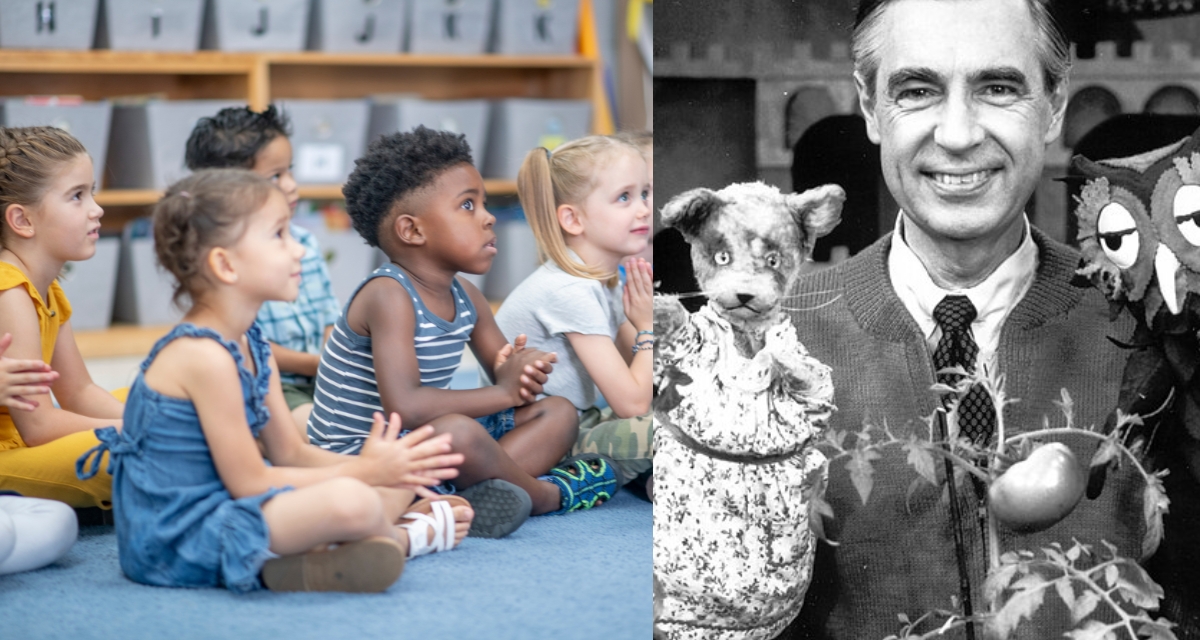
It’s probably no secret to most that Mister Rogers had a unique style when it came to communicating with children. In fact, it became one of his life’s missions to understand them and make them feel understood. He was a champion for increasing education and helping teachers and parents better communicate with kids at their own pace.
Rogers was so diligent about using the right words, some staffers who were near and dear to him came up with a made-up language called “Freddish” to help describe his communication techniques. They took it even further when some drafted a “manual” to help everyone on set speak his language.
‘Freddish’
Maxwell King, the director of the Fred Rogers Center, discusses how important it was for Rogers to use the exact right words in every situation. He discusses his book, The Good Neighbor: The Life and Works of Fred Rogers, in a self-written article for The Atlantic, sharing just how meticulous he was. “He insisted that every word, whether spoken by a person or a puppet, be scrutinized closely, because he knew that children—the preschool-age boys and girls who made up the core of his audience—tend to hear things literally.”
Rogers was so insistent upon it, King says, other staffers recognized it immediately and compiled a list. And this wasn’t just because he was the “boss,” but because he was so good-hearted and respected. King continues, “As Arthur Greenwald, a former producer of the show, put it to me, ‘There were no accidents on Mister Rogers’ Neighborhood. He took great pains not to mislead or confuse children, and his team of writers joked that his on-air manner of speaking amounted to a distinct language they called ‘Freddish.’”
With that in mind, staffers came up with nine strict rules as guidelines for understanding these rules. Open Culture shares, “His care with language so amused and awed the show’s creative team that, in 1977, Greenwald and writer Barry Head created an illustrated satirical manual called ‘Let’s Talk About Freddish.’ Anyone who’s seen the documentary Won’t You Be My Neighbor? knows Rogers could take a good-natured joke at his expense, likely including the imaginative reconstruction of his methods below.”
Nine rules
The “rules” were as follows:
- State the idea you wish to express as clearly as possible, and in terms preschoolers can understand. Example: It is dangerous to play in the street.
- Rephrase in a positive manner, as in: It is good to play where it is safe.
- Rephrase the idea, bearing in mind that preschoolers cannot yet make subtle distinctions and need to be redirected to authorities they trust. As in, ‘Ask your parents where it is safe to play.’
- Rephrase your idea to eliminate all elements that could be considered prescriptive, directive, or instructive. In the example, that’d mean getting rid of ‘ask’: Your parents will tell you where it is safe to play.
- Rephrase any element that suggests certainty. That’d be ‘will’: Your parents can tell you where it is safe to play.
- Rephrase your idea to eliminate any element that may not apply to all children. Not all children know their parents, so: Your favorite grown-ups can tell you where it is safe to play.
- Add a simple motivational idea that gives preschoolers a reason to follow your advice. Perhaps: Your favorite grown-ups can tell you where it is safe to play. It is good to listen to them.
- Rephrase your new statement, repeating the first step. ‘Good’ represents a value judgment, so: Your favorite grown-ups can tell you where it is safe to play. It is important to try to listen to them.
- Rephrase your idea a final time, relating it to some phase of development a preschooler can understand. Maybe: Your favorite grown-ups can tell you where it is safe to play. It is important to try to listen to them, and listening is an important part of growing.”
Boosting cognitive skills
Rogers would probably be pleased to know that research continues to show that stronger communication with children leads to more “emotionally stable” teenagers. In a piece for PsyPost, Vladimir Hedrih shares that “data found that better parent-child communication is associated with stronger non-cognitive abilities in adolescents. The link was found to be both direct and achieved indirectly—better parent-child communication increases the social support available to children, which makes them more physically active, which in turn boosts their cognitive skills.” (He cites PLOS One as his source.)
David Bradley is the founder of the Big Head Bob character, which seeks to help educate children online and in the classroom in a fun way, not unlike Rogers did. He shares with Upworthy, “A BIG lesson I’ve learned is that communicating with children isn’t simply about using smaller words. Adults need to understand how a child might interpret what they hear and what could be misunderstood. I try to make abstract ideas more concrete, and use situations that kids can relate to, like being mean because they were just hangry. I made it into a cartoon!”
Translating complex ideas
Bradley advises using language wisely. ‘We want to avoid language that makes kids feel judged. For example, rather than saying ‘don’t be sad’ or ‘manage your emotions’, I would explain that emotions are messages and then give them practical tools for responding to those feelings. I’m a visual learner, and that’s perhaps why I make all this content. That process of translating complex ideas into language children can understand is something I think Fred Rogers did extraordinarily well.”
Using “Freddish” was one wonderful way for the adults in the room to communicate clearly without stoking fear or misunderstandings. The hope is that those positive, well-crafted moments can stick in the mind and help form more resilient teens and adults