upworthy
Add Upworthy to your Google News feed.
Google News Button
Identity

Here's how 18 people got over being homophobic, proving there's hope for everyone

"I looked for logical reasons to be and couldn't find any."

lgbtq, homopbobia, overcoming homophobia

Homophobia? Get over it.

There are many different reasons why some people are homophobic. A lot of them are raised in religious households where homosexuality is seen as sinful and they never get over their indoctrination.

A study from 2018 found that people who foster homophobic attitudes are less intelligent than those who accept people regardless of their sexuality. For the study, researchers asked subjects if they agree or disagree with the following statement: “Homosexual couples should have the same rights as heterosexual couples do.”

After comparing data sets, researchers found that the lower a person's cognitive intelligence, the more likely they are to be homophobic.

An older study from 2016 using an eye-tracking device found that some homophobic men seem to have an impulsive, automatic attraction to other men.

Homophobic attitudes are more prevalent in people with authoritarian personality types. Authoritarians have “submissive attitudes toward strong leaders, a desire to punish all who violate conventional moral codes, and strong fear that conventional morality is breaking down.”


There are also some who believe that humans evolved to be homophobic because it favors the propagation of the species. "In its simplest form, parents who showed a concern for their child’s sexual orientation may have left more descendants than those who were indifferent,” Gordon Gallup, a human sexuality researcher, wrote.

(It should be noted that Gallup formulated his theory in the ‘80s.)

Regardless of how people become homophobic, the good news is that Americans are slowly becoming more accepting of LGBTQ people. A Reddit user by the name of aestheticbear wanted to prove that everyone is capable of losing their homophobic views by asking the subforum, “What happened that made you stop being homophobic?”

According to the posts, growing up and meeting people who are LGBTQ was one of the most effective ways for people to get over their homophobia. It also helped when they got away from religious parents and began to see the world with their own eyes.

Here are 18 of the best ways that people got over being homophobic.

1. 

"I met some gay people. As it turns out they were just people." — moolord

2. 

"Not homophobic, but I woke up at about 10 when my mom said my uncle was banned from coming to our vacation condo by my father because he was gay. Before then I kind of let the arguments and both sides bit wash over me, but that was a crystalization point where I started noticing it as pure bigotry. I'm sorry the nicest dude in the family full of domestic violence and white-collar drug abusers cant come to Christmas because he's gay? You're both cheating on each other, sanctity of what marriage now?" — Robin_Games

3. 

"My mom slapped me and told me everyone has a right to be happy. That was in 9th grade 13 years ago." — Bloodllust

4. 

"Homophobia was the norm when I was growing up, then I got older and the political landscape changed which made me question my belief and I came to the conclusion it just didn't make any sense to be homophobic." — LuciferIsFallen

5. 

"I came out as gay." — pethal

6

"Realised that, fundamentally, being gay is just 'what' you are. It’s not 'who' you are." — Alternative-Rain-718

7. 

"I wasn't super homophobic, just a 'love the sinner, hate the sin' kind of guy. On my last day in high school, someone said 'Why do I care? They're not hurting me.' Cured me in three seconds. I still remember how magical that moment was for me." — Dirgonite

8. 

"Stopped listening to my homophobic family and left their religion. Oh and also realized I myself was pretty gay." — Raidden

9. 

"There are 20 years between myself and my youngest brother. I (and my SO) was raised in an explicitly homophobic/biphobic/transphobic fundamentalist religion (that I left with my SO in my early 20s) so I had a lot of internalized, conditioned, toxic beliefs about the LGBTQ that needed to be deconstructed. My little brother was obviously either gay or bi and it was obvious from the time he was six imho. He came out to my sisters, SO, and I as bi when he was 11 and we were like "tell us something we don't know lol." I think watching him just grow up, it was obvious that he hadn't chosen to be that way, it was just how he was. This false narrative that LGBTQ are somehow defective or sinners became more disgusting to me over time.

I can't remember exactly when it happened but my SO and I were like 'if our future child happened to be LGBTQ, could we teach that child the things we were taught about the LGBTQ?" We were like "no, that would be evil.'

Now, we have an 18yo niece that recently came out as a lesbian and we feel honored to be the only family that she trusts enough to introduce to her first GF. Spending time with her just reaffirms the fact that there is nothing wrong with the LGBTQ, it was our upbringing that was defective." — Jormungandr91

10. 

"I was in the military during the repeal of don’t ask don’t tell. I wasn’t pro-gay whatever that might mean but sitting in those mandatory command meetings really opened my eyes. There were some legit homophobes trying every trick in the book to justify everything from moving sleeping arrangements to outright violence out in the open with gay people in the room.

I may not have been super sympathetic before that but after I realized just how difficult it was for a gay person just to go to work. Or how many precautions they were taking on a daily basis to keep in the closet. It pushed me from disinterested in the subject to siding with the obviously pragmatic stance of pro-gay marriage and gays in the military." — Pencilowner

11. 

"Went off to college, started meeting gay people, quickly realized that their awesomeness was no different than any straight person’s awesomeness, stopped bothering to “otherize” them as I had in high school." — hailnaux

12. 

"I became good friends with someone who came out to me a year or so after we got to know each other. Turns out he wasn't the abomination that my Christian parents/church had taught me all gays were. Indoctrination of children is a bitch." — Vefantur

13. 

"Honestly I think it was Lady Gaga. I was young and impressionable and she was cool and so LGBT+ friendly that I just started accepting people. And then it turned out I was a lil gay too so things worked out well lol." — plutoforprez

14. 

"I grew up and met some openly gay people." — polkavert

15. 

"I became an atheist. Through a painful experience of getting through serious depression, I came out the other side with a different worldview. As soon as I shed religion I began to question a lot of things including how I really feel about LGBTQIA people vs what I'd been indoctrinated to believe. They are just people trying to go about their normal routine like myself. There's no vast conspiracy or 'gay agenda.'

Years later, I suspect I'm one of them now. I might be asexual but I'm not sure yet." —HonestSummer

16. 

"As a teen I loved to make fun/bash gay people and listen to heavy metal. Then one day Rob Halford from Judas Priest came out as gay. Well, he is fucking Rob Halford and he can do whatever the fuck he wants. He is Rob Halford and being gay did not make him any less amazing in my eyes. After that I stopped caring about people being gay or not. Who am I to second guess or mock Rob Halford's life choices?" — cambeiu

17.

"I looked for logical reasons to be and couldn't find any." — theyellowmeteor

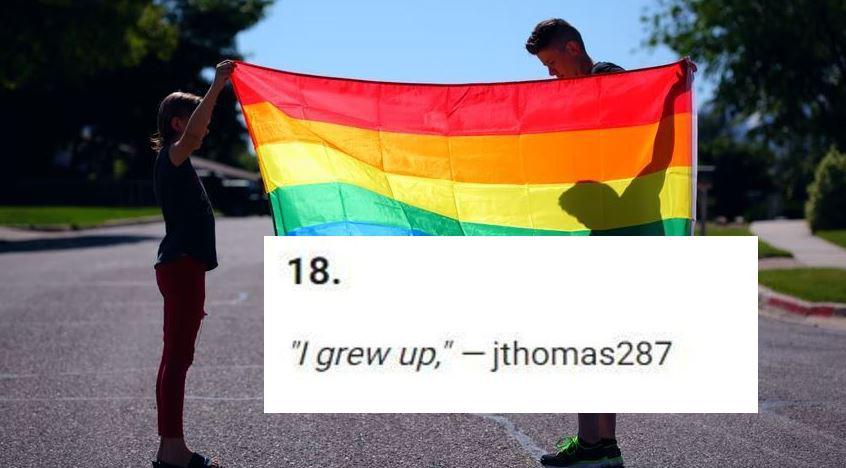
18. 

"I grew up." — jthomas287

NAPA is launching a free merch collection, changing how we celebrate automotive careers
Enter the Toolbelt Generation
True

These days, cars can do a lot more than get you from point A to point B. With features like emergency braking, electric powertrains, and self-parking systems, getting behind the wheel of a modern vehicle means being surrounded by cutting-edge technology. While innovation races ahead, one important element is being left in the dust: trained professionals who know how to fix these increasingly complex systems.

By 2027, the industry is anticipating a nationwide shortage of nearly 800,000 technicians – everything from avionics experts to diesel and collision repair specialists. And while the industry is expected to grow by 3% in the next decade, not enough young people are entering the field quickly enough, and the skills needed to do the job are changing fast.


Enter the "Toolbelt Generation"

Gen Z has increasingly been shifting away from traditional four-year colleges, exploring trade school alternatives as a smarter path forward. This cultural shift has dubbed them the "Toolbelt Generation," and they're onto something big. With a 16% increase in vocation-focused community colleges last year, young people are choosing flexible, hands-on careers without the heavy cost of traditional college education.

But here's the thing: while university students get all the fanfare – the branded hoodies, the campus pride, the cultural celebration – trade school students have been missing out on that same sense of belonging and recognition. Despite outdated stereotypes that paint trade work as "lesser than," these students are actually mastering some of the most sophisticated technology on the planet. Until now, society just hasn't caught up to celebrating what they do.

A creative solution rooted in culture

The NAPA TradeWear Collection is the latest initiative they have using a brilliant solution to change this narrative entirely. In partnership with Dickies and prolific video game artist Stephen Bliss, NAPA launched TradeWear – their first-ever, free merch collection celebrating young trade school students and the automotive technician career path.

The inspiration came from a fascinating cultural insight: automotive and racing games were cited as one of the biggest influences of the current generation of trade school students. That's where Stephen Bliss comes in – he's been behind some of this generation's most iconic video game artwork, making him the perfect partner to bridge the digital-to-physical journey that's inspiring real careers.

"Being an automotive technician is such a badass career," said Stephen Bliss, designer of the new NAPA TradeWear line. "It's both an art and a science, and I designed this line with that artful side in mind – celebrating what drives people to create something tangible with their own hands."

The collection does more than just look cool – it's making a statement that these career paths deserve the same pride and recognition as any traditional college experience.

"NAPA is working to break down barriers for the next generation of technicians by eliminating financial barriers, debunk outdated stereotypes, and create cutting edge training methods to fill this automotive technician gap,” said Danny Huffaker, SVP, Product & Marketing at NAPA, “TradeWear is the latest initiative in champion young technicians, celebrating technical careers with the same pride we give to traditional college paths."

An innovative approach

TradeWear represents just one way NAPA is rising to meet this moment of industry transformation. As America's largest network of automotive parts and care, they're taking a comprehensive approach to supporting the next generation of technicians.

NAPA is set to debut the Autotech XcceleratoR in early 2026—a breakthrough that fuses XR (extended reality) and AI to transform how technicians learn. Think of it as a flight simulator for cars: immersive, hands-on practice with smart guidance that adapts to each learner, building real-world skills faster and safer. As a first-of-its-kind program at national scale, XcceleratoR is designed to train more students in less time, elevate quality across the industry, and set the standard for the next 100 years of automotive training.

NAPA is also championing educational investment through expanded scholarship programs. This year, NAPA launched the Carlyle Tools MAX Impact Scholarship, providing monthly $2,500 awards plus professional-grade Carlyle toolboxes to empower emerging skilled technicians. This initiative joins a comprehensive scholarship portfolio that delivered educational support this year through partnerships with WD40, the University of the Aftermarket, TechForce and SkillsUSA.

Looking toward the future

In a world full of desk jobs and digital burnout, technician jobs in the automotive industry allow people to create an entirely different way of living – a flexible, hands-on career without the heavy cost of a traditional college education.

By investing in innovative training, providing financial support, and most importantly, instilling pride in a new generation of workers through initiatives like TradeWear, NAPA is helping ensure these exciting career paths continue to thrive for generations to come.

Check out the new NAPA TradeWear collection and snag a free item from the collection.

cruise ships, cruise living, vacation, lifestyle, alternative living, alternative lifestyles, aging, seniors
via Alonso Reyes/Unsplash

A couple lives permanently on cruise ships instead of paying for assisted living.

It comes as no surprise to many of us, but cost of living in the United States has gone up so by leaps and bounds in recent years. So much so that living on a cruise ship has become a reasonable idea for some retirees. When Nancy and Robert Houchens of Charlottesville, Virginia, retired, they decided to sell almost everything they had and live out their golden years hopping from cruise ship to cruise ship.

"We had a 3,000-square-foot home full of furniture...and everything we own now would fit in the back of a pickup truck," Robert told USA Today.


“We sold all of our estates except for a little condominium we have in Florida, so when we get too old to cruise, we have somewhere to live,” Nancy added. “And we did keep two vehicles, and what we kept is in half of (Robert's mother's storage unit), which is, I don't know, 10x10 or something. We just walked away from everything.”

Life on a cruise ship is stress-free for the couple because their needs are taken care of on the ship. "It's been great. I don't cook. I don't clean," Nancy told the Miami Herald.

- YouTube www.youtube.com

The couple has found that living on a cruise ship isn’t as expensive as some may assume. Even though inflation has driven up the cost of travel in the U.S., it hasn’t significantly impacted the cruise industry.

“It's much cheaper than a nursing home or assisted living. It was just a good fit for us. It's a good fit for a lot of people,” Robert told the Miami Herald.

The cost of a nursing home for one person usually runs anywhere from $8-10,000 per month, for reference.

The couple plans their trips differently than someone who is going on vacation. “We look for the best deal, not the destination,” Nancy told Cruise Passenger.

The couple initially planned to spend $4,000 a month living on the ships. “Our original budget was $4,000 a month. This included gratuities. Of course, things are more expensive now, so that budget has had to increase a little. Depending on where we go, we may or may not need the internet,” she told Cruise Passenger.

cruise ships, cruise living, vacation, lifestyle, alternative living, alternative lifestyles, aging, seniors Literally sailing off into the sunset. Giphy

“Our phone plan covers most everywhere for 25 cents a minute to call with free internet and texting,” Nancy continued. “We have an annual travel insurance plan, and one of our credit cards also has travel insurance.”

The roughly $4,000 the couple spends a month includes food, and they don’t have to bother paying for a car. They also try to book their cruises consecutively so they don’t waste money paying for expensive hotels when transferring between cruise lines.

Not a bad deal.

Last July, the Houchens celebrated their 1,000th day sailing with Carnival Cruise Line since the 1980s, and they look forward to countless more days at sea with each other and the new friends they’ve made on their never-ending cruise. And today, they're still going strong.

They're not alone in loving their new lifestyle. CBS News reports in 2025 that "cruise retirements" are more popular than ever.

@lovepeacecruise

Nancy and Robert Houchens of Charlottesville, Virginia - Couple retires to live on cruise ships because it's 'cheaper than a nursing home' #livingonacruiseship #retirement #carnival #carnivalcruise #funship #carnivalship #carnivalshiptok #cruiseship #cruise #cruiser #cruiselife #vacation #travel #cruisevacation #cruisetravel #cruisetok #cruisetiktok #cruiseaddict

“We cruise Carnival because of the people,” Richard told Travel Pulse. “It isn’t the destinations for us anymore, it’s the journey—and the biggest part of the journey is the people.”

This article originally appeared two years ago. It has been updated.

angela duckworth, grit, ted talk, success, psychologist, therapist
via TED / YouTube

Angela Duckworth speaking at a TED event.

Why is it that some people are high achievers who have a track record of success and some people never come close to accomplishing their dreams? Is it talent, luck, or how you were raised? Is it that some people are just gifted and have exceptional talents that others don't?

The good news is, according to psychologist Angela Duckworth, the most critical factor in being a high achiever has nothing to do with talent or intelligence. It’s how long you can keep getting back up after getting hit. She calls it “grit” and, according to Duckworth’s research, it’s the common denominator in high achievers across the board, whether it’s cadets at West Point or kids in a spelling bee. Duckworth goes into depth on the topic in her book Grit: The Power of Passion and Perseverance.


What personal traits make someone successful?

“The common denominator of high achievers, no matter what they’re achieving, is this special combination of passion and perseverance for really long-term goals,” Duckworth revealed on The Mel Robbins Podcast. “And in a word, it’s grit.”


“Partly, it’s hard work, right? Partly it’s practicing what you can’t yet do, and partly it’s resilience,” she continued. “So part of perseverance is, on the really bad days, do you get up again? So, if you marry passion for long-term goals with perseverance for long-term goals well then you have this quality that I find to be the common denominator of elite achievers in every field that I've studied."

When pressed to define the specific meaning of grit, Duckworth responded: “It’s these two parts, right? Passion for long-term goals, like loving something and staying in love with it. Not kind of wandering off and doing something else, and then something else again, and then something else again, but having a kind of North Star."

- YouTube www.youtube.com

For anyone who wants to achieve great things in life, grit is an attitude that one can develop for themselves that isn’t based on natural abilities or how well one was educated. Those things matter, of course, but having a gritty attitude is something someone can learn.

"I am not saying that there aren't genes at play because every psychologist will tell you that's also part of the story for everything and grit included,” Duckworth said. “But absolutely, how gritty we are is a function of what we know, who were around, and the places we go."

Why grit is so important

Grit is critical for people to become highly successful because it means that you stick with the task even when confronted with barriers. In every journey of taking an idea that you love and turning it into reality there is going to be what’s known as the dark swamp of despair—a place that you must wade through to get to the other side. It takes grit and determination to make it through the times when you fear that you might fail. If it were easy, then everyone could be high achievers.


Grit is what keeps people practicing in their room every night as teenagers and makes them an accomplished guitar player. Grit is what makes a basketball player the first one in the gym and the last to leave so that they make the starting lineup. Grit is knocking on the next door after 12 people have just slammed their doors in your face.

The wonderful thing about Duckworth’s work is that it presents an opportunity for everyone willing to do the work. You can no longer use the fact that you may not have specialized intelligence or a God-given talent as an excuse. All you need is perseverance and passion and you have as good a shot as anyone at achieving your dreams.

Education

Social skills expert shares 3 'magic phrases' that make you more likable

Sometimes, we need to overcommunicate how we feel about others.

vanessa van edwards, likability, communications skills, people skills, people laughing, good advice

Vanessa Van Edwards and people at a party.

A familiar misstep people make when trying to be likable is trying to impress others. They want to show they are funny, intelligent, and a great storyteller. They think being the life of the party is the road to likability. However, study after study shows that it’s a lot easier to be likable. All you have to do is show interest in others. To put it simply: If you like people, you will become more likable.

There’s a slight wrinkle in the notion that liking more people makes you more likable. Many people you like aren’t sure that you like them. The psychological phenomenon known as signal amplification bias says it best. We tend to overestimate how clearly we broadcast our feelings and intentions towards others. So, the person we like and who likes us may not know the feeling is mutual.


“We think our signals are obvious,” Vanessa Van Edwards told Steve Bartlett on the Diary of a CEO podcast. “If we like someone or if we’re having a good time, we think, ‘Oh, they for sure know it.’ They don’t.” Van Edwards is a communications expert and the author of Captivate: The Science of Succeeding with People.

To help people clearly communicate their feelings, Van Edwards suggests three “magic phrases” to show you care. Check out the video below.


Phrase 1: ‘I was just thinking of you’

“You think of a lot of people in your life all the time,” she said. “If you are thinking of someone and you can text them: ‘I was just thinking of you, how are you?’ I was just thinking of you, how’d that project go?’ was just thinking of you. It has been a while since we talked.’ You see a movie, you see a documentary, you see a matcha latte, you see a mug, you see a ceramic candle, and you’re like, ‘Ah, this made me think of you,’” Van Edwards said. “My text messages, my conversations, are full of actual moments where I was triggered to think of that person, actually,” she said, noting the importance of being genuine. “If you don’t think of someone, they’re not a person you need to have in your life.”


Phrase 2: ‘You’re always so …’

"So if you're with someone and you're impressed by them or they're interesting or they're funny, say, 'You always make me laugh. You’re always so interesting,’ or ‘You’re always so great in interviews.' Giving them a label that is a positive label is the best gift you can give someone, because it's fighting that signal amplification bias,” she continued.


Phrase 3: ‘Last time we talked, you mentioned …’

“We are so honored when we get brain space—that you remembered and you’re going to bring it up,” she said. “And you specifically bring up something that they lit up with, something they were like, ‘Ah, it was great, it was exciting, it was wonderful.’”


If studies show the more you like other people, the more likable you become, Van Edwards has the next logical step in becoming more likable. She makes it clear that, due to signal amplification bias, many people you like may not even know it. When we employ her three ways to be more likeable, though, we can let people know we like them without making them feel uncomfortable, thus establishing bond to build on.

Internet

Gen Xers and Boomers share ‘grimy’ parts of the 70s they were happy to leave behind

Such a good reminder of the progress we’ve made in the past 50 years.

Times square, 42nd street and 7th ave, new york city, NYC, 1970s

Times Square in 1973 was pretty "sleazy."

When people talk about the world older generations grew up in, it's often looked at through the rose-colored glasses of nostalgia. Life was simpler back then. We didn't have all the trappings of technology or the burdens of busy modern life. Sure, we had to do more things manually, but the world was safer and cleaner and generally better back then, right?

Not so fast. As some of the younger generations have noticed, the 1970s is often spoken about with nostalgic fondness but portrayed differently in entertainment. That observation led someone to ask Gen Xers and Boomers, "Were the 1970s really as grimy and gloomy and sleazy as the movies make it look?" Surprisingly, folks who lived through the '70s took off their rose-colored glasses to remind us all of how far we've actually come in the past 50 years.


While "grimy" and "gloomy" and "sleazy" may be strong terms, they're not entirely inaccurate, according to the older folks who responded to the question. Of course, some places had more problems than others and big cities had it the worst, but some of the "grime" was widespread. Here are the truths behind the film portrayals:

Smog in Los Angeles

While L.A. still struggles with air quality, it has seen a vast, visible improvement since the days of thick, brown smog hovering over the city and people mistaking it for a gas attack.

"I lived in Los Angeles as a kid, and it wasn't unusual to have days we weren't allowed to go outside at school because the smog was so bad it literally hurt to breathe."

"A old joke that probably doesn't make sense nowadays: 'What do you see in California when the smog lifts? UCLA.'"

"We called them Smog alerts. We couldn’t go out for recess on those days."

"The mountains were mythical, growing up in L.A. On the occasional clear day you’d hear people saying, 'Wait, those are there all the time?' Thank goodness for better emissions control."

Air and water pollution in general

The Environmental Protection Agency was begun under President Nixon in 1970, and it would take awhile for the new department to get established and policies to take hold.

"Yes. 60’s and 70’s every major American city had days where there was really low visibility, distant landmarks obscured, brown, white, rusty, hazy cast and layers. Car, truck and bus exhaust pollution. In some areas, strong chemical and odors fr factories and animal processing plants. In the winter you could taste the sulfur in the air from some smaller city power stations burning coal. Flying into some cities was a descent from clean air into a dark brown layer of pollution."

"Bad enough that the EPA was born at that time; Woodsy Owl, the 'Give a Hoot, Don't Pollute' mascot was born; the Crying Indian commercial was first broadcast; the Clean Water Act was amended (originally from 1948 and called Federal Water Pollution Control Act).

We lived near a refinery town in the 60s and 70s. Gawd, I had asthma and was constantly having to go to the hospital, to the point the doctors told my parents to keep me inside. Or course, them being smokers made it pretty much from the frying pan to the fire.

The 70s were the years of introducing environmental awareness to a population that was coughing, hacking and used to brown air."

"That was when people finally said 'Wait, you mean rivers aren't supposed to catch fire when a train passes by and some sparks fly off the rail?' and 'What do you mean they're actually supposed to have flowing water in them, instead of oozing sludge?'"

Littering was commonplace

It might be hard to imagine now, but it was totally normal in certain eras to just throw your trash out the window of your car or leave your bottles or cans wherever you finished them.

1977 TV public service announcement www.youtube.com

"I think everyone kinda forgets how much trash there was. My generation grew up with the crying Indian and 'give a hoot, don't pollute.' Before that, people really did just throw their trash out the car windows. There was a LOT more trash on the roads."

"We used to make a fair bit of money picking up aluminum cans, and smashing them to sell for scrap. Loads of them."

"It was quite common for people to throw trash out of their cars. beer bottles by the side of the road. In the late 1970s, Michigan voted in bottle deposits, and afterwards there was quite a difference in the roadside as you crossed the Ohio border in I-75. With the deposits, there was more incentive to pick them up, too, because each one was worth a dime. Didn't take too many to pay for a $1 movie that had already been in the big theaters for a month or two."

"Recycling was pretty much non-existent. It seemed that people burned trash a lot more commonly, as well."

"There's a scene in Mad Men where they have a picnic and Don casually pitches his beer can into the woods. It used to be like that."

Times Square was NSFW

If people think Times Square is tacky now, with all of its flashy billboards, it's a far cry from the "sleazy" strip it used to be.

Times square, 42nd street and 7th ave, new york city, NYC, 1970s A photo near Times Square from 1973.Dan McCoy/Wikimedia Commons

"That Times Square scene in Taxi Driver was Cinema Verite, it was exactly like that."

"Yeah, I used to have to travel to New York in the late ‘70s. The sleaze factor around Times Square was significant."

"Times Square was full of porn theaters and you didn’t go to what is now the High Line neighborhood unless you wanted hookers and blow."

"First time I went to NYC as a kid in like 1994 I remember a ton of porn theaters. They must have cleaned them all up within a few years, because I never saw them again on later visits."

People smoked everywhere

"Everyone smoked. Everyone and everywhere. I can’t believe we all don’t have lung cancer. Even us nonsmokers."

"Restaurants and Bars were smoky greasy and pretty grimy. It had to be a really nice place to smell fresh. The lighting was terrible. Most places had terrible air circulation. Everywhere reeked of cigarette, pipe and cigar smoke. Food odors. Old grease."

"Grimy? Yes. People smoked in their offices. After hours outside in the unemployment line, get to stand in line an oxygen free smoke filled enclosed sea of humanity with one bathroom to be insulted by cranky civil servants. Seems every building had cigarette and cigar tar wall and ceiling coatings."

Were there a lot of great things about the 1970s? Of course. There's a lot that we can take from every decade that was positive, including the one we are living through now. But this reflection on the less-than-stellar elements of the '70s and the big improvements we've made since then on all of these fronts should give us hope that we are capable of collectively moving in the right direction.