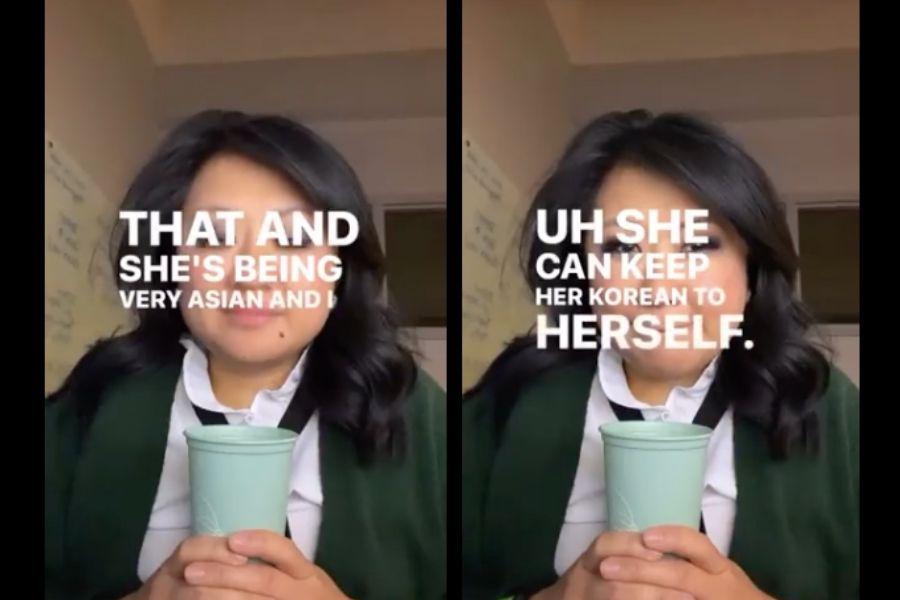
A woman complained about a news anchor sharing a Korean tradition. The responses are everything.

We’ve seen people call into news stations to complain about news anchors for unbelievable reasons before, from complaints about clothing choices to judgments about body size. Now we can add being “very Asian” to the list. Yes, seriously. Michelle Li is an award-winning Asian American reporter and news anchor for NBC St. Louis. On New…

Asian Americans, racism
Photo credit: Michelle Li/TwitterA caller complained about St. Louis news anchor Michelle Li "being very Asian."

We’ve seen people call into news stations to complain about news anchors for unbelievable reasons before, from complaints about clothing choices to judgments about body size. Now we can add being “very Asian” to the list. Yes, seriously.

Michelle Li is an award-winning Asian American reporter and news anchor for NBC St. Louis. On New Year’s Day, in a segment about traditional new year food dishes, she shared, “I ate dumpling soup. That’s what a lot of Korean people do.”

Neat, right? A cool cultural tradition to learn about if someone wasn’t already familiar with it.

Or, if you’re the sad woman who called into the station to complain, an “offensive” statement Li should have kept to herself. Yes, really.


Li shared a recording of the woman’s one-minute call, in which she said she was “offended” by Li sharing her tradition. “I don’t think it was appropriate that she said that, and she’s being very Asian…she can keep her Korean to herself.”

The woman’s insistence that a white person couldn’t say something similar about a cultural tradition makes no sense, of course. If an anchor had Irish ancestry and said that their family ate corned beef and cabbage because that’s a traditional new year’s meal in Ireland, would they be fired? Um, no. How this woman confused a specific cultural tradition with someone making a generalization about white people is baffling, and her complaining about an Asian American “being very Asian” is even more so.

The responses were swift and supportive.

Some support came in the form of sarcasm.

Some came in the form of common sense.

And some came in the form of the #VeryAsian hashtag.

In fact, the phrase caught on like wildfire, resulting in “Very Asian” merch for a good cause.

Along with another anchor, Gia Vang, Li created a website with shirts and hats with “Very Asian” on them, some of them in Li’s handwriting. For a limited time, people can buy these “Very Asian” wearables, with all proceeds going to the Asian American Journalists Association, an organization that supports Asian American journalists, works to advance diversity in newsrooms and strives to ensure fair and accurate coverage of communities of color.

They even have merch for #VeryAsian kids:

If someone is going to complain about a woman doing her job and being herself simply because she is of Asian descent, at least some good can come out of it. Michelle Li should not have been subjected to that woman’s racism, but it’s heartening to see how she and those who support her take that lemon and make lemonade from it.

To donate directly to the Asian American Journalists Association, go here.

  • Middle schoolers in New Hampshire created an adorable mini boat that sailed all the way to Norway
    Photo credit: FacebookThe Rye Riptide washed up on the shores of Norway.
    ,

    Middle schoolers in New Hampshire created an adorable mini boat that sailed all the way to Norway

    The project was part of a very unique program designed to “connect students around the world.” Mission accomplished.

    This story brings a whole new meaning to the word friendship.

    In October 2020, the middle schoolers of Rye Junior High, in Rye, New Hampshire, bid a bon voyage to their handmade mini-boat, which set sail off the coast of New Hampshire to who-knows-where.

    Measuring only 5.5 feet, the “Rye Riptides” was indeed a small ship. It ran crewless, but carried a bountiful cargo of colorful artwork made by students, along with a GPS tracking device that reported the boat’s location … sometimes.

    Cut to 462 days and 8,300 miles later, and what started out as a simple science project became a surprise discovery for some Norwegian sixth graders, and a fun new connection across the Atlantic.

    Rye Junior High had partnered with Educational Passages, a nonprofit organization that aims to connect students around the world to the ocean and each other. Once the kit arrived, the kids started building while learning about ocean currents, science and math. However, science teacher Sheila Adams shares that the more artistic, right-brained activities equally found their way into the curriculum. “The students needed to use their writing skills to inform others about their mini-boat project, describe our school and town to people of other languages, just in case, and write requests to get the boat deployed,” she said in a release.

    Then the pandemic nearly derailed the whole thing

    COVID-19 nearly threatened to knock the Rye Riptides off its course. The boat had been constructed, but not yet decorated, when students were moved to taking class online. Then, there was the matter of launching the boat. Which Cassie Stymiest, Executive Director of Educational Passages, noted was “challenging with all the restrictions in place.”

    Luckily, creativity, resourcefulness and a little technology saved the day. Working remotely, each piece of art was done at home, then scanned, printed and made into a collage. Then, Ms. Stymiest connected with the Sea Education Association (SEA), which set the Rye Riptides on its journey.

    Would the boat make it to Europe? Rye student Solstice Reed wasn’t so sure. “Honestly, I thought it would sink,” she admitted to the Portsmouth Herald. Considering the boat was cruising the ocean waters during hurricane season, the skepticism was well-founded. During the more tumultuous periods, the GPS signal only came in intermittently. And for a long while, there was nothing but radio silence.

    The little boat that did

    But then, at long last, on the small Norwegian island of Smøla, the Rye Riptides successfully made it to dry land. Sure, it was a bit dismantled and covered in barnacles, but inside, all the adorable trinkets remained intact. The Smøla students peered with wonder into their bounty of photos, signed facemasks, fall leaves, acorns and state quarters, gifts sent out almost two years ago.

    Isn’t your inner child just squealing with delight right now?

    The voyage of the small boat went viral in a big way, sailing across social media, and making headlines.

    Human connection found its way across the sea in the most wholesome and magical way. It’s really cool to see that educational programs like this exist, impacting both the hearts and minds of young students. Mission, successful.

    To help support Educational Passages on even more wholesome adventures just like this one, consider donating here.

    This article originally appeared four years ago. It has been updated.

  • At 83, Paul McCartney reveals 10 songs that are the ‘soundtrack to his life’
    Photo credit: via Raph_PH/Wikimedia CommonsPaul McCartney live on stage.

    Sir Paul McCartney, 83, has lived a life that’s full of music, from listening to his father James play dancehall songs on the piano as a child, to joining a skiffle group with John Lennon as a teenager, to becoming the biggest band of all time with The Beatles. Then, he forged a solo career as a member of Wings and under his own name that has yielded more number-one hits than any other songwriter.

    McCartney’s music has been a cornerstone of pop culture for over 60 years, but what are the songs that formed his musical taste? Paul recently revealed the ten songs that have “soundtracked my life” to the BBC’s  Vernon Kay on his show Tracks Of My Years, which premieres on May 25 on BBC Sounds and iPlayer.

    The full episode hasn’t been released, but the BBC revealed the 10 songs that Paul chose, in no particular order.

    John Lennon – “Imagine” 

    In 1971, a year after the breakup of The Beatles, John Lennon released what would become his signature song, a wistful (and slightly acerbic) plea for humanity to envision a world without religion, war, or possessions, and to live in harmony. “When we came to not writing together, I think it was difficult for both of us,” McCartney once said of Lennon. “But, y’know, he still did ‘Imagine.’ He still did one of his best things ever.”

    McCartney has routinely played songs written primarily by Lennon in concert, including “A Day in the Life,” “Give Peace a Chance,” and “Help!”, but he won’t touch “Imagine.” “There’s no shame in doing [Lennon’s] songs,” McCartney said. “In fact, I considered doing a major tribute to John…But then people started saying, ‘Why don’t you do ‘Imagine?” And I thought, ‘F***ing hell, Diana Ross does ‘Imagine’.’ They all do ‘Imagine’. That’s when I backed off the whole thing.”

    The Beach Boys – “God Only Knows” 

    “God Only Knows,” written by Brian Wilson of The Beach Boys and Tony Asher, appeared on the band’s 1966 masterpiece Pet Sounds and is often cited by McCartney as one of his favorites. “I just think it’s a great song—melody, harmonies, words, you know,” Paul said. “I love it, you know. …It’s my favorite Beach Boys song.”

    “Brian Wilson sort of proved himself to be like a really amazing composer,” McCartney added. “And I was into chords and harmonies and stuff at that time, and we ended up [in] kind of like a rivalry. [The Beatles would] put a song out and Brian [would] hear it, and then he’d do one, which is nice. [It was] like me and John [Lennon]. You know, you’d kind of try and top each other all the time.”

    Bob Dylan – “Tambourine Man” 

    Released in 1965 on Dylan’s Bringing It All Back Home, an album that merged his earlier folk sound with his growing interest in rock ‘n roll, “Tambourine Man” is one of his first songs to introduce psychedelic imagery. It’s often believed the song is about a drug dealer, but the tambourine man in the story may actually be Bruce Langhorne, a session guitarist, who brought a giant Turkish drum to a session.

    McCartney recently ribbed Dylan for not playing the song in his live set. “I’ve been to see a couple of shows of Bob’s, and I couldn’t tell what the song was that he was doing,” McCartney said, according to Music Radar. “Now, that’s a bit much because, I mean, I know his stuff and, you know, I get it if he doesn’t want to do ‘Mr Tambourine Man,’ you know, maybe he’s fed up with that, but I would like to hear it. And I’ve paid.”

    Prince – “Kiss” 

    The Purple One had a big hit in 1986 with this cheeky, minimalist funk track about how he doesn’t care if a woman is “rich” or “cool”; he just wants her “extra time” and her “kiss.” The song topped the charts, beating out number two, “Manic Monday” by The Bangles, which was also written by Prince.

    In 2016, shortly after Prince’s death, McCartney snuck Prince’s “Let’s Go Crazy” into his set while performing in his hometown of Minneapolis, Minnesota. 

    The Human League – “Don’t You Want Me” 

    “You were working as a waitress in a cocktail bar….” the song begins, and you either quickly change the station or roll up the car windows and scream, “Don’t you want me, baby? Don’t you want me, Oooooooooooh.” Evidently, McCarney is a roll-up-the-windows-and-belt-it-out kinda guy. Who knew?

    The Kinks – “You Really Got Me” 

    In 1964, The Kinks released a monster with their third single, “You Really Got Me,” which, with its revolutionary distorted guitar sound, helped spark the rock era and served as a blueprint for heavy metal and punk. The song was released at the peak of Beatlemania, and both bands shared several bills in their early years, but didn’t really hit it off. “Paul McCartney was one of the most competitive people I’ve ever met. Lennon wasn’t. He just thought everyone else was sh*t,” Kinks’ frontman, Ray Davies, recalled. 

    Elvis Presley – “All Shook Up” 

    It’s hard to understand how big an impact Elvis’s 1957 hit “All Shook Up” had on a teenage McCartney. He and his friend, Ian James, struck out trying to meet girls at a fairgrounds, and he remembers going back home, and the two listened to the song to cheer themselves up. “The blues had gone. The headache had gone. We were like new people,” McCartney said, according to American Songwriter. “I just love that song so much for being able to do that. There’s just good moments like that, very reminiscent of the kind of moments you had when you were just starting a band.”

    Buddy Holly – “That’ll Be The Day” 

    “That’ll Be the Day” has a big role in the Beatles’ history. It was routinely played by The Quarrymen, their earlier skiffle incarnation, featuring McCartney, Lennon, and George Harrison. It was also the first song they recorded as a demo in 1958 with Lennon on lead vocals. The recording would later be featured on The Beatles’ 1995 release Anthology 1

    Chuck Berry – “Maybelline” 

    Berry greatly influenced the Beatles’ music, especially the way he turned his songs into stories. “From the first minute we heard the great guitar intro to ‘Sweet Little Sixteen,’ we became fans of the great Chuck Berry,” McCartney said, according to Far Out. “His stories were more like poems than lyrics – the likes of ‘Johnny B Goode’ or ‘Maybellene.’”

    It’s no surprise the rock ‘n roll pioneer made it to McCartney’s top 10, although many wondered why a Little Richard song wasn’t in there, too. McCartney routinely sang Little Richard songs in the early Beatles years, including a rousing version of “Long Tall Sally.”

    Gene Vincent – “Be-bop-a-Lula”

    “Be-bop-a-Lula” was the first record McCartney ever purchased, and it would stick with him forever. “Yeah, it was the first record I bought, you know, and in those days, I think this with the Beatles, you know, it made us realize how special it is for people to buy records because we didn’t have much money. And you think about your purchase … so precious, man. It was all your money that week would go on that record,” he recalled in an interview with Ronnie Wood of The Rolling Stones. “It was in the film The Girl Can’t Help It. We finally saw him sing it, you know, with the Blue Caps and stuff, so I just loved it. It’s just such a beautiful record, you know.”

    McCartney has a new album out, May 29, The Boys of Dungeon Road, featuring “Home to Us,” a duet with Ringo Starr.

  • Father of LGBTQ kids has a perfect response to homophobic new neighbor who tried to shame him
    Photo credit: Photo by Jasmin Sessler on UnsplashDad responds to rude neighbor with rainbow flags.

    Sometimes, when we encounter unsavory behavior from others, a response is warranted. But the real art is responding in a way that’s clear, strong, and yet still peaceful. For an example of this, look no further than Xander’s dad, who was on the receiving end of hate from his neighbor. Rather than spewing back the same amount of vitriol, his colorful comeback had courage, wit and just the right amount of flair.

    As Xander tells us in the video, the retort came after the neighbor told his dad that having two gay kids (Xander’s sister Claire is a lesbian) meant he “failed as a parent.” “So dad took a moment then replied with this…” the onscreen text reads. Next thing you know, Xander’s dad can be seen filling his backyard with huge (like, parade-level huge) rainbow pride flags. A dozen of them at least.

    The video ends with the words: “No, saying things like that does.”

    Then it happened again with even more flags

    In another video, we learn that the not-so-friendly neighborhood watch told his dad that he wasn’t allowed to fly “gay flags” anymore.

    But rather than accept defeat, or resort to cruelty, he simply looked at the rules, only to discover that his house was actually outside the map by 2 meters (6.5 feet). So up the pride flags went! And even more this time!

    Flag responses seem to run in the family. In another video, Xander explains that his neighbor (where have all the friendly ones gone?) said he couldn’t sell his house because of the small window-sized trans flag hung near the roof. So Xander got an even bigger one that covered the entire back side.

    Are gay people more likely to have gay siblings than straight people?

    In another video, Xander introduced his sister, who is a lesbian, raising the question: is it more likely for gay people to have a gay sibling than a straight person? Research says yes. Gay women and men are more likely to have gay siblings than straight women and straight men. Somewhere between 7 to 16% of gay people also have a gay sibling.

    Why the pride flag still matters so much

    Pride Flags have long been a nonviolent way to stand up for the LGBTQ community. And yet, they still manage to whip up plenty of heated controversy, particularly at schools. The original eight colors all had a specific meaning, and only one color (pink) denoted sexuality. Meaning that the pride flag was and is just as nuanced and dynamic as the people it represents.

    The flag has taken on many different forms over the years as it evolves to speak for more marginalized communities, but it remains a peaceful and artistic form of protest. One that always seems to get the message across.

    This article originally appeared four years ago. It has been updated.

  • A lucky ‘metal detectorist’ found the Sheriff of Nottingham’s ring, valued at $11,000
    Photo credit: via UnsplashEnglish metal detector hobbyist finds a real treasure near Nottingham.

    If you know the song, sing along!

    “Robin Hood and Little John, walking through the forest/Laughing back and forth at what the other’n has to say/Reminiscing this and that and having such a good time/Oo-de-lally, oo-de-lally, golly, what a day…

    “Never ever thinking there was danger in the water/They were drinking, they just guzzled it down/Never dreaming that a scheming sheriff and his posse/Was a-watching them and gathering around.”

    There never was a greater set of foes than Robin Hood and that evil Sheriff, whose greed was even more legendary than Robin Hood’s archery skills.

    A metal detectorist just found the Sheriff’s ring

    In a deliciously ironic turn of fate, a retired merchant navy engineer in England has found a treasure that would have made his country’s most popular folk hero proud. Graham Harrison, a 65-year-old metal detector enthusiast, discovered a gold signet ring that once belonged to the Sheriff of Nottingham.

    The discovery was made on a farm in Rushcliffe, Nottinghamshire, 26.9 miles from Sherwood Forest. The forest is known worldwide for being the mythological home of Robin Hood and his band of Merry Men. A central road that traversed the forest was notorious in Medieval times for being an easy place for bandits to rob travelers going to and from London.

    Today, the forest is a designated National Nature Reserve. It contains ancient oaks that date back thousands of years, making it an important conservation area.

    “It was the first big dig after lockdown on a glorious day. We were searching two fields. Other detectorists kept finding hammered coins but I’d found nothing,” Harrison said according to the Daily Mail. “Then I suddenly got a signal. I dug up a clod of earth but couldn’t see anything. I kept breaking up the clod and, on the last break, a gold ring was shining at me. I broke out into a gold dance.”

    Harrison sent the ring to the British Museum’s Portable Antiquities Scheme to have it authenticated.

    After doing some research they found that it was once owned by Sir Matthew Jenison, who was the Sheriff of Nottingham between 1683 and 1684.

    The first accounts of Robin Hood, then known as Robyn Hode, first appear as early as the 13th and 14th centuries, a few hundred years before Sir Matthew served as sheriff.

    But there’s no doubt that the archer and leader of Merry Men would have been delighted to know that an everyday guy came into possession of the Sheriff of Nottingham’s ring.

    Sir Matthew was knighted in 1683 and acted as a commissioner to examine decaying trees in Sherwood Forest. He was later elected to Parliament in 1701. However, a series of lawsuits over shady land dealings would eventually be his ruin and he’d die in prison in 1734.

    The gold signet ring bears the coat of arms of the Jenison family, who were known for getting rich off a treasure trove of valuables left for safekeeping during the English Civil War.

    The valuables were never claimed, so the Jenisons took them for themselves.

    Was Robin Hood a real person?

    The whole thing makes you question how much of the legend of Robin Hood is actually true. Experts debate whether Robin Hood stories are based on one person or accounts of multiple different people. Various versions of the mythology begin and end in different time periods, but all share some similarities: Namely, Robin Hood shooting a bow and arrow and being constantly at odds with the evil Sheriff of Nottingham.

    In the end, Robin Hood was said to have been murdered by his aunt. As he bled to death, “Little John placed Robin’s bow in his hand and carried him to a window from where Robin managed to loose one arrow. Robin asked Little John to bury him where the arrow landed, which he duly did. … A mound in Kirklees Park, within bow-shot of the house, can still be seen and is said to be his last resting place,” according to Historic UK.

    Another site, a cemetery in Yorkshire, features a tombstone that reads:

    Here underneath this little stone
    Lies Robert, Earl of Huntingdon
    Ne’er [never] archer was as he so good
    And people called him Robin Hood
    Such outlaws as he and his men
    Will England never see again.

    Believe it or not, that wasn’t the only ring

    What makes the story even more remarkable is that a second ring found at the same site five minutes before Harrison’s discovery was sold at auction in 2023. The circa 1560 posy ring, inscribed with the words “I Meane Ryght,” was found by water company worker Andy Taylor and is also believed to have belonged to a member of the Jenison family.

    What happened to the ring after it was found

    As for Harrison, he decided that he would sell the ring to someone who appreciates its importance.

    “There can’t be many people who’ve found anything like that. I’m only selling it because it’s been stuck in a drawer,” Harrison said. “I hope it will go to someone who will appreciate its historical value.” It was sold at auction by Hansons Auctions for £8,500 ($11,115).

    You can witness the intense final moments of the auction here:

    Let’s hope that the man who sold the ring does what Robin Hood would have done with a piece of jewelry that adorned the hand of a nobleman whose family came into money by taking other people’s loot. Surely, he’d take the proceeds from the auction and give them to the poor.

    This article originally appeared four years ago. It has been updated.

  • Gen Xers recall how young we were when we started babysitting. It’s even blowing our own minds.
    Photo credit: CanvaGen X started babysitting at shockingly young ages.

    Much has been made of the contrast between Gen X and Gen Z/Gen Alpha childhoods, but some differences feel more significant than others.

    Obviously, Gen X didn’t have smartphones, social media, or even the Internet during our formative years. We roamed and explored our towns with little to no adult supervision. We came home when the streetlights went on or when our parents came to find us after the television PSA that said, “Parents, it’s 10 p.m. Do you know where your kids are?

    Some realities of Gen X childhood sound made up to younger generations, but some even sound bonkers to our own adult ears. Topping that list is how old so many of us were when we started babysitting. Some of us have had to check in with one another to make sure our memories are correct. Was I really putting someone else’s babies to bed at age 11?

    Yes, I was. And so were countless other preteens.

    Gen Xers regularly started babysitting as young as age 8

    “I need you to back me up,” wrote a Gen Xer on TikTok. “Did we not babysit entire families as children? I was 11 with zero training and full responsibility for 3 kids and an infant…paid $5 and a party pizza…My kids don’t believe me. My parents don’t recall.”

    Other Gen Xers do recall, and we’re a bit baffled by it. It didn’t seem all that odd to us at the time. But looking back, especially as parents ourselves, who let us do that? Check out these examples from TikTok, which are in no way out of the ordinary:

    “The day after my 10th birthday the neighbors down the street were excited I was finally old enough to babysit their kids. Their kids were 3 and 5. Apparently your age hitting double digits was all the qualifications needed.”

    “Yup! 11 and babysat a newborn! Like what!? 🤣 Why did they let and why did my parents let me?”

    “I was 10 watching 4 kids and I had to make dinner. 😂”

    “Yes! I was about 12 and babysat 3 kids – one was an infant and I had zero training. I was paid $2-3 an hour.”

    “Yep I had a neighbor kid I took care of starting at 8. She was 2.”

    “I was 11 watching a 2 and 3 year old. Made meals, changed diapers, gave baths. Zero training or babysitting classes taken.”

    “I was 8 and babysitting 2 nephews from one brother and 3 from another… all under the age of 5.”

    “I was 9 and holding it down with a 4, 2, and newborn. The ‘80s were wild!!!!”

    “I started babysitting my 3 year old and 6 month old brothers when I was 8. My mom went back to school and I was in charge on weekends and all summer.”

    @rochelle.digital

    Well, I mean my generation basically watched ourselves all the time so babysitting was no big deal! Can you imagine a 10 year old watch your baby alone these days? Maybe for a very short period of time if they were siblings. Other than that heck no! #nostalgiatok #80skid #80skids #generationx

    ♬ Major Tom (Coming Home) – Peter Schilling

    Gen X has spent most of its lives in caretaking roles

    Being full-on babysitters at age eight is genuinely wild, considering how most kids that age today have their own babysitters. Even knowing how different our childhoods were from the digital-native generations, having an eight- or nine-year-old caring for babies and toddlers feels like questionable decision-making on the part of all adults involved.

    As a Gen Xer, I was babysitting other people’s kids by age 11. Even though I was quite mature for my age, that seems awfully young to me now. I’m sure preteens babysitting still happens, but it’s definitely not the norm.

    And that’s probably a good thing. On one hand, there’s nothing wrong with kids learning responsibility at a young age. On the other hand, if you’re a Gen Xer who started babysitting at age eight and is a parent now, you’ve likely spent nearly all of your life in a caretaking role. And you’re likely continuing in that role both with your young adult kids and your aging parents.

    Was Gen X childhood or Gen Z childhood healthier?

    There are a lot of questions we can raise in hindsight. Even if we were capable of babysitting kids not much younger than ourselves, were we any good at it? Was it healthy for us or for those kids? Did the expectations placed on us help us learn responsibility? Or did some of us have adult responsibilities placed on us too early?

    We can ask the flip side of the same questions about younger generations. Have we expected too little of them? Has protecting their childhoods prevented them from learning responsibility? Is it healthy for kids to be constantly supervised? Did Gen X grow up and swing the pendulum too far the other way in raising Gen Z?

    Can we really even answer those questions? Gen X has been called the least parented generation, which has certainly led to some conflicting perspectives. Our childhoods are often touted as being “carefree” when viewed through rose-colored glasses. But for many Gen Xers, especially women, the reality was more like “underparented while being expected to take on parenting responsibilities.”

    In many ways, Gen X childhood was pretty great, but the premature babysitting thing was “legit sus,” as our kids would say. What were the adults thinking? Is it too late to ask?

  • Iconic writer Kurt Vonnegut’s simple graphs show how to write the 3 stories everyone loves
    Photo credit: via David Comburg/YouTubeKurt Vonnegut explains the shapes of stories.
    ,

    Iconic writer Kurt Vonnegut’s simple graphs show how to write the 3 stories everyone loves

    “There’s no reason why the simple shapes of a story can’t be fed into computers.”

    To be a great fiction writer requires understanding basic story structures and being clever enough to disguise them so your audience doesn’t know they’re watching or reading something they’ve seen before. Academics suggest that there are only a finite number of plots and structures, but that number varies based on who’s doing the talking.

    Writer Kurt Vonnegut, best known for his satirical works on American politics and culture, including “Slaughterhouse-Five,” “Cat’s Cradle” and “Sirens of Titan,” was obsessed with the shapes of stories and summed up his views in one powerful sentence: “The fundamental idea is that stories have shapes which can be drawn on graph paper and that the shape of a given society’s stories is at least as interesting as the shape of its pots or spearheads.”

    What are the shapes of stories?

    In the video below, Vonnegut explains the shapes of three different types of stories. The first one he starts with is “person gets into trouble.”

    The first question is where the main character or protagonist starts their journey. Are they in a state of good or bad fortune, and how does that change from beginning to end? The arc of this story is simple, someone starts off in good fortune, they get into trouble, and then find their way out. “Somebody gets into trouble, then gets out of it again. People love that story. They never get tired of it,” Vonnegut says with a smirk.

    The second is called “boy gets girl,” which is the basics of the story: someone finds something “wonderful,” their life is on an upward trajectory, then they trail downwards until they can get the girl or boy back. He finishes with the “most popular story” of Western civilization, and that is “Cinderella.”What’s interesting about the story is that it’s about a poor little girl whose mother has died, and her life is pure misery. But her story has a massive upswing when she meets her fairy godmother and can go to the ball. But once the clock strikes midnight, her life crashes down in a matter of seconds.

    Vonnegut’s eerie prediction about AI

    What’s interesting is that at the beginning of the video, Vonnegut notes that stories are relatively “simple” and that they should be able to be plugged into computers that could then regurgitate the same story over and over again. It almost feels like an eerie predictor of artificial intelligence. “There’s no reason why the simple shapes of a story can’t be fed into computers. They are beautiful shapes,” Vonnegut says. “Now this is an exercise in relativity, really. It’s the shape of the curves are what matters, and not their origins.”

    After seeing Vonnegut map out the basic plotlines of stories, it’s hard not to see them every time you watch a movie or TV show. It is amazing that, because there are so few characters and plot arcs in modern storytelling, anyone can create anything that feels new.

    This story originally appeared three years ago. It has since been updated.

  • The surprisingly mysterious reason we use the $ symbol for the U.S. dollar
    Photo credit: CanvaWhy do we use $ to represent a dollar?
    ,

    The surprisingly mysterious reason we use the $ symbol for the U.S. dollar

    The U.S. dollar and its symbol have an international origin story.

    We see many symbols in our everyday lives that we likely don’t pay much attention to: the @ in our email addresses, for instance, or the % in our weather forecasts. But do we ever wonder where these symbols came from? Why they look like they do? Or how they came to mean what they mean?

    One of the most commonly used symbols that most of us are clueless about is the dollar sign ($). Why does it have an “S” if there’s no “s” in “dollar”? Is there supposed to be one line or two? And where did the $ symbol even originate?

    As educator and etymology enthusiast Rob Watts (better known as RobWords on YouTube) explains, the answers to those questions are surprisingly complicated.

    The first written use of the dollar sign as we know it appeared in a handwritten letter sent by a man in New Orleans in 1778. Some may be under the impression that the $ is an amalgamation of “U” and “S,” as in United States, but nope. Its origin isn’t actually from the United States at all.

    The international origins of the U.S. dollar start in Spain

    In fact, we have to take a whole international tour through hundreds of years of currency history to arrive at what we think is the origin of the $. As Watts shares, we don’t know with 100% certainty.

    The story begins with the Spanish real, the silver coin that served as the currency of Spain in the 14th century. A larger coin, worth eight times the value of the real, became known as a “piece of eight” in English. Those pieces of eight made their way to the Americas through colonialism in the 15th and 16th centuries.

    “The discovery of huge, gleaming reserves of silver in Central and South America meant that they could also be made there, too,” Watts shares. “At the local mints, they took on a new name as well, based on the fixed weights of  silver they were made from. They became known as the ‘peso,’ meaning ‘unit of weight.’”

    spanish dollar, piece of eight, peso, coin
    A Spanish piece of eight dating between 1651 and 1773. Photo credit: Portable Antiquities Scheme/Wikimedia Commons

    Because of their reliability and divisibility into smaller units, these pesos started being used not just in the Spanish-speaking colonies, but in British colonies in the Caribbean and North America as well.

    Hold the peso thought. We’ll come back to it momentarily.

    The word “dollar” can be traced back to the German Joachimsthaler coin

    In the meantime, another coin of similar value from the German town of Joachimsthal had gained traction in Europe.

    “In precisely the same way that a round slab of beef from Hamburg became known as a hamburger, this round slab of silver from Joachimsthal became known as a Joachimsthaler,” Watts explains. “And in exactly the same way that a hamburger is sometimes just called a ‘burger,’ a Joachimsthaler was sometimes just called a ‘thaler.’”

    Joachimsthaler, thaler, german dollar, coin
    A Joachimsthaler coin from 1525. Photo credit: TommyG/Wikimedia Commons

    “Thaler” became “daalder” in the Netherlands, “daler” in parts of Scandinavia, and “dollar” in the English-speaking world.

    But that dollar wasn’t the dollar we ended up with.

    “By 1700, the thaler had been adapted to have almost exactly the same silver content as another coin that was competing for usage in Europe: the ‘piece of eight’ or peso,” says Watts. “And so, to help differentiate between the two similarly valued coins, people started referring to the peso as ‘the Spanish dollar.’ This Spanish dollar was the de facto currency of the Americas right up until the American Revolution.”

    spanish dollar, piece of eight, peso, coin
    A Spanish dollar from Mexico circa 1771. Photo credit: Heritage Auctions/Wikimedia Commons

    The dollar sign actually comes from the peso symbol

    Prior to declaring independence from Britain, the U.S. used the British pound for accounting. But the Spanish dollar, or peso, was the coin most often used as currency, so post-Revolution, the U.S. adopted the dollar as its own. (The first official U.S. dollar coin was minted in 1792.)

    So, long story short, the Spanish dollar, or peso, was the basis for the U.S. dollar. Which finally leads us to where the $ came from.

    The symbol used for pesos way back when was “ps,” with the “s” written like a superscript. When written with a pen in one stroke, the “s” ended up with a line through it. And when someone wanted to indicate plural pesos, they would write the symbol twice. The second instance, written more quickly, ended up blending the “p” and “s” together to look more like a $.

    Essentially, the evolution looked like this:

    dollar, dollar sign, peso
    Theories of where the dollar sign came from. Photo credit: JesperZedlitz/Wikimedia Commons

    What about the double-lined dollar sign?

    How did the $ with two lines come about? As shown in the image above, the two lines often lead people to the “U” plus “S” theory. However, Watts points out that the first printed version of the dollar sign appeared in 1797. That dollar sign actually had two lines, with no indication that “U” and “S” were the reason. Both versions of the symbol were in use by the close of the 18th century.

    Watts goes into some of the other theories about where the double-lined dollar sign comes from. However, there doesn’t seem to be solid evidence to back any of them up.


    Isn’t that wild? Who knew that our currency had such a complicated origin story? Or that we don’t even really know for certain why we use $ for the almighty dollar?

    Thanks, Rob Watts, for making us all a little bit smarter. You can follow him on YouTube for more word fun.

  • Woman lives on a cruise ship for free, but says there are 4 things she’s not allowed to do
    A woman looks out over the ocean while standing on a cruise ship.

    Upworthy has covered a few stories about people who decided to live permanently on cruise ships because it’s cheaper than living on land or in a nursing home. These stories have connected with millions because they say a lot about the modern cost of living but are also aspirational.

    Christine Kesteloo has become popular on TikTok with over one million followers because she shares what living on a cruise ship is really like. Kesteloo is the wife of the ship’s Staff Chief Engineer, so she gets to live on the boat for free. She only has to pay for alcohol and soda, which she gets for half off according to Business Insider.

    So what is life actually like on board?

    “I live on a cruise ship for half the year with my husband, and it’s often as glamorous as it sounds,” she told Business Insider. “After all, I don’t cook, clean, make my bed, do laundry or pay for food.“

    Kesteloo’s life seems pretty stress-free. After all, she’s basically on a permanent vacation. However, even though she lives on a cruise ship as a “wife on board,” there are a few things she either can’t or shouldn’t do.

    Here are the four things she cannot do

    She shared these four things in a TikTok video with nearly 10 million views.

    1. Gambling

    Kesteloo says she cannot sit at a slot machine and “play my heart out until I win.” She believes it would “look a little weird if I, as the wife of the staff chief engineer, won a big jackpot.”

    2. Leaving the ship with the guests

    When the ship arrives at a destination, she can’t get off with the guests. She must wait about an hour and exit the vessel with the crew. When returning to the ship, she also has to be on time. “No, they will not wait for us,” she says. And the same goes for her husband, if they “miss the ship, someone else will take over the role.”

    3. Sitting in a crowded pool

    Although Kesteloo has access to the pool, gym, and all the ship’s amenities, she’s cautious not to interfere with the guests’ good time. She’ll exit the pool if it’s busy because “it’s just the right thing to do.”

    4. Traveling without international traveler insurance

    She must have insurance in case of a misfortune on the ship. But as a citizen of the Netherlands, they already have coverage and just have to pay a few extra dollars a month.

    The comments had one big question

    Though folks generally welcomed Kesteloo’s advice, some of the most popular commenters on the video were from women regretting that they married men who aren’t chief engineers on cruise ships or those who want to know where to find a single one.

    “OK, can you explain how to marry a cruise ship engineer?” one female commenter wrote.

    “How. in. the. H E double hockey sticks do I become the wife of a cruise ship engineer???? I don’t have to work AND cruise for free!” another added.

    “Does he have any single friends with same job??? Asking for me,” one more asked.

    For even more tips on living this charmed life, follow Kesteloo on TikTok. Who knows, by now she might even have some advice for landing your own cruise ship engineer spouse.

    This article originally appeared three years ago. It has been updated.

Pets

Cat owner put a first-person camera on its collar and accidentally filled the world with delight

Family

Millennial mom is stunned when grandma compares parenting in the 80s to now

Identity

Father of LGBTQ kids has a perfect response to homophobic new neighbor who tried to shame him

Pop Culture

A lucky ‘metal detectorist’ found the Sheriff of Nottingham’s ring, valued at $11,000