The English language is full of idiosyncrasies and inconsistencies that can drive English learners batty. But even for native English speakers, some words and phrases can cause confusion in ways they may not expect.
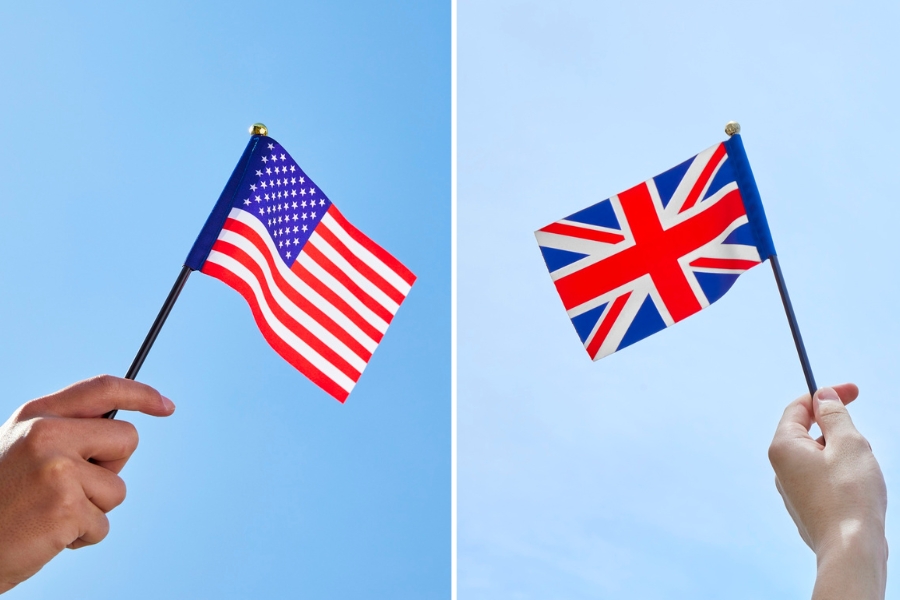
For instance, not only are there English words that mean opposite things depending on how they are used (called contronyms), but there are also words and phrases that have opposite meanings depending on where they are used.
Evan Edinger moved to the United Kingdom 13 years ago. He shares videos on YouTube about his experience as an American living in the U.K., including linguistic differences. For instance, saying the food in London is “quite good” may sound like a compliment, but it would likely be received as a bit of an insult by Londoners.
“English is full of words that quietly flip meaning when you cross the Atlantic,” he says. “Words that you think sound polite or a compliment, like this one, can really land you in hot water if you use them across the pond.”
“Quite”
That’s because Americans generally use “quite” as an intensifier. If something is “quite good,” we see it as better than just “good.” For Brits, “quite” is often used as a dampener, so “quite good” can mean less good than simply “good.”
“With all due respect…”
Other opposite meanings are less subtle, like the phrase “with all due respect.”
“I’ve lived in this country for over 13 years, and I’ve only found out this year, Brits do not mean this when they say it,” shares Edinger. “When an American says, ‘With all due respect,’ it’s usually just a polite way to pad out some criticism. ‘With all due respect, I think we should do it this way instead.’ Basically, ‘I respect you. I do. But I do disagree with you in this instance.’ In Britain, they say the same words, ‘with all due respect,’ but the implication is that they actually don’t respect you or your opinion at all. The amount of respect that you’re due? That’s in question. ‘With the respect you’re due,’ which, of course, is nothing.”
“I’ll bear that in mind…”
It’s a bit similar with “I’ll bear that in mind.” In the U.S., that usually means you’ll consider it and might actually do it. In the U.K., it more often means you have no intention of doing it and have probably already forgotten it.
“Though diving deeper into the data, it would appear that Americans in the Northeast are significantly more likely to share the British stance,” Edinger adds. “I think that makes sense, actually. But overall, American culture prioritizes direct communication. If they like your idea, an American will probably tell you. Same as if they dislike it, you’ll know. As a lot of British culture emphasizes indirectness and not causing offense, expressions like, ‘I’ll bear that in mind,’ act as a polite way of refusing an idea without outright saying it to soften the blow.”
To “table” something
If you’re an American and you hear “let’s table that discussion,” it means, “Let’s not talk about this now. We’ll come back to it later, if we have time.” For Brits, it means, “Let’s talk about this right now.”
“This is one expression that causes a lot of confusion in international meetings,” says Edinger. “In British English, to table a motion or an issue means to bring it forward for discussion. For instance, if an item is tabled in parliament, well, it has been figuratively put on the table to be addressed immediately.”
In the U.S., it’s the opposite.
“In both houses of the United States Congress, the motion to table is used to kill a motion without debate or further discussion,” he says. “Quite interesting that both countries’ political bodies have the same word that means quite literally the very opposite. It’s quite literally the difference between, ‘Well let’s talk about this immediately. It’s really important,’ and ‘Let’s never speak of this again.’”
A “moot point”
For Brits, a “moot point” is a point that’s debatable—something that can be argued either way, which aligns with its original meaning. A moot was an Anglo-Saxon assembly or court, so a moot point is one that would be argued there.
For Americans, a moot point isn’t debatable—it’s irrelevant. It doesn’t matter. There’s no point in debating it at all anymore. (Or, as Joey on Friends would say, “Like a cow’s opinion.”)
How did we end up with such an opposite meaning? Edinger explains:
“Often, an important part of law school is arguing hypothetical cases in a moot court for practice. It’s similar to a mock trial. So, a moot point would be a point brought up in a moot court. During the 19th century in America specifically, this evolved more to focus on the hypothetical nature of the moot point.”
Edinger points out that even the Supreme Court of the United States uses the term “moot question” to refer to a question that has no bearing on an issue.
Solicitor
In the U.S., when we hear the word “solicitor,” we usually think of a door-to-door salesperson or someone who knocks on the door trying to persuade us to buy something or believe something. People often hang “No Solicitors” signs on their front porches to deter them.

A “No Solicitors” sign in the U.K. might be confusing, as a solicitor is not a salesperson but “a qualified legal professional who provides specialist legal advice on different areas of law and is responsible for representing a client’s legal interests.” Americans would call them lawyers, but in the U.K., a lawyer could be anyone working in a law-related role.
Public school
A solicitor in the U.S. probably went to public school, and a highly regarded solicitor in the U.K. also probably went to public school, but the term means something completely different in each country.
In the U.S., a public school is a free school funded by the government that anyone has the right to attend. In the U.K., a public school is one of the prestigious, selective, and expensive private boarding schools attended by the children of wealthy families. The famous Eton College is a public school in the British sense, but not at all in the American sense.
To make matters even more confusing, what Americans call public schools, Brits call state schools. In the U.S., we usually use “state school” to refer to public universities.
Momentarily
If a pilot announces, “We’ll be landing momentarily,” Americans understand that to mean “very soon.” But for Brits, that sentence might be confusing, since “momentarily” means “just for a moment.” As in, maybe the plane will touch down and then immediately take off again.
It’s the difference between “in a moment” and “for a moment,” which may not seem huge but could lead to big misunderstandings.
It just goes to show that even when we speak the same language, there’s plenty of room for miscommunication.
You can follow Evan Edinger on YouTube for more.